

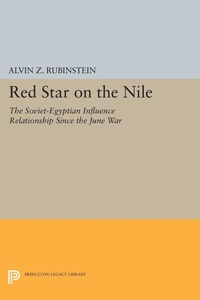
Red Star on the Nile
The Soviet-Egyptian Influence Relationship Since the June War
Published on 8. March 2015
Book
Paperback/Softback
410 pages
978-0-691-61678-0 (ISBN)
Description
The Soviet-Egyptian relationship after the June War of 1967 was a new one for both countries, and its consequences were of global importance. Drawing on all available Soviet and Arab materials, Alvin Rubinstein develops the concept of influence as an analytical tool and explores in comprehensive fashion the diplomatic, military, political, and economic aspects of the influence relationship between the two nations in recent years. The author's approach is chronological, analytical, and oriented toward the issues. He finds that the relationship has been fundamentally asymmetrical in aims and accomplishments. Egypt's remarkable comeback after the June War would not have been possible without Soviet aid, but Moscow benefited primarily in the context of the Soviet-American strategic rivalry in the Middle East, and only peripherally in terms of influence over Egypt.
Considering broader Soviet-Third World relationships, the author shows that there is no demonstrable correlation between intensified interactions and influence, that an extensive presence is no assurance of influence, and that Soviet influence can seldom be exercised at will in the absence of an ability to project Soviet military power directly. Originally published in 1977. The Princeton Legacy Library uses the latest print-on-demand technology to again make available previously out-of-print books from the distinguished backlist of Princeton University Press. These editions preserve the original texts of these important books while presenting them in durable paperback and hardcover editions. The goal of the Princeton Legacy Library is to vastly increase access to the rich scholarly heritage found in the thousands of books published by Princeton University Press since its founding in 1905.
Considering broader Soviet-Third World relationships, the author shows that there is no demonstrable correlation between intensified interactions and influence, that an extensive presence is no assurance of influence, and that Soviet influence can seldom be exercised at will in the absence of an ability to project Soviet military power directly. Originally published in 1977. The Princeton Legacy Library uses the latest print-on-demand technology to again make available previously out-of-print books from the distinguished backlist of Princeton University Press. These editions preserve the original texts of these important books while presenting them in durable paperback and hardcover editions. The goal of the Princeton Legacy Library is to vastly increase access to the rich scholarly heritage found in the thousands of books published by Princeton University Press since its founding in 1905.
More details
Series
Language
English
Place of publication
New Jersey
United States
Target group
College/higher education
Professional and scholarly
Product notice
Paperback (trade)
Dimensions
Height: 234 mm
Width: 156 mm
Thickness: 22 mm
Weight
620 gr
ISBN-13
978-0-691-61678-0 (9780691616780)
Copyright in bibliographic data and cover images is held by Nielsen Book Services Limited or by the publishers or by their respective licensors: all rights reserved.
Schweitzer Classification
Other editions
Additional editions
Alvin Z. Rubinstein
Red Star on the Nile
The Soviet-Egyptian Influence Relationship Since the June War
E-Book
06/2015
1st Edition
Princeton University Press
€73.99
Available for download
Person
Alvin Z. Rubinstein
Content
*Frontmatter, pg. i*Contents, pg. vii*Preface, pg. xi*Prologue, pg. 1*Chapter One. Transfiguration, pg. 9*Chapter Two. The Illusory Consensus, pg. 44*Chapter Three. To the War of Attrition, pg. 66*Chapter Four. Myrmidons from Moscow, pg. 90*Chapter Five. Sadat's Uneasy Alliance with the Soviet Union, pg. 129*Chapter Six. The End of Illusion, pg. 168*Chapter Seven. Toward Confrontation, pg. 212*Chapter Eight. Strategic Imperatives and the October War, pg. 248*Chapter Nine. The Diplomacy of Discord, pg. 288*Chapter Ten. Currents of Influence, pg. 330*Appendices, pg. 347*Selected Bibliography, pg. 367*Index, pg. 375