

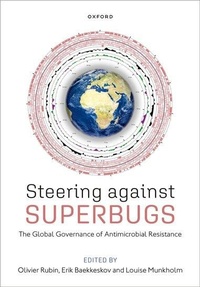
Steering Against Superbugs
The Global Governance of Antimicrobial Resistance
Published on 19. May 2023
Book
Paperback/Softback
302 pages
978-0-19-289947-7 (ISBN)
Description
The societal consequences of antimicrobial resistance (AMR) are severe. They include declining health outcomes from longer illnesses, prolonged stays in hospital, loss of protection for patients undergoing medical procedures, increased health care expenditure, and increased mortality. They also include declining global food security as AMR damages farm animal health and crop yields. Despite AMR being a transboundary crisis, concerted global initiatives that effectively combat AMR have been few and far between.
Steering Against Superbugs analyses ways to reduce barriers and create opportunities for coordination. The expert contributions in this volume offer specific and original insights about what global governance of AMR means, and ways to help solve AMR issues. They show that effective governance relies crucially on pursuing local level implementation of key policies, and equitable recognition of solutions across multiple sectors within countries, and across the Global North and South.
With the COVID-19 pandemic, societies across the world have been reminded of the devastating consequences of not being able to effectively counter global health threats. AMR is arguably one of the most severe long-term threats to human, animal, and environmental health. There is momentum for global political action around novel and emerging disease threats and Steering Against Superbugs contributes with original and insightful research to inform ongoing and future debates.
Steering Against Superbugs analyses ways to reduce barriers and create opportunities for coordination. The expert contributions in this volume offer specific and original insights about what global governance of AMR means, and ways to help solve AMR issues. They show that effective governance relies crucially on pursuing local level implementation of key policies, and equitable recognition of solutions across multiple sectors within countries, and across the Global North and South.
With the COVID-19 pandemic, societies across the world have been reminded of the devastating consequences of not being able to effectively counter global health threats. AMR is arguably one of the most severe long-term threats to human, animal, and environmental health. There is momentum for global political action around novel and emerging disease threats and Steering Against Superbugs contributes with original and insightful research to inform ongoing and future debates.
Reviews / Votes
This volume collects together key insights from across social sciences on AMR governance. AMR is now the third-leading underlying cause of death globally, which is why a global approach and global governance is necessary. Through a global perspective, the case studies in this volume highlight both successes and challenges of local, regional, and global governance for AMR. As we work together across the world to tackle the 'silent' AMR pandemic, I strongly recommend this book for all in the global and public health and policy sphere to help galvanise action to address the insidious and complex health emergency of AMR. * Professor Dame Sally Davies, UK Special Envoy on Antimicrobial Resistance (AMR) * Steering Against Superbugs comprehensively unpacks the root social drivers of antimicrobial resistance and masterfully situates these drivers in their cultural, historical and political contexts. Rubin, Baekkeskov, and Munkholm have brought together some of the world's leading thinkers in this field and have pro?vided us with some of the best ideas yet to tackle this intensifying global health challenge that already kills more than 1.2 million people each year. * Professor Steven J. Hoffman, Director of the Global Strategy Lab and the WHO Collaborating Centre on Global Governance of Antimicrobial Resistance, York University, Canada * This exciting volume achieves what many have been waiting for: a compen?dium of social science approaches to antimicrobial resistance. With a focus on governance, the authors demonstrate the strengths of different disciplines by providing evidence at multiple scales of the ways in which antibiotics, and drug resistance, is-and can be-governed. From clinics, to bednets, to global policy spaces, the book introduces the reader to detailed case studies that enlighten and awaken interest in the multiple dimensions that make up the complex challenge of antimicrobial resistance globally. * Professor Clare Chandler, Anthropology of Antimicrobial Resistance lead and founding Director, AMR Centre, London School of Hygiene & Tropical Medicine. * Microbes, humans, One Health, and the interplay between them through AMR. This book introduces the reader to the conceptual issues of AMR, and then steers her through governance challenges, One Health aspects, global awareness, advocacy and regulatory matters. This is essential reading, not just for those working in this critical field but also for policy- makers, healthcare leaders, One Health professionals, and the wider community-providing an armament of knowledge, insight, and perspectives in the fight against AMR. * Professor & Head Sujith J Chandy, Department of Pharmacology & Clinical Pharmacology, Christian Medical College Vellore, India *More details
Language
English
Place of publication
Oxford
United Kingdom
Target group
Professional and scholarly
College/higher education
Dimensions
Height: 171 mm
Width: 247 mm
Thickness: 20 mm
Weight
532 gr
ISBN-13
978-0-19-289947-7 (9780192899477)
Copyright in bibliographic data and cover images is held by Nielsen Book Services Limited or by the publishers or by their respective licensors: all rights reserved.
Schweitzer Classification
Other editions
Additional editions
Olivier Rubin | Erik Baekkeskov | Louise Munkholm
Steering Against Superbugs
The Global Governance of Antimicrobial Resistance
E-Book
05/2023
1st Edition
OUP eBook
€44.99
Available for download
Olivier Rubin | Erik Baekkeskov | Louise Munkholm
Steering Against Superbugs
The Global Governance of Antimicrobial Resistance
E-Book
04/2023
1st Edition
OUP eBook
€44.99
Available for download
Persons
Olivier Rubin is a disaster expert specializing in exploring the political and bureaucratic dynamics of slow-onset disasters such as famines, climate-induced disasters, pandemics, and antimicrobial resistance. With twenty years of experience in disaster and crisis management, Rubin has received several highly competitive multiyear grants and published widely in international outlets pertaining to crisis management, politics & public administration, and public health. Dr Rubin's recent years have been devoted to health crisis research with investigations of the global governance of antimicrobial resistance and the challenges of integrating evidence-based decision making in major health crises responses.
Erik Baekkeskov is a political scientist who researches and teaches governance at the intersection of public health and crisis management. His theoretical work has particularly focused on the roles of science and experts, and the related logic of policy-making and public administration. His empirical work has focused on cases of public health threats, including the 2009 H1N1 pandemic, 2014 Ebola, 2020 COVID-19, and the growing antimicrobial resistance crisis. His work is published in public policy, public administration, and public health academic journals and volumes.
Louise Munkholm is an independent researcher and consultant. She holds a PhD in social science from Roskilde University. Her research focuses on the sociology of law, including the development, application, and enforcement of regulatory responses to transnational phenomena, such as AMR. Her scholarly publications include books with Hart Publishing and Routledge, and articles in journals such the Journal of Law and Society, Globalization and Health, the Journal of Public Health Policy, and Public Administration and Development.
Erik Baekkeskov is a political scientist who researches and teaches governance at the intersection of public health and crisis management. His theoretical work has particularly focused on the roles of science and experts, and the related logic of policy-making and public administration. His empirical work has focused on cases of public health threats, including the 2009 H1N1 pandemic, 2014 Ebola, 2020 COVID-19, and the growing antimicrobial resistance crisis. His work is published in public policy, public administration, and public health academic journals and volumes.
Louise Munkholm is an independent researcher and consultant. She holds a PhD in social science from Roskilde University. Her research focuses on the sociology of law, including the development, application, and enforcement of regulatory responses to transnational phenomena, such as AMR. Her scholarly publications include books with Hart Publishing and Routledge, and articles in journals such the Journal of Law and Society, Globalization and Health, the Journal of Public Health Policy, and Public Administration and Development.
Content
1: Steering against Superbugs: Research agenda and four perspectives for global governance
Part I: Framing and conceptualizing AMR
2: Pills and Politics - a historical analysis of international antibiotic regulation since 1945
3: Global eradicationism and AMR
4: Conceptualizing AMR as a creeping disaster in terms of pace and space
Part II: Coordination and leadership in AMR governance
5: Combatting AMR in the EU - governmental dimensions
6: Contested governance of collective action against AMR in the EU
7: What would it take to move the global AMR agenda forward in the Global South?
Part III: AMR Governance from below
8: The individual in global and national AMR governance
9: Governing AMR: a case for considering governance
10: A sociological look beyond the surface of the national action plans against AMR: How state professionals adjust to global governance
Part IV: A One Health Perspective on AMR
11: One Health and AMR governance
12: From policy to practice: Challenges and opportunities for cross-sectoral AMR mitigation and response efforts
13: Joint action against AMR with a One Health perspective
Part V: Global advocacy and awareness of AMR
14: Policy entrepreneurship and problem brokering in the global governance of AMR
15: Global attention to Antimicrobial Resistance and Climate Change in the era of Social Media
16: The policy context for responses to antimicrobial resistance in India
Part VI: Regulatory responses to AMR
17: A case for the global governance of AMR by regulating the pharmaceutical supply chain
18: Sustainable procurement of pharmaceuticals - a tool to combat global antimicrobial resistance
19: International Law and AMR: Learning from 15 years implementing the International Health Regulations
Part I: Framing and conceptualizing AMR
2: Pills and Politics - a historical analysis of international antibiotic regulation since 1945
3: Global eradicationism and AMR
4: Conceptualizing AMR as a creeping disaster in terms of pace and space
Part II: Coordination and leadership in AMR governance
5: Combatting AMR in the EU - governmental dimensions
6: Contested governance of collective action against AMR in the EU
7: What would it take to move the global AMR agenda forward in the Global South?
Part III: AMR Governance from below
8: The individual in global and national AMR governance
9: Governing AMR: a case for considering governance
10: A sociological look beyond the surface of the national action plans against AMR: How state professionals adjust to global governance
Part IV: A One Health Perspective on AMR
11: One Health and AMR governance
12: From policy to practice: Challenges and opportunities for cross-sectoral AMR mitigation and response efforts
13: Joint action against AMR with a One Health perspective
Part V: Global advocacy and awareness of AMR
14: Policy entrepreneurship and problem brokering in the global governance of AMR
15: Global attention to Antimicrobial Resistance and Climate Change in the era of Social Media
16: The policy context for responses to antimicrobial resistance in India
Part VI: Regulatory responses to AMR
17: A case for the global governance of AMR by regulating the pharmaceutical supply chain
18: Sustainable procurement of pharmaceuticals - a tool to combat global antimicrobial resistance
19: International Law and AMR: Learning from 15 years implementing the International Health Regulations