

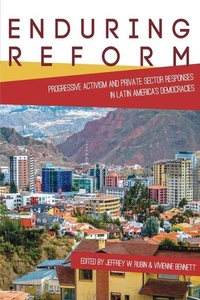
Enduring Reform
Progressive Activism and Private Sector Responses in Latin America's Democracies
Published on 18. March 2015
Book
Paperback/Softback
272 pages
978-0-8229-6316-5 (ISBN)
Description
Over the last twenty years, business responses to progressive reform in Latin America have shifted dramatically. Until the 1990s, progressive movements in Latin America suffered violent repression sanctioned by the private sector and other socio-political elites. The powerful case studies in this volume show how business responses to reform have become more open-ended as Latin America's democracies have deepened, with repression tempered by the economic uncertainties of globalization, the political and legal constraints of democracy, and shifting cultural understandings of poverty and race.
Enduring Reform presents five case studies from Mexico, Brazil, and Argentina in which marginalized groups have successfully forged new cultural and economic spaces and won greater autonomy and political voice. Bringing together NGO's, local institutions, social movements, and governments, these initiatives have developed new mechanisms to work 'within the system,' while also challenging the system's logic and constraints.
Through firsthand interviews, the contributors capture local businesspeople's understandings of these progressive initiatives and record how they grapple with changes they may not always welcome, but must endure. Among their criteria, the contributors evaluate the degree to which businesspeople recognize and engage with reform movements and how they frame electoral counterproposals to reformist demands. The results show an uneven response to reform, dependent on cultural as much or more than economic factors, as businesses move to decipher, modify, collaborate with, outmaneuver, or limit progressive innovations.
From the rise of worker-owned factories in Buenos Aires, to the collective marketing initiatives of impoverished Mayans in San Cristobal de las Casas, the success of democracy in Latin America depends on powerful and cooperative social actions and actors, including the private sector. As the cases in Enduring Reform show, the democratic context of Latin America today presses businesspeople to endure, accept, and at times promote progressive change in unprecedented ways, even as they act to limit and constrain it.
Enduring Reform presents five case studies from Mexico, Brazil, and Argentina in which marginalized groups have successfully forged new cultural and economic spaces and won greater autonomy and political voice. Bringing together NGO's, local institutions, social movements, and governments, these initiatives have developed new mechanisms to work 'within the system,' while also challenging the system's logic and constraints.
Through firsthand interviews, the contributors capture local businesspeople's understandings of these progressive initiatives and record how they grapple with changes they may not always welcome, but must endure. Among their criteria, the contributors evaluate the degree to which businesspeople recognize and engage with reform movements and how they frame electoral counterproposals to reformist demands. The results show an uneven response to reform, dependent on cultural as much or more than economic factors, as businesses move to decipher, modify, collaborate with, outmaneuver, or limit progressive innovations.
From the rise of worker-owned factories in Buenos Aires, to the collective marketing initiatives of impoverished Mayans in San Cristobal de las Casas, the success of democracy in Latin America depends on powerful and cooperative social actions and actors, including the private sector. As the cases in Enduring Reform show, the democratic context of Latin America today presses businesspeople to endure, accept, and at times promote progressive change in unprecedented ways, even as they act to limit and constrain it.
Reviews / Votes
Enduring Reform is a novel, innovative, and important collection exploring the nuances and complexities of business responses to progressive politics in contemporary Latin America. Rubin and Bennett offer a masterful collection that shows ways of thinking of businesspeoples' motivations and preferences that go beyond simple economic explanations and crude assumptions about hostility to progressive movements. * Peter Kingstone, King's College London * Enduring Reform stands out in a large body of literature examining political reform by focusing specifically on the reaction of business interests to examples of successful progressive reform in Argentina, Brazil, and Mexico. Given the growing recognition of the importance of markets, public-private partnerships and the private sector more generally, such a focus is long overdue. * Philip Oxhorn, McGill University * The book also adds a new analytical dimension, asking how, in each case, these projects have been received by local business, what this tells us about the future of such reforms, and what it all means for the health of democracy. * Latin American Research Review *More details
Series
Language
English
Place of publication
Pittsburgh PA
United States
Target group
College/higher education
Product notice
Paperback (trade)
Unsewn / adhesive bound
Illustrations
10 black and white illustrations
Dimensions
Height: 228 mm
Width: 154 mm
Thickness: 22 mm
Weight
403 gr
ISBN-13
978-0-8229-6316-5 (9780822963165)
Copyright in bibliographic data and cover images is held by Nielsen Book Services Limited or by the publishers or by their respective licensors: all rights reserved.
Schweitzer Classification
Other editions
Additional editions
Jeffrey Rubin | Vivienne Bennett
Enduring Reform
Progressive Activism and Private Sector Responses in Latin America's Democracies
E-Book
02/2020
Princeton University Press
€53.99
Available for download
Persons
Jeffrey W. Rubin is associate professor of history at Boston University. He is the author of Decentering the Regime: Ethnicity, Radicalism, and Democracy in Juchitan, Mexico, coauthor of Sustaining Activism: A Brazilian Women's Movement and A Father-Daugh Vivienne Bennett, the author of The Politics of Water, chairs the Liberal Studies Department at California State University, San Marcos.