

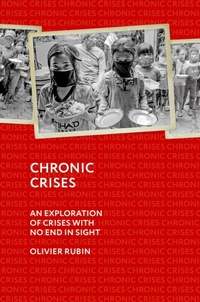
Chronic Crises
An Exploration of Crises with No End in Sight
Will be published approx. on 5. August 2026
Book
Hardback
280 pages
978-0-19-778644-4 (ISBN)
Description
Recent years have made apparent we are living in a world of chronic crises: prolonged disasters that continue to impact people's lives long after their onset. Climate change, famine, and the COVID-19 pandemic represent a few of these disasters--instead of a return to "an accepted state of normalcy" in their wake, the ramifications continue to reverberate around the world.
In Chronic Crises, Olivier Rubin examines what happens, socially and politically, when the end life of a disaster is characterized by a perpetual state of crisis dynamics. He identifies three distinct types of chronic crisis: seething chronic crises, such as famine and multiple starvation deaths; perpetual chronic crises, including antimicrobial resistance and climate change; and transitional chronic crises, exemplified by COVID-19 and HIV/AIDS. Rubin describes the nature of each category, including the underlying temporal dynamics, the disparate impacts in different parts of the globe and different social groups, and how communities adjust to the crises. He then analyzes the politics, investigating how the different features of the crisis types influence policymakers' attention and response, their ability and incentives to put chronic crises on the political agenda, and the prospects for implementing effective policies. Looking to the future, Rubin provides policy recommendations and practical advice for crisis management dealing with chronic crises moving forward.
In Chronic Crises, Olivier Rubin examines what happens, socially and politically, when the end life of a disaster is characterized by a perpetual state of crisis dynamics. He identifies three distinct types of chronic crisis: seething chronic crises, such as famine and multiple starvation deaths; perpetual chronic crises, including antimicrobial resistance and climate change; and transitional chronic crises, exemplified by COVID-19 and HIV/AIDS. Rubin describes the nature of each category, including the underlying temporal dynamics, the disparate impacts in different parts of the globe and different social groups, and how communities adjust to the crises. He then analyzes the politics, investigating how the different features of the crisis types influence policymakers' attention and response, their ability and incentives to put chronic crises on the political agenda, and the prospects for implementing effective policies. Looking to the future, Rubin provides policy recommendations and practical advice for crisis management dealing with chronic crises moving forward.
More details
Language
English
Place of publication
New York
United States
Target group
College/higher education
Product notice
sewn/stitched
Cloth over boards
Dimensions
Height: 236 mm
Width: 165 mm
Thickness: 29 mm
Weight
522 gr
ISBN-13
978-0-19-778644-4 (9780197786444)
Copyright in bibliographic data and cover images is held by Nielsen Book Services Limited or by the publishers or by their respective licensors: all rights reserved.
Schweitzer Classification
Person
Olivier Rubin is Professor in Disaster Research in the Department of Social Sciences and Business at Roskilde University, Denmark. He specializes in exploring the governance and socio-economic dynamics associated with disasters and major crises. His focus is mostly on the political and bureaucratic dynamics of prolongated disasters, such as famines, climate change, pandemics, and antimicrobial resistance. With 20 years of experience in disaster and health crisis research, Rubin has received several highly competitive multiyear grants on disaster research in both the Global North and South, and he has published widely in international outlets pertaining to crises, international development, and politics.
Content
- 1: Chronic crisis introduced
- 2: The theories of condensed, creeping, and chronic crises
- 3: Analyzing chronic crises: Capturing impact and politics
- 4: The nature of seething chronic crises
- 5: The politics of seething chronic crises
- 6: The nature of perpetual chronic crises
- 7: The politics of perpetual chronic crises
- 8: The nature of transitional chronic crises
- 9: The politics of transitional chronic crises
- 10: A world of chronic crises