

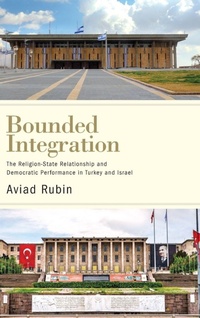
Bounded Integration
The Religion-State Relationship and Democratic Performance in Turkey and Israel
Published on 1. December 2020
Book
Hardback
324 pages
978-1-4384-8077-0 (ISBN)
Description
Investigates Turkey and Israel's contrasting treatment of religion and demonstrates how this treatment has had a significant impact on these countries' democratic performance.
In this comparative study of the religion-state relationship in Turkey and Israel in the modern era, Bounded Integration reveals the influence this dynamic interaction has had on democratic performance in both countries. In societies where a dominant religion serves as an important component of individual and collective identity, the imposition of secular policies from above may not facilitate democratization but may rather impede the embedding of democracy in society. Moreover, the inclusion or exclusion of religion following statehood may facilitate a certain type of path-dependent political culture, one with long-term political consequences. Aviad Rubin's refreshing analytical approach comparing and contrasting the region's only two longstanding democratic entities and the dynamics of religion and the state in two different religions, Islam and Judaism, facilitates generalizable lessons for emergent political regimes in the post-Arab Spring Middle East.
In this comparative study of the religion-state relationship in Turkey and Israel in the modern era, Bounded Integration reveals the influence this dynamic interaction has had on democratic performance in both countries. In societies where a dominant religion serves as an important component of individual and collective identity, the imposition of secular policies from above may not facilitate democratization but may rather impede the embedding of democracy in society. Moreover, the inclusion or exclusion of religion following statehood may facilitate a certain type of path-dependent political culture, one with long-term political consequences. Aviad Rubin's refreshing analytical approach comparing and contrasting the region's only two longstanding democratic entities and the dynamics of religion and the state in two different religions, Islam and Judaism, facilitates generalizable lessons for emergent political regimes in the post-Arab Spring Middle East.
Reviews / Votes
"A fascinating book, very well researched and written, that makes an important contribution to the literature on religion-state relations." - Nahshon Perez, coauthor of Governing the Sacred: Political Toleration in Five Contested Sacred SitesMore details
Series
Language
English
Place of publication
Albany, NY
United States
Target group
Professional and scholarly
US School Grade: College Graduate Student and over
Illustrations
3 Tables, black and white; 10 Figures
Dimensions
Height: 235 mm
Width: 157 mm
Thickness: 24 mm
Weight
678 gr
ISBN-13
978-1-4384-8077-0 (9781438480770)
Copyright in bibliographic data and cover images is held by Nielsen Book Services Limited or by the publishers or by their respective licensors: all rights reserved.
Schweitzer Classification
Other editions
Additional editions
Aviad Rubin
Bounded Integration
The Religion-State Relationship and Democratic Performance in Turkey and Israel
E-Book
12/2020
1st Edition
State University of New York Press
from
€88.99
Available for download
Person
Aviad Rubin is Senior Lecturer in the Division of Government and Political Theory in the School of Political Science at the University of Haifa.
Content
List of Illustrations
Acknowledgments
Introduction
1. Reconceptualizing the Role of Religion in Democratic Regimes
2. Religion and State in Turkey's Prerepublican Era
3. Turkey's Authoritarian Laicism, 1923-1950
4. Religion and Democracy under Kemalist Hegemony, 1950-2000
5. Religion, Democracy, and the Prevalence of Hegemonic Tendencies, 2000-2017
6. Zionism and Religion before Independence
7. An Era of Constructive Collaboration, 1948-1967
8. A Period of Transition, 1960s-1980s
9. Mounting Challenges, Successful Containment, 1980s-2017
10. Religion, State, and Democracy: Conclusions and Lessons for Emergent Arab Regimes
Notes
Bibliography
Index
Acknowledgments
Introduction
1. Reconceptualizing the Role of Religion in Democratic Regimes
2. Religion and State in Turkey's Prerepublican Era
3. Turkey's Authoritarian Laicism, 1923-1950
4. Religion and Democracy under Kemalist Hegemony, 1950-2000
5. Religion, Democracy, and the Prevalence of Hegemonic Tendencies, 2000-2017
6. Zionism and Religion before Independence
7. An Era of Constructive Collaboration, 1948-1967
8. A Period of Transition, 1960s-1980s
9. Mounting Challenges, Successful Containment, 1980s-2017
10. Religion, State, and Democracy: Conclusions and Lessons for Emergent Arab Regimes
Notes
Bibliography
Index