

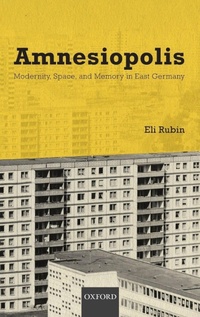
Amnesiopolis
Modernity, Space, and Memory in East Germany
Published on 18. February 2016
Book
Hardback
208 pages
978-0-19-873226-6 (ISBN)
Description
Amnesiopolis explores the construction of Marzahn, the largest prefabricated housing project in East Germany, built on the outskirts of East Berlin in the 1970s and 1980s, and touted by the regime as the future of socialism. It focuses particularly on the experience of East Germans who moved, often from crumbling slums left over as a legacy of the nineteenth century, into this radically new place - one defined by pure functionality and rationality - a
material manifestation of the utopian promise of socialism.
Eli Rubin employs methodologies from critical geography, urban history, architectural history, environmental history, and everyday life history to ask whether their experience was a radical break with their personal pasts and the German past. Amnesiopolis asks: can a dramatic change in spatial and material surroundings sever the links of memory that tie people to their old life narratives, and if so, does that help build a new socialist mentality in the minds of historical subjects?
The answer is yes and no-as much as the East German state tried to create a completely new socialist settlement, divorced of any links to the pre-socialist past, the massive construction project uncovered the truth buried-literally-in the ground, which was that the urge to colonize the outskirts of Berlin was
not new at all. Furthermore, the construction of a new city out of nothing, using repeating, identical buildings, created a panopticon-like effect, giving the Stasi the possibility of more complete surveillance than they previously had.
material manifestation of the utopian promise of socialism.
Eli Rubin employs methodologies from critical geography, urban history, architectural history, environmental history, and everyday life history to ask whether their experience was a radical break with their personal pasts and the German past. Amnesiopolis asks: can a dramatic change in spatial and material surroundings sever the links of memory that tie people to their old life narratives, and if so, does that help build a new socialist mentality in the minds of historical subjects?
The answer is yes and no-as much as the East German state tried to create a completely new socialist settlement, divorced of any links to the pre-socialist past, the massive construction project uncovered the truth buried-literally-in the ground, which was that the urge to colonize the outskirts of Berlin was
not new at all. Furthermore, the construction of a new city out of nothing, using repeating, identical buildings, created a panopticon-like effect, giving the Stasi the possibility of more complete surveillance than they previously had.
Reviews / Votes
Eli Rubin has written a wonderfully inspiring study which will be of great interest to social and cultural historians of the GDR, to urban historians, critical geographers and anyone interested in the achievements and discontents of modernity more generally. * Jorg Arnold, Reviews in History * The author's interdisciplinary approach to the history of this once prestigious project makes Amnesiopolis a fascinating read ... a very knowledgeable and well-written study that will capture the attention of academic and non-academic readers alike. * Stefanie Eisenhuth, German History *More details
Other editions
Additional editions
E-Book
02/2016
1st Edition
OUP eBook
€50.49
Available for download
Person
Eli Rubin is an Associate Professor of History at Western Michigan University. He received his PhD in 2004 from the University of Wisconsin-Madison, and in 2005 his dissertation was awarded the Fritz Stern Prize for the best dissertation in German History by the Friends of the German Historical Institute in Washington, DC. His first monograph, Synthetic Socialism: Plastics and Dictatorship in the German Democratic Republic was published in 2008. From
2007-2009 he held an Alexander von Humboldt Stiftung Postdoctoral Fellowship in Germany as a fellow of the Zentrum für Zeithistorische Forschung in Potsdam.
2007-2009 he held an Alexander von Humboldt Stiftung Postdoctoral Fellowship in Germany as a fellow of the Zentrum für Zeithistorische Forschung in Potsdam.
Content
1. Planning Utopia: The Housing Program, Berlin, and Marzahn ; 2. Moonscape on the Mark: Socialism, Modernity and the Construction of a New World ; 3. Rainbows and Communism: Rupture in the Material, Sensory and Mnemonic Worlds of Marzahn's New Residents ; 4. Growing With Marzahn: Childhood, Community, and the Space of Socialism's Future ; 5. Plattenbau Panopticon: The Stasi, Surveillance, and Plattensiedlungen