

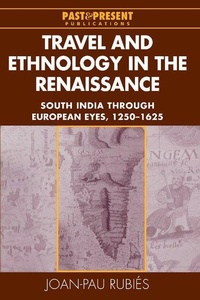
Travel and Ethnology in the Renaissance
South India through European Eyes, 1250-1625
Published on 21. December 2000
Book
Hardback
470 pages
978-0-521-77055-2 (ISBN)
Description
This book, first published in 2000, offers a wide-ranging and ambitious analysis of how European travellers in India developed their perceptions of ethnic, political and religious diversity over three hundred years. It analyses the growth of novel historical and philosophical concerns, from the early and rare examples of medieval travellers such as Marco Polo, through to the more sophisticated narratives of seventeenth-century observers - religious writers such as Jesuit missionaries, or independent antiquarians such as Pietro della Valle. The book's approach combines the detailed contextual analysis of individual narratives with an original long-term interpretation of the role of cross-cultural encounters in the European Renaissance. An extremely wide range of European sources is discussed, including the often neglected but extremely important Iberian and Italian sources. However, the book also discusses a number of non-European sources, Muslim and Hindu, thereby challenging simplistic interpretations of western 'orientalism'.
Reviews / Votes
'A startling new study of the transforming effects of Indian travel on European culture.' Felipe Fernandez-Armesto, The Independent Weekend Review (Book of the Year) '... [an] impressively erudite, well researched, and eloquently written book'. Peter Burke, University of Cambridge '... a work of great erudition and high quality. It is impressive both in the range and closeness of its reading of sixteenth- and seventeenth-century European accounts of south India, and in the analytical power with which they are discussed. This really does seem to me an important and original contribution to our understanding of the development of European perceptions of the non-European world.' Sir John Elliott, University of Oxford '... an accomplishment of stunning intellectual and scholarly proportions. It is unique in its effective conceptualisation of a vast cultural terrain, its breathtaking comprehensiveness, and the sensitivity with which the author reads texts ... The range of materials studied, most unknown to the ordinary, intelligent reader, alone makes the work something that will long command the field.' John M. Headley, The University of North Carolina, Chapel Hill '... brilliant' Felipe Fernandez-Armesto, The Times Literary Supplement 'Rubies's book is an erudite, engaging and lucid account of travel writing in the Renaissance, particularly with regard to South India. Its lightly worn scholarship allows the reader to engage with the sheer diversity of individual representation.' Dilip Menon, The Hindu 'A richly textures book of great scholarship, which breaks down the walls separating 'Indian' and 'European' history.' The Book Review '... an intelligent guidebook for anyone who has cause to refer to Renaissance travel writing ... it is hoped that it will receive a much larger readership than that.' Journal of Ecclesiastical History '... it will rekindle an interest in some of the most exciting and interesting examples of early European writing.' Journal of Imperial & Commonwealth History '... deep and thought-provoking ...' E-Journal of Portuguese HistoryMore details
Series
Language
English
Place of publication
Cambridge
United Kingdom
Target group
Professional and scholarly
Illustrations
12 Halftones, unspecified
Dimensions
Height: 235 mm
Width: 157 mm
Thickness: 32 mm
Weight
908 gr
ISBN-13
978-0-521-77055-2 (9780521770552)
Copyright in bibliographic data and cover images is held by Nielsen Book Services Limited or by the publishers or by their respective licensors: all rights reserved.
Schweitzer Classification
Other editions
Additional editions
E-Book
01/2005
1st Edition
Cambridge University Press
€55.99
Available for download
Person
Content
Preface; 1. The search for India: the empire of Vijayanagara through European eyes; 2. Marco Polo's India and the Latin Christian tradition; 3. Establishing lay science: the merchant and the humanist; 4. The Portuguese and Vijayanagara: politics, religion and classification; 5. The practice of ethnography: Indian customs and castes; 6. The social and political order: Vijayanagara decoded; 7. The historical dimension: from native traditions to European orientalism; 8. The missionary discovery of South Indian religion: opening the doors of idolatry; 9. From humanism to scepticism: the independent traveller in the seventeenth century; 10. Conclusion: before orientalism; Appendix; Bibliography.