

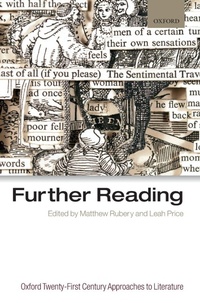
Further Reading
Published on 6. February 2020
Book
Hardback
432 pages
978-0-19-880979-1 (ISBN)
Description
What does reading mean in the twenty-first century? As other disciplines challenge literary criticism's authority to answer this question, English professors are defining new alternatives to close reading and to interpretation more generally. Further Reading brings together thirty essays drawing on approaches as different as formalism, historicism, neuroscience, disability, and computation. Contributors take up the following questions: What do we mean when we talk about 'reading' today? How are reading techniques evolving in the digital era? What is the future of reading?
This book foregrounds reading as a topic worthy of investigation in its own right rather than as a sub-section of histories of the book, sociologies of literacy, or theories of literature. As our knowledge of reading changes in step with the media and the scholarly tools used to apprehend it, a more precise understanding of this topic is crucial to the discipline's future. This collection introduces new ways of conceptualizing the term's forms, boundaries, and uses. Its contributors bring varied vocabularies to bear on the contested nature and continued importance of reading, within the academy and beyond.
This book foregrounds reading as a topic worthy of investigation in its own right rather than as a sub-section of histories of the book, sociologies of literacy, or theories of literature. As our knowledge of reading changes in step with the media and the scholarly tools used to apprehend it, a more precise understanding of this topic is crucial to the discipline's future. This collection introduces new ways of conceptualizing the term's forms, boundaries, and uses. Its contributors bring varied vocabularies to bear on the contested nature and continued importance of reading, within the academy and beyond.
Reviews / Votes
A uniformly well-written, interesting volume. Every essay will find its own readers. Summing Up: Highly recommended. Upper-division undergraduates through faculty and professionals. * B. A. McGowan, Northern Illinois University, CHOICE * ...[a] fascinating collection...rather than dutifully map out the state of the field, Further Reading pushes at its boundaries and makes new connections, as its title suggests...This book is a substantial contribution to the study of reading not because it delivers a definitive picture of its subject, but because it delivers a sprawling and heterogeneous one. * Gill Partington, TLS *More details
Series
Language
English
Place of publication
Oxford
United Kingdom
Target group
Professional and scholarly
Dimensions
Height: 250 mm
Width: 175 mm
Thickness: 27 mm
Weight
900 gr
ISBN-13
978-0-19-880979-1 (9780198809791)
Copyright in bibliographic data and cover images is held by Nielsen Book Services Limited or by the publishers or by their respective licensors: all rights reserved.
Schweitzer Classification
Other editions
Additional editions
Matthew Rubery | Leah Price
Further Reading
Book
03/2022
Oxford University Press
€53.92
Shipment within 15-20 days
Persons
Matthew Rubery is Professor of Modern Literature at Queen Mary University of London. He is the author of The Untold Story of the Talking Book (Harvard, 2016) and The Novelty of Newspapers: Victorian Fiction after the Invention of the News (Oxford, 2009). He also co-curated 'How We Read: A Sensory History of Books for Blind People', a public exhibition held at the UK's first annual Being Human festival.
Leah Price is Distinguished Professor of English at Rutgers University. Her books include What We Talk About When We Talk About Books (Basic, 2019),How to Do Things with Books in Victorian Britain (Princeton, 2012) and The Anthology and the Rise of the Novel (Cambridge, 2000). She has written on media old and new for the New York Times, London Review of Books, Times Literary Supplement, San Francisco Chronicle, and Boston Globe.
Leah Price is Distinguished Professor of English at Rutgers University. Her books include What We Talk About When We Talk About Books (Basic, 2019),How to Do Things with Books in Victorian Britain (Princeton, 2012) and The Anthology and the Rise of the Novel (Cambridge, 2000). She has written on media old and new for the New York Times, London Review of Books, Times Literary Supplement, San Francisco Chronicle, and Boston Globe.
Content
Introduction
Scenes
1: Joseph Howley: In Ancient Rome
2: Christopher Cannon: In the Classroom
3: Isabel Hofmeyr: In the Custom House
4: Steven Connor: In Public
5: Wendy Griswold: Across Borders
6: Natalie Phillips, Cody Mejeur, Melissa Klamer, Karah Smith, and Sal Antonnuci: Neuroimaged
Styles
7: Elaine Treharne: Distant
8: Deidre Lynch: Assigned
9: Garrett Stewart: Actual
10: Elaine Freedgood and Cannon Schmitt: Technical
11: Rita Felski: Postcritical
12: Andrew Piper: Enumerative
13: Christina Lupton: Repeat
Senses
14: Johanna Drucker: Sight
15: Christopher Grobe: Sound
16: Gillian Silverman: Touch
17: Georgina Kleege: Aurality
18: Rebecca Sanchez: Deafness
19: Jonathan Lazar: Accessibility
Brains
20: Paul B. Armstrong: Neuroscience
21: Andrew Elfenbein: Mental Representation
22: Lisa Zunshine: Mindreading and Social Status
23: Ane%zka Kuzmi%cova: Consciousness
24: Gabrielle Starr and Amy Belfi: Pleasure
25: Maryanne Wolf: Dyslexia
Futures
26: Whitney Trettien: Tracked
27: Rebecca Walkowitz: Translated
28: Jessica Pressman: Electronic
29: Lori Emerson: Interfaced
30: Stephen Ramsay: Machine
31: Lisa Gitelman: Not
Scenes
1: Joseph Howley: In Ancient Rome
2: Christopher Cannon: In the Classroom
3: Isabel Hofmeyr: In the Custom House
4: Steven Connor: In Public
5: Wendy Griswold: Across Borders
6: Natalie Phillips, Cody Mejeur, Melissa Klamer, Karah Smith, and Sal Antonnuci: Neuroimaged
Styles
7: Elaine Treharne: Distant
8: Deidre Lynch: Assigned
9: Garrett Stewart: Actual
10: Elaine Freedgood and Cannon Schmitt: Technical
11: Rita Felski: Postcritical
12: Andrew Piper: Enumerative
13: Christina Lupton: Repeat
Senses
14: Johanna Drucker: Sight
15: Christopher Grobe: Sound
16: Gillian Silverman: Touch
17: Georgina Kleege: Aurality
18: Rebecca Sanchez: Deafness
19: Jonathan Lazar: Accessibility
Brains
20: Paul B. Armstrong: Neuroscience
21: Andrew Elfenbein: Mental Representation
22: Lisa Zunshine: Mindreading and Social Status
23: Ane%zka Kuzmi%cova: Consciousness
24: Gabrielle Starr and Amy Belfi: Pleasure
25: Maryanne Wolf: Dyslexia
Futures
26: Whitney Trettien: Tracked
27: Rebecca Walkowitz: Translated
28: Jessica Pressman: Electronic
29: Lori Emerson: Interfaced
30: Stephen Ramsay: Machine
31: Lisa Gitelman: Not