

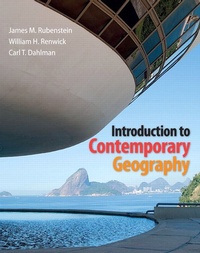
Introduction to Contemporary Geography
Description
With an innovative integration of visuals, text, and spatial graphics, Introduction to Contemporary Geography presents a modular and highly graphical springboard to introductory geography-ideal for contemporary students and learning styles. This innovative new resource partners best-selling human geography author Jim Rubenstein with environmental and physical geographer Bill Renwick, economic/political/cultural geographer Carl Dahlman, and the information architects at Dorling Kindersley (DK). The authors' approachable prose and DK's bold visual style combine to engage students with little to no science background, encouraging them to become scientifically literate and responsible consumers, readers, and voters.
More details
Persons
William H. Renwick earned a BA from Rhode Island College and a PhD in geography from Clark University. He has taught at the University of California, Los Angeles, and Rutgers University and is currently Associate Professor of Geography at Miami University. A physical geographer with interests in geomorphology and environmental issues, his research focuses on impacts of land-use change on rivers and lakes, particularly in agricultural landscapes in the Midwest. He is co-author of Pearson's Introduction to Geography 5e.
Carl T. Dahlman earned degrees in sociology, music, and urban affairs before receiving his PhD in geography from the University of Kentucky in 2001. He is Associate Professor of Geography at Miami University, where his teaching focuses on political geography, migration and mobility, and globalization. His current research includes the role of European integration in the geopolitics of Southeastern Europe. He is co-author of Pearson's Introduction to Geography 5e.
Content
1. Thinking Geographically
2. Weather, Climate, and Climate Change
3. Landforms
4. Biosphere
5. Population
6. Migration
7. Languages and Religions
8. Political Geography
9. Development
10. Food and Agriculture
11. Industry
12. Services and Settlements
13. Urban Patterns
14. Resources