

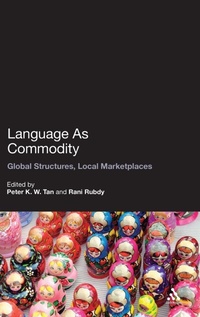
Language As Commodity
Global Structures, Local Marketplaces
Published on 21. September 2008
Book
Hardback
248 pages
978-1-84706-422-6 (ISBN)
Description
This is a comprehensive volume which engages with language policies and positions to highlight the issues surrounding language commodification and globalization.Throughout human history, languages have been in competition with each other. As the world becomes more globalized, this trend increases. It affects the decision-making of those in positions of power and determines macro language policies and planning. Often decisions about language (or dialects or language variety) are related to usefulness - defined in terms of their pragmatic and commercial currency or their value as symbols of socio-cultural identity. Languages can be modes of entry into coveted social hierarchies or strongholds of religious, historical, technological and political power bases. Languages are seen now as commodities that carry different values in an era of globalization.This volume engages with language policies and positions in relation to the roles and functions these languages adopt. It examines the 'value' of languages, defined in terms of the power they have in the global marketplace as much as within the complex matrices of the local socio-politics.
These valuations strongly underpin the various motivations that influence policy-making decisions, and in turn, these motivations create the tensions that characterize many language-related issues; tensions that arise when languages become commodified.
These valuations strongly underpin the various motivations that influence policy-making decisions, and in turn, these motivations create the tensions that characterize many language-related issues; tensions that arise when languages become commodified.
Reviews / Votes
Mention -Book News, February 2009 The link between discourse, globalization and language policies and practices is one that this book introduces us to in a comprehensive way, and it is hoped that more volumes on this area of research will be seen in the future * .Journal of Sociolinguistics, 2009 * ...every chapter challenges and informs our thinking and understanding of language planning and policy, language commodification, globalisation and neoliberalism and, inevitably, the imposition of English around the world. * New Zealand Studies in Applied Linguistics * An excellent source for case studies... and as a reference work for students and instructors in the social sciences. We will use it in our classes. * Journal of Multilingual and Multicultural Development * In the eyes of this reviewer, [Language as Commodity] certainly can be recommended to researchers and students interested in the linguistic dimensions of globalization both for the ample data it provides and the complementary fashion in which it deals with it. * Journal of Multicultural Discourses *More details
Language
English
Place of publication
London
United Kingdom
Publishing group
Bloomsbury Publishing PLC
Target group
College/higher education
Illustrations
10
Dimensions
Height: 240 mm
Width: 161 mm
Thickness: 18 mm
Weight
534 gr
ISBN-13
978-1-84706-422-6 (9781847064226)
Copyright in bibliographic data and cover images is held by Nielsen Book Services Limited or by the publishers or by their respective licensors: all rights reserved.
Schweitzer Classification
Other editions
Additional editions
E-Book
09/2008
1st Edition
Continuum Publishing Corporation
€47.49
Available for download
Persons
Dr Rani Rubdy is at the National Institute of Education, Nanyang Technological University, Singapore. Peter Tan is at the Department of English Language and Literature at the National University of Singapore, Singapore.
Content
Introduction, Peter KW Tan (National University of Singapore, Singapore) and Rani Rudby (National Institute of Education, Nanyang Technological University, Singapore); 1. Dimensions of Globalization and Applied Linguistics, Paul Bruthiaux (Nanyang Technological University, Singapore); 2. Linguistic Instrumentalism in Singapore, Lionel Wee (National University of Singapore, Singapore); 3. The Commodification of Malay: trading in futures, Lubna Alsagoff (National Institute of Education, Nanyang Technological University, Singapore); 4. Beyond Linguistic Instrumentalism: the place of Singlish in Singapore, Huan Hoon Chng (National University of Singapore, Singapore); 5. Linguistic Pragmatism and Globalization in Singaporean Chinese homes, Bee Chin Ng (Nanyang Technological University, Singapore); 6. Anatomies of Linguistic Commodification, T Ruanni F Tupas (National University of Singapore, Singapore); 7. A Commodified English Language? The view through the medium-of-instruction, Peter K W Tan (National University of Singapore, Singapore); 8. English in India: the privilege and priveleging of social class, Rani Rubdy (Nanyang Technological University, Singapore); 9. Language Policy, Vernacular Education and Language Economics, Nkonko Kamwangamalu (Howard University, Washington D.C., USA); 10. The Implicit Trilingual Model in China, Agnes Lam and Wenfeng Wang (University of Hong Kong, Hong Kong); 11. The Global Structuring of English and Labour Markets, Jinghe Han (University of Western Sydney, Australia) & Michael Singh (University of Western Sydney, Australia); 12. On the Appropriateness of the Metaphor of LOSS, David Block (University of London, UK).