

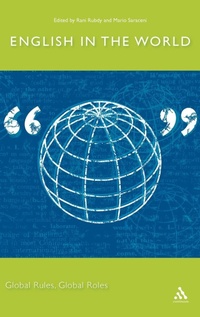
English in the World
Global Rules, Global Roles
Published on 25. March 2006
Book
Hardback
226 pages
978-0-8264-8905-0 (ISBN)
Description
English today, is a truly global language, which plays an important role in international communication, trade, diplomacy, sport, science, technology and culture. One of the consequences of the global predominance of English is that non-native speakers of English now outnumber native speakers. Unlike many international languages, English has no official body prescribing its norms and this has led to a complicated picture of English diversity. This collection of essays by internationally renowned academics brings together different theoretical perspectives that reflect this debate on norms. The first section examines different conceptions of English as an international language, looking at world Englishes, native-speakers and 'standard' English. The second section looks at the pedagogical implications of English as an international language, and addresses such questions as how can we design a curriculum for teaching English, what methods are most effective for teaching English, and what are the key considerations in the ESL classroom? "English in the World" will be of interest to students and researchers of world Englishes, applied linguistics and English as a second language.
Reviews / Votes
"Must Read!!!" -Today's Books, July 1, 2006 mention- Today's Books- Must Read/ September 1, 2006 "As a whole, this anthology serves both as an useful primer to some of the most controversial topics in the field and as a thought-provoking series of chapters addressing core concerns of world Englishes scholars: standards, teaching, intelligibility, and policy. While few entries contribute entirely unfamiliar material, they do provide an accessible refresher for those wanting to become up-to-date in the field. And especially welcome in a text about world Englishes topics is the diversity of the authors themselves: while the majority are Inner Circle-based scholars, only two are working from the United States. This diversity, along with the variety of topics and opinions, makes this accessible and engaging volume worthy of thoughtful consideration of its many provocative ideas." -Tracey McHenry, World Englishes, 2009More details
Language
English
Place of publication
London
United Kingdom
Publishing group
Bloomsbury Publishing PLC
Target group
College/higher education
Professional and scholarly
Dimensions
Height: 240 mm
Width: 161 mm
Thickness: 17 mm
Weight
508 gr
ISBN-13
978-0-8264-8905-0 (9780826489050)
Copyright in bibliographic data and cover images is held by Nielsen Book Services Limited or by the publishers or by their respective licensors: all rights reserved.
Schweitzer Classification
Other editions
Additional editions
E-Book
03/2006
1st Edition
Continuum Publishing Corporation
€111.99
Available for download
Persons
Dr Rani Rubdy is at the National Institute of Education, Nanyang Technological University, Singapore. Mario Saraceni is a Lecturer in the School of Languages and Area Studies, at the University of Portsmouth.
Content
Introduction - Rani Rubdy and Mario Saraceni; Part I: Conceptualising EIL; 1. An interview with Tom McArthur; Rani Rubdy and Mario Saraceni; 2. Global intelligibility and local diversity: possibility or paradox?; Jennifer Jenkins, King's College London; 3. English as a lingua franca in the expanding circle: what it isn't Barbara Seidlhofer, Vienna University; 4. Defining the 'successful bilingual speaker' of English Luke Prodromou, freelance teacher; 5. Which model of English: Native-speaker, nativised or lingua franca?; Andy Kirkpatrick, Curtin University of Technology, Perth, Australia.; 6. World Englishes or English as a lingua franca? A view from the perspective of non-Anglo Englishes; Peter Tan, Vincent Ooi and Andy Chiang, National University of Singapore. 7. Standard English in the World; Anthea Fraser Gupta, University of Leeds.; Part II: Pedagogical Implications of EIL; 8. EIL curriculum development; Sandra McKay, San Francisco State University; 9. A multi-dimensional approach to teaching English for the world Brian Tomlinson, Leeds Metropolitan University; 10. Teaching EIL - teaching international or intercultural English? What teachers should know; Nicos Sifakis, Hellenic Open University, Greece.; 11. English as an international language, world Englishes and their conditions of (im)possibility; Ruanni Tupas, National University of Singapore; 12. English in the world does not mean English everywhere: the case for multilingualism in the ELT/ESL profession; Michael Joseph and Esther Ramani, University of the North, South Africa; 13. An interview with Suresh Canagarajah; Rani Rubdy and Mario Saraceni.