

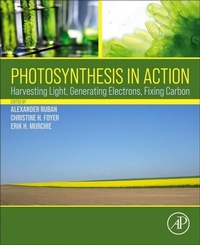
Photosynthesis in Action
Harvesting Light, Generating Electrons, Fixing Carbon
Published on 19. January 2022
Book
Paperback/Softback
290 pages
978-0-12-823781-6 (ISBN)
Description
Photosynthesis in Action examines the molecular mechanisms, adaptations and improvements of photosynthesis. With a strong focus on the latest research and advances, the book also analyzes the impact the process has on the biosphere and the effect of global climate change. Fundamental topics such as harvesting light, the transport of electronics and fixing carbon are discussed. The book also reviews the latest research on how abiotic stresses affect these key processes as well as how to improve each of them. This title explains how the process is flexible in adaptations and how it can be engineered to be made more effective.
End users will be able to see the significance and potential of the processes of photosynthesis. Edited by renowned experts with leading contributors, this is an essential read for students and researchers interested in photosynthesis, plant science, plant physiology and climate change.
End users will be able to see the significance and potential of the processes of photosynthesis. Edited by renowned experts with leading contributors, this is an essential read for students and researchers interested in photosynthesis, plant science, plant physiology and climate change.
More details
Language
English
Place of publication
San Diego
United States
Publishing group
Elsevier Science Publishing Co Inc
Target group
College/higher education
Product notice
Paperback (trade)
Unsewn / adhesive bound
Illustrations
100 illustrations (50 in full color); Illustrations
Dimensions
Height: 191 mm
Width: 235 mm
Thickness: 21 mm
Weight
610 gr
ISBN-13
978-0-12-823781-6 (9780128237816)
Copyright in bibliographic data and cover images is held by Nielsen Book Services Limited or by the publishers or by their respective licensors: all rights reserved.
Schweitzer Classification
Other editions
Additional editions
Alexander Ruban | Christine Foyer | Erik Murchie
Photosynthesis in Action
Harvesting Light, Generating Electrons, Fixing Carbon
E-Book
01/2022
Academic Press
€68.99
Available for download
Persons
Dr Alexander Ruban is a Professor in Biophysics at the Queen Mary University of London, UK. His research focuses on the molecular mechanisms of light energy utilisation and management in the photosynthetic membrane. The major goal of his lab is to understand how biological matter is designed to conduct a variety of intimate physical processes accompanying photosynthetic energy conversion and how structural properties of the photosynthetic light harvesting proteins govern flexibility and efficiency of photosynthesis. Recent advances of Professor Ruban's research include a discovery of the photoprotective molecular switch in the photosystem 2 antenna and establishment of the great plasticity in the light harvesting antenna design of higher plants. He has an impressive research and publication record and his expertise in plant physiology, biophysics and biochemistry make him uniquely suited to act as lead editor on this foundational, comprehensive title. Dr Christine Foyer is a Professor of Plant Science at the University of Leeds, UK. With over 400 published papers and 30,000 citations, Dr Foyer's research is widely renowned within plant science. She is President Elect of the Association of Applied Biologists, the General Secretary of the Federation of European Societies of Plant Biologists, an elected Board Member of the American Society of Plant Biologists and a Member of the French Academy of Agriculture. She will soon take up the role of Editor in Chief of Food and Energy Security. She is also a senior Editor for Plant, Cell and Environment and an Associate Editor for the Biochemical Journal, The Journal of Experimental Biology and Physiologia Plantarum. The Foyer lab uses multidisciplinary approaches incorporating -omics technologies, molecular and biochemical techniques and whole plant physiology. Her expertise in the latest technology will bridge the gap between research and practice for students and advanced researchers. Erik Murchie developed a strong interest in biology and plants from an early age with family backgrounds including forestry. He graduated from the University of Exeter in 1990 and then gained a PhD in plant ecophysiology (1995) at the University of Sheffield, UK, focused on adaptation of photosynthesis light in natural systems. A deliberate move into crop metabolism led to postdoctoral work at INRA Versailles (France), the University of Sheffield and the International Rice Research Institute (The Philippines). Whilst a postdoc Erik developed ideas into acclimation of photosynthesis to high light in rice and wheat canopies that were born from his work as a PhD student and relevant to enhancement of resource use efficiency. From 2007- 2018 Erik worked as a lecturer and Associate Professor in Crop Science at the University of Nottingham (UK) where his group has worked with diverse systems including LED-based horticulture, and developing the area of 3D analysis of light distribution and photosynthesis in canopies. Since 2019 Erik has held a Chair in Applied Plant Physiology at Nottingham, studying natural genetic variation in photosynthesis in crop and wild species, water use efficiency and developing new tools for studying photosynthesis in the field.
Content
Section I: Principles
1. Harvesting light
2. Transport of electrons
3. Carbon fixation
Section II: Adaptations
4. Abiotic stress and adaptation in light harvesting
5. Abiotic stress and adaptation of electron transport: Regulation of the production and processing of ROS signals in chloroplasts
6. Abiotic stress, acclimation, and adaptation in carbon fixation processes
Section III: Action
7. Improving light harvesting
8. Improving the transport of electrons
9. Improving carbon fixation
Section IV: Synthesis
10. Integrating the stages of photosynthesis
11. Photosynthesis in action: The global view
1. Harvesting light
2. Transport of electrons
3. Carbon fixation
Section II: Adaptations
4. Abiotic stress and adaptation in light harvesting
5. Abiotic stress and adaptation of electron transport: Regulation of the production and processing of ROS signals in chloroplasts
6. Abiotic stress, acclimation, and adaptation in carbon fixation processes
Section III: Action
7. Improving light harvesting
8. Improving the transport of electrons
9. Improving carbon fixation
Section IV: Synthesis
10. Integrating the stages of photosynthesis
11. Photosynthesis in action: The global view