

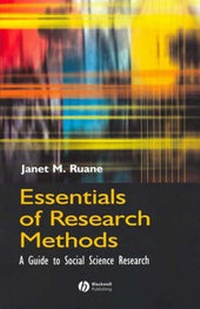
Essentials of Research Methods
A Guide to Social Science Research
1st Edition
Published on 13. July 2004
Book
Paperback/Softback
256 pages
978-0-631-23049-6 (ISBN)
Description
Essentials of Research Methods is a concise and accessible introduction to research methods in the social sciences.
Written by an expert of research methods teaching, this book takes extraordinary care to focus the reader on experiences in his or her everyday life as a way of understanding and performing research methods.
Introduces students to research methods with clear, concise, and accessible prose.
Focuses the reader on everyday life as a way to understand research methods.
Covers ethics, data gathering and analysis, and statistics.
Includes further reading lists, graphs, exercises, study questions, a glossary, and an annotated list of web resources.
Written by an expert of research methods teaching, this book takes extraordinary care to focus the reader on experiences in his or her everyday life as a way of understanding and performing research methods.
Introduces students to research methods with clear, concise, and accessible prose.
Focuses the reader on everyday life as a way to understand research methods.
Covers ethics, data gathering and analysis, and statistics.
Includes further reading lists, graphs, exercises, study questions, a glossary, and an annotated list of web resources.
Reviews / Votes
"Janet Ruane has written the most lively and lucid introductory methods book I've ever read. The book is filled with contemporary examples that will engage the beginning student while providing a thorough and memorable grounding in the conduct of social research."Edward J. Hackett, Arizona State University
"Finally a well written, non-intimidating, down-to-earth beginners methods textbook. Ruane truly fills a void in the literature. Her book will delight both teachers and students."
Sophia P. Tsakraklides, Temple University
"Essentials provides a basis for making research methods accessible and, more important, interesting to students. Ruane's no-nonsense approach, real-life examples, and avoidance of jargon-laden explanations allow students to learn, understand, and appreciate research methods in spite of themselves ...Great book!"
Maureen Outlaw, Providence College
More details
Language
English
Place of publication
Hoboken
United Kingdom
Publishing group
John Wiley and Sons Ltd
Target group
Professional and scholarly
Dimensions
Height: 229 mm
Width: 153 mm
Thickness: 20 mm
Weight
390 gr
ISBN-13
978-0-631-23049-6 (9780631230496)
Copyright in bibliographic data and cover images is held by Nielsen Book Services Limited or by the publishers or by their respective licensors: all rights reserved.
Schweitzer Classification
Other editions
New editions
Book
01/2016
Wiley
€32.90
Shipment within 15-20 days
Person
Janet M. Ruane is Associate Professor of Sociology at Montclair State University. She is co-author of Second Thoughts: Seeing Conventional Wisdom Through the Sociological Eye (with Karen Cerulo, third edition, 2004). She has taught research methods to undergraduates for more than fifteen years.
Content
List of Figures and Tables. Preface.
Acknowledgements.
1. When Should We Trust What We Know? Why Research Methods?.
2. Ethics: It's the Right Thing To Do.
3. Some Perfectly Valid Points: Measurement, Internal, and External Validity.
4. Measure By Measure-Making the Abstract Concrete.
5. If It Glitters Is It Gold? Assessing Measures.
6. One Thing Leads to Another: Causal Analysis.
7. Designing Ideas: Research Strategies.
8. An Informative Few:Sampling.
9. Our Inquisitive Nature: The Questionnaire.
10. Talking Heads: The Interview.
11. Watch and Learn: Field Research.
12. Getting Organized: Descriptive Statistics.
13. Beyond Description: Inferential Statistics.
References.
Web Resources.
Index
Acknowledgements.
1. When Should We Trust What We Know? Why Research Methods?.
2. Ethics: It's the Right Thing To Do.
3. Some Perfectly Valid Points: Measurement, Internal, and External Validity.
4. Measure By Measure-Making the Abstract Concrete.
5. If It Glitters Is It Gold? Assessing Measures.
6. One Thing Leads to Another: Causal Analysis.
7. Designing Ideas: Research Strategies.
8. An Informative Few:Sampling.
9. Our Inquisitive Nature: The Questionnaire.
10. Talking Heads: The Interview.
11. Watch and Learn: Field Research.
12. Getting Organized: Descriptive Statistics.
13. Beyond Description: Inferential Statistics.
References.
Web Resources.
Index