

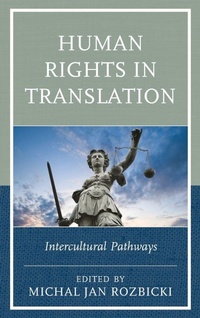
Human Rights in Translation
Intercultural Pathways
Published on 26. October 2018
Book
Hardback
252 pages
978-1-4985-8141-7 (ISBN)
Description
This volume reflects on what happens when the idea and practice of universal human rights cross the cultural borders between different communities of knowledge. Although such rights are usually presumed to be founded on certain globally shared beliefs, the norms and values of many cultures are often incommensurable with these "universal" principles, and hence the need to translate and "vernacularize" them. Any law that would successfully institutionalize them must frame human rights in a way that defers to the historically constituted cultural capital of the society in which it is to function. The essays in this book seek to illuminate different cognitive contexts that produce different meanings of rights, identify spaces of intercultural crossings where differences can coexist, and offer usable narratives and metaphors that could help mediate between distinct cultures. They show that the path forward does not lead through a unified theory of human rights that can be applied globally, nor through mere repackaging of rights in a more understandable language. What is needed is a deep understanding of the process of intercultural dialogue, the cultural "grammar" involved in relationships of difference.
Reviews / Votes
This volume provides a nuanced look at the intercultural complexities which arise-and the translations and dialogue necessary-when Western Enlightenment-infused notions of universal human rights traverse cultural and nation-state borders, especially in the spaces and contexts of the postcolonial non-West. The theoretical deliberations in the book are illuminated through current and historical case studies from across the world. These cases delve into the intersections of the universal and the local and highlight the inclusive possibilities that could emerge in the third spaces of being and knowing. By weaving together the knotty threads of the legal, policy-level, and cultural debates between individualism and individual rights, collectivism, differing cultural and societal perceptions regarding human rights and duties, and the need to protect human dignity as well as to respect cultural diversity, this volume keenly reminds us of the necessity of these debates in our world so interconnected yet fraught with violence and social injustices stemming from religious conflict, migration, the flow of refugees, gender politics, and other pressing transnational issues. -- Nilanjana Bardhan, Southern Illinois University Notably since 1945 the discourse of human rights has become global, but what does this mean in the different contexts (conceptual, social, political, legal) in which the idea has been taken up? How do ideas forged in a specific Western-European and transatlantic-tradition 'translate' (literally and metaphorically) when crossing cultures? What happens if and when they do? And how should scholars and practitioners think about these phenomena? This valuable interdisciplinary collection, with its wide-ranging theoretical chapters and empirical case studies, draws on contemporary thinking about interculturality and intercultural dialogue, and brings a refreshingly new and illuminating approach to issues which, as the editor says, admit of no easy solution. -- Ralph Grillo, University of SussexMore details
Language
English
Place of publication
United States
Publishing group
Bloomsbury Publishing Plc
Target group
Professional and scholarly
Product notice
sewn/stitched
Cloth over boards
With dust jacket
Dimensions
Height: 235 mm
Width: 157 mm
Thickness: 20 mm
Weight
568 gr
ISBN-13
978-1-4985-8141-7 (9781498581417)
Copyright in bibliographic data and cover images is held by Nielsen Book Services Limited or by the publishers or by their respective licensors: all rights reserved.
Schweitzer Classification
Other editions
Additional editions
Human Rights in Translation
Intercultural Pathways
E-Book
10/2018
1st Edition
Lexington Books
€40.49
Available for download
Persons
Content
Part I: Conceptual Frameworks
Chapter 1: Human Rights and the Grammar of Interculturality, Michal Jan Rozbicki
Chapter 2: Human Rights against Human Rights: Universal Declaration of Human Rights, Interpretative Discrepancies, and Intercultural Transpositions, Mario Ricca
Part II: Rights and Religion
Chapter 3: Transgender Rights in Pakistan?: Global, Colonial, and Islamic Perspectives, Jeffrey A. Redding
Chapter 4: The Off-Centered Hub of Secularism: Religion Inside Human Rights Projections and Quotidian Life, Melisa Vazquez
Chapter 5: Migration' as a Metaphor for Religious Conversion: a Reinterpretation of Freedom of Conscience and Belief in Colonial India and Pakistan, Shazia Ahmad
Part III: Rights and Migration
Chapter 6: Protestant Work Ethic Revisited: The Ephemeral Nature of Commitment to Human Rights, Hisako Matsuo and Rachel Santon
Chapter 7: Politics, Religion and Debt: Translating Lives into Normative Frameworks for Asylum Seekers in Italy, Tommaso Sbriccoli
Chapter 8: The Role of Human Rights Frameworks in Refugee Host State Integration, Rachel Santon
Part IV: Rights and Cultural Difference
Chapter 9: Defending Liberty from Tyranny in Dostoevsky's Siberia: The Impact of Captivity on an Intercultural Consensus Regarding Human Rights, Elizabeth Blake
Chapter 10: The ASEAN Human Rights Declaration as a Case of Human Rights Translation, Marcella Ferri
Chapter 11: The Color Curtain: Richard Wright on Race, Rights and Western Values, Anders Walker
Chapter 1: Human Rights and the Grammar of Interculturality, Michal Jan Rozbicki
Chapter 2: Human Rights against Human Rights: Universal Declaration of Human Rights, Interpretative Discrepancies, and Intercultural Transpositions, Mario Ricca
Part II: Rights and Religion
Chapter 3: Transgender Rights in Pakistan?: Global, Colonial, and Islamic Perspectives, Jeffrey A. Redding
Chapter 4: The Off-Centered Hub of Secularism: Religion Inside Human Rights Projections and Quotidian Life, Melisa Vazquez
Chapter 5: Migration' as a Metaphor for Religious Conversion: a Reinterpretation of Freedom of Conscience and Belief in Colonial India and Pakistan, Shazia Ahmad
Part III: Rights and Migration
Chapter 6: Protestant Work Ethic Revisited: The Ephemeral Nature of Commitment to Human Rights, Hisako Matsuo and Rachel Santon
Chapter 7: Politics, Religion and Debt: Translating Lives into Normative Frameworks for Asylum Seekers in Italy, Tommaso Sbriccoli
Chapter 8: The Role of Human Rights Frameworks in Refugee Host State Integration, Rachel Santon
Part IV: Rights and Cultural Difference
Chapter 9: Defending Liberty from Tyranny in Dostoevsky's Siberia: The Impact of Captivity on an Intercultural Consensus Regarding Human Rights, Elizabeth Blake
Chapter 10: The ASEAN Human Rights Declaration as a Case of Human Rights Translation, Marcella Ferri
Chapter 11: The Color Curtain: Richard Wright on Race, Rights and Western Values, Anders Walker