

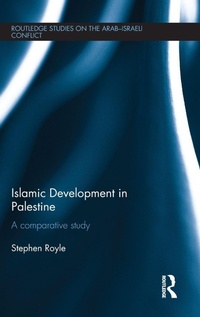
Islamic Development in Palestine
A Comparative Study
1st Edition
Published on 6. October 2016
Book
Hardback
210 pages
978-1-138-64081-8 (ISBN)
Description
This book assesses the capabilities of an Islamic approach in aiding self-organisation by examining the case of the occupied Palestinian territories in conjunction with a comparative analysis of four other nations. Three main mechanisms of Islamic development are explored; finance, microfinance and charity. Identifying the need to recognise the non-linear nature of societal interaction at the individual, community and state levels, the book uses complexity theory to better understand development. It assesses the role of Islamic development at macro and micro levels and identifies issues with rigid and hierarchical policy making.
More details
Series
Language
English
Place of publication
London
United Kingdom
Publishing group
Taylor & Francis Ltd
Target group
College/higher education
Illustrations
1 s/w Abbildung, 1 s/w Zeichnung, 2 s/w Tabellen
2 Tables, black and white; 1 Line drawings, black and white; 1 Illustrations, black and white
Dimensions
Height: 240 mm
Width: 161 mm
Thickness: 16 mm
Weight
487 gr
ISBN-13
978-1-138-64081-8 (9781138640818)
Copyright in bibliographic data and cover images is held by Nielsen Book Services Limited or by the publishers or by their respective licensors: all rights reserved.
Schweitzer Classification
Other editions
Additional editions
Book
12/2019
1st Edition
Routledge
€64.80
Shipment within 15-20 days
E-Book
10/2016
Routledge
€59.49
Available for download
E-Book
10/2016
Routledge
€59.49
Available for download
Person
Stephen Royle is an experienced analyst based in the Middle East. He has previously been an advisor to the Palestinian Prime Minister. Stephen obtained his PhD from the Department of Politics, Philosophy and Religion, at the University of Lancaster, United Kingdom
Content
Introduction 1. The Practicality of Islamic Development Mechanisms 2. Comparative Studies: Iran and Egypt 3. Comparative Studies: Malaysia and Lebanon 4. The Occupied Palestinian Territories 5. Islamic Finance in the Occupied Palestinian Territories 6. Islamic Microfinance in the Occupied Palestinian Territories 7. Zakat and Islamic Charities in the West Bank 8. Conclusion