

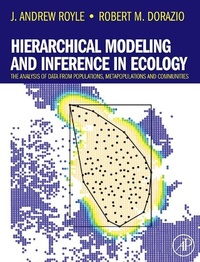
Hierarchical Modeling and Inference in Ecology
The Analysis of Data from Populations, Metapopulations and Communities
Published on 15. October 2008
Book
Hardback
464 pages
978-0-12-374097-7 (ISBN)
Description
A guide to data collection, modeling and inference strategies for biological survey data using Bayesian and classical statistical methods.
This book describes a general and flexible framework for modeling and inference in ecological systems based on hierarchical models, with a strict focus on the use of probability models and parametric inference. Hierarchical models represent a paradigm shift in the application of statistics to ecological inference problems because they combine explicit models of ecological system structure or dynamics with models of how ecological systems are observed. The principles of hierarchical modeling are developed and applied to problems in population, metapopulation, community, and metacommunity systems.
The book provides the first synthetic treatment of many recent methodological advances in ecological modeling and unifies disparate methods and procedures.
The authors apply principles of hierarchical modeling to ecological problems, including
* occurrence or occupancy models for estimating species distribution
* abundance models based on many sampling protocols, including distance sampling
* capture-recapture models with individual effects
* spatial capture-recapture models based on camera trapping and related methods
* population and metapopulation dynamic models
* models of biodiversity, community structure and dynamics
This book describes a general and flexible framework for modeling and inference in ecological systems based on hierarchical models, with a strict focus on the use of probability models and parametric inference. Hierarchical models represent a paradigm shift in the application of statistics to ecological inference problems because they combine explicit models of ecological system structure or dynamics with models of how ecological systems are observed. The principles of hierarchical modeling are developed and applied to problems in population, metapopulation, community, and metacommunity systems.
The book provides the first synthetic treatment of many recent methodological advances in ecological modeling and unifies disparate methods and procedures.
The authors apply principles of hierarchical modeling to ecological problems, including
* occurrence or occupancy models for estimating species distribution
* abundance models based on many sampling protocols, including distance sampling
* capture-recapture models with individual effects
* spatial capture-recapture models based on camera trapping and related methods
* population and metapopulation dynamic models
* models of biodiversity, community structure and dynamics
More details
Language
English
Place of publication
San Diego
United States
Publishing group
Elsevier Science Publishing Co Inc
Target group
Professional and scholarly
Post-graduate research biologists in ecology and population dynamics and field surveys - engaged in field data collection and modelling for all practical and theoretical applications; Biostatisticians
Product notice
sewn/stitched
Paper over boards
Dimensions
Height: 236 mm
Width: 188 mm
Thickness: 30 mm
Weight
953 gr
ISBN-13
978-0-12-374097-7 (9780123740977)
Copyright in bibliographic data and cover images is held by Nielsen Book Services Limited or by the publishers or by their respective licensors: all rights reserved.
Schweitzer Classification
Other editions
Additional editions
J. Andrew Royle | Robert M. Dorazio
Hierarchical Modeling and Inference in Ecology
The Analysis of Data from Populations, Metapopulations and Communities
E-Book
10/2008
Academic Press
€64.95
Available for download
Persons
Dr Royle is a Senior Scientist and Research Statistician at the U.S. Geological Survey's Patuxent Wildlife Research Center. His research is focused on the application of probability and statistics to ecological problems, especially those related to animal sampling and demographic modeling. Much of his research over the last 10 years has been devoted to the development of methods illustrated in our new book. He has authored or coauthored more than 100 journal articles, and co-authored the books Spatial Capture Recapture, Hierarchical Modeling and Inference in Ecology and Occupancy Estimation and Modeling: Inferring Patterns and Dynamics of Species Occurrence, all published by Academic Press.
Content
Introduction; Site-occupancy models; Closed population models; Modelling individual effects in closed populations; Abundance as a state variable; Abundance as a state variable; Dynamic site occupancy models; Cormack-Jolly-Seber models; Jolly-Seber models; Animal community models; Occupancy models with spatial dynamics; Open models for animal communities; Temporaly dynamic models for abundance; Other potential topics; Statistical concepts and philosophy; Appendices (online or in text) Appendix1: R-tutorial, Sample R-functions for implementing several methods Appendix2: WinBUGS tutorial and R2WinBUGS package Appendix3:Sample WinBUGS and R-scripts for examples used in book