

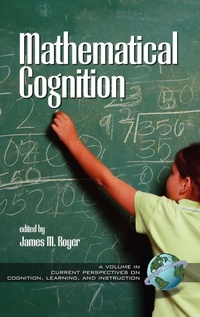
Mathematical Cognition
Will be published approx. on 1. January 2003
Book
Hardback
272 pages
978-1-930608-35-1 (ISBN)
Description
This book is divided into seven chapters including: a broad overview of mathematical cognition; development of mathematical cognition; working memory, automaticity and mathematical problem solving; mathematical problem solving; and methematical learning disabilities.
More details
Series
Language
English
Place of publication
Charlotte
United States
Publishing group
Emerald Publishing Inc
Target group
College/higher education
Professional and scholarly
Dimensions
Height: 240 mm
Width: 161 mm
Thickness: 19 mm
Weight
575 gr
ISBN-13
978-1-930608-35-1 (9781930608351)
Copyright in bibliographic data and cover images is held by Nielsen Book Services Limited or by the publishers or by their respective licensors: all rights reserved.
Schweitzer Classification
Content
Introduction; James M. Royer.
Chapter 1. The Development Of Math Competence In The Preschool And Early School Years: Cognitive Foundations And Instructional Strategies; Sharon Griffin.
Chapter 2. Perspectives On Mathematics Strategy Development; Martha Carr And Hillary Hettinger.
Chapter 3. Mathematical Problem Solving; Richard E. Mayer.
Chapter 4. Learning Disabilities In Basic Mathematics: Deficits In Memory And Cognition; David C. Geary And Mary K. Hoard.
Chapter 5. Relationships Among Basic Computational Automaticity, Working Memory, And Complex Mathematical Problem Solving: What We Know And What We Need To Know; Loel T. Tronsky And James M. Royer.
Chapter 6. Mathematics Instruction: Cognitive, Affective And Existential Perspectives; Allan Feldman.
Chapter 7. A Brief History Of American K-12 Mathematics Education In The 20th Century; David Klein.
Chapter 8. Assessment In Mathematics: A Developmental Approach; John Pegg.
Chapter 1. The Development Of Math Competence In The Preschool And Early School Years: Cognitive Foundations And Instructional Strategies; Sharon Griffin.
Chapter 2. Perspectives On Mathematics Strategy Development; Martha Carr And Hillary Hettinger.
Chapter 3. Mathematical Problem Solving; Richard E. Mayer.
Chapter 4. Learning Disabilities In Basic Mathematics: Deficits In Memory And Cognition; David C. Geary And Mary K. Hoard.
Chapter 5. Relationships Among Basic Computational Automaticity, Working Memory, And Complex Mathematical Problem Solving: What We Know And What We Need To Know; Loel T. Tronsky And James M. Royer.
Chapter 6. Mathematics Instruction: Cognitive, Affective And Existential Perspectives; Allan Feldman.
Chapter 7. A Brief History Of American K-12 Mathematics Education In The 20th Century; David Klein.
Chapter 8. Assessment In Mathematics: A Developmental Approach; John Pegg.