

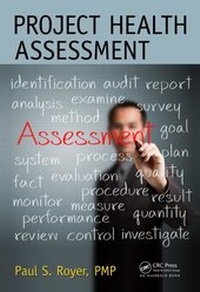
Project Health Assessment
1st Edition
Published on 3. November 2014
Book
Hardback
382 pages
978-1-4822-5282-8 (ISBN)
Description
Project managers, sponsors, team members, and involved stakeholders know when things aren't going well. A frequent first indication is a missing or errant process. Project Health Assessment presents an innovative approach for assessing project processes through a set of ten critical success factors based on PMI's PMBOK (R) Guide knowledge areas. The findings from such assessments can help project managers reduce project risk, improve stakeholder satisfaction, and increase the likelihood of project success, as demonstrated by 30+ assessments done over 15 years of putting this approach into practice.
Project Health Assessment breaks down each PMBOK (R) Guide knowledge area into its process steps, inputs, and outputs and then creates critical success factor questions that evaluate its effectiveness and potential risk. These questions can be used by project managers to establish sufficient project processes or by external entities to evaluate a project and assess its overall risk
The book illustrates critical success factor points through numerous case studies, including a step-by-step example of how to conduct a project health assessment from engagement acquisition through startup, initial assessment, and periodic follow-up assessments. The book provides several downloadable document, spreadsheet, and scheduling templates that practitioners can customize and use in their projects. Using these tools, you can avoid or minimize the cost of failed projects to your organization.
Project Health Assessment breaks down each PMBOK (R) Guide knowledge area into its process steps, inputs, and outputs and then creates critical success factor questions that evaluate its effectiveness and potential risk. These questions can be used by project managers to establish sufficient project processes or by external entities to evaluate a project and assess its overall risk
The book illustrates critical success factor points through numerous case studies, including a step-by-step example of how to conduct a project health assessment from engagement acquisition through startup, initial assessment, and periodic follow-up assessments. The book provides several downloadable document, spreadsheet, and scheduling templates that practitioners can customize and use in their projects. Using these tools, you can avoid or minimize the cost of failed projects to your organization.
Reviews / Votes
"Too many projects fail, many for repeatable reasons. We need to work hard to resolve Cobb's Paradox (1995): `We know why projects fail; we know how to prevent their failure - so why do they still fail?' The insights in this book provide a valuable framework to promote project health and optimize the chances of project success, both within specific projects and more widely in project-based organizations. Our projects are too important to be allowed to fail, and following Paul Royer's advice will help us to do better."-Dr. David Hillson, The Risk Doctor
"Often, people hear a project health assessment is to be conducted and believe it is an audit or a performance review. Paul Royer's, Project Health Assessment dispels this myth and explains how useful a health assessment is for anyone seeking ways to ensure project success. Covering the Project Management Institute's knowledge areas, Royer presents critical success factors for a health assessment and his own model, which one can adopt and use to further improvements in any aspect of a project."
-Ginger Levin, PhD, PMP, PgMP, OPM3 Certified Professional
"This book is a `mind dump' if you will of more than fifteen years of practitioner experience in the area of project risk management specialized in assessing the projects' health. The specific recommendations in this book are intended for information technology project professionals. It provides practical advice regarding: (1) project management oversight and review, (2) what a project health assessment is, (3) how to tailor the specific project's objectives and organizational culture to optimize project's objectives, (4) critical success factor points, and (5) several customizable assessment templates to use."
-Ovidiu Cretu, Ph.D., PE
"This book is an invaluable how-to resource and reference for those looking to expand their consulting capability, as well as those companies looking to perform self-assessments.
Using background information, examples, flowcharts, and templates, the book tells you step by step:
Why Project Health Assessments should be undertaken
What steps are necessary to complete one
How the steps need to be done, by giving insight on what things to look for and questions to ask
It makes an excellent addition to any Project Management Quality program."
-Stephen W. Maas MPM, PMP
"Paul Royer has written a book that should be in every project manager's library. Paul has set down his extensive experience to provide a profound and pragmatic advice to help project managers make a thorough project health assessment. Paul shares his insights with great clarity in a book full of best practice advice. This is not just useful to the experienced project manager but to senior management who want to have a better understanding of the options they have to evaluate projects and take corrective actions to minimize risks."
-Rodolfo Siles, PMP, MScM, SCPM
More details
Series
Language
English
Place of publication
Oakville
Canada
Target group
College/higher education
Project managers.
Illustrations
80 s/w Tabellen, 70 s/w Abbildungen
80 Tables, black and white; 70 Illustrations, black and white
Dimensions
Height: 254 mm
Width: 178 mm
Weight
885 gr
ISBN-13
978-1-4822-5282-8 (9781482252828)
Copyright in bibliographic data and cover images is held by Nielsen Book Services Limited or by the publishers or by their respective licensors: all rights reserved.
Schweitzer Classification
Other editions
Additional editions
PMP, Paul S. Royer
Project Health Assessment
E-Book
10/2014
Auerbach Publishers Inc.
€57.99
Available for download
Person
Paul S. Royer is a senior project management consultant with specialties in project planning, external quality assurance and risk assessment, project recovery, and project management office administration and development. He was certified as a PMI (R) Project Management Professional (R) in 2001 and practices his trade in the Pacific Northwest.
Mr. Royer's professional career in information technology began in 1965 as an engineering student co-op trainee from UC Berkeley assigned to the Simulation Section of the Flight Research Center, NASA, Edwards Air Force Base, California. From that beginning and after a stint as a military policeman with the US Army, Paul continued in IT with two years at the Napa County Auditor-Controller, completed his BA at UCB, and worked twenty-six years with Kaiser Permanente Medical Care Program in Northern California, ten years as a consultant at CIBER, four years leading his own firm Proactive Risk Management, and since 2011 as the project management administrator for the Washington State Health Benefit Exchange's Project Management Office.
Paul obtained his Bachelor of Arts degree from the University of California at Berkeley, where he has also taught logical data modeling, relational database design, and structured analysis. He has also taught numerous project management classes while with Kaiser and CIBER and at the Community College of Bellevue, Washington. In addition, he is a published author of "Risk Management: The Undiscovered Dimension of Project Management," (2000, PMI Project Management Journal, 31 (1), March) and Project Risk Management: A Proactive Approach (2002, Vienna, VA: Management Concepts). He has also delivered the following presentations on various aspects of risk management: How Healthy Is Your Project (PMI Connections 2000 Proceedings, September 2000), How Healthy Is Your Program? (PMI New Jersey Chapter Annual Symposium, May 2001), and Risk Management and the "Small" Project (PMI Puget Sound Chapter, September 2002).
Paul began as a programmer trainee taking on ever-increasing management responsibility covering diverse specialties within IT for twenty years, finally transitioning into the field of project/program management in the late 1980s. Since 1997, Paul has provided more than thirty project quality assurance and risk assessments to public agencies in Oregon, Washington, California, and Missouri. The process improvement from these assessments increased project success rates; although in a few cases, the best result was to help the sponsor shut down the project and minimize loss. This assessment experience was key to developing the project health assessment techniques described in this book.
Mr. Royer's professional career in information technology began in 1965 as an engineering student co-op trainee from UC Berkeley assigned to the Simulation Section of the Flight Research Center, NASA, Edwards Air Force Base, California. From that beginning and after a stint as a military policeman with the US Army, Paul continued in IT with two years at the Napa County Auditor-Controller, completed his BA at UCB, and worked twenty-six years with Kaiser Permanente Medical Care Program in Northern California, ten years as a consultant at CIBER, four years leading his own firm Proactive Risk Management, and since 2011 as the project management administrator for the Washington State Health Benefit Exchange's Project Management Office.
Paul obtained his Bachelor of Arts degree from the University of California at Berkeley, where he has also taught logical data modeling, relational database design, and structured analysis. He has also taught numerous project management classes while with Kaiser and CIBER and at the Community College of Bellevue, Washington. In addition, he is a published author of "Risk Management: The Undiscovered Dimension of Project Management," (2000, PMI Project Management Journal, 31 (1), March) and Project Risk Management: A Proactive Approach (2002, Vienna, VA: Management Concepts). He has also delivered the following presentations on various aspects of risk management: How Healthy Is Your Project (PMI Connections 2000 Proceedings, September 2000), How Healthy Is Your Program? (PMI New Jersey Chapter Annual Symposium, May 2001), and Risk Management and the "Small" Project (PMI Puget Sound Chapter, September 2002).
Paul began as a programmer trainee taking on ever-increasing management responsibility covering diverse specialties within IT for twenty years, finally transitioning into the field of project/program management in the late 1980s. Since 1997, Paul has provided more than thirty project quality assurance and risk assessments to public agencies in Oregon, Washington, California, and Missouri. The process improvement from these assessments increased project success rates; although in a few cases, the best result was to help the sponsor shut down the project and minimize loss. This assessment experience was key to developing the project health assessment techniques described in this book.
Content
Introduction to Project Health Assessment
Project Health Assessment History
Project Life Cycle and Process Overview
Initiating Process Group
Planning Process Group
Executing Process Group
Monitoring and Controlling Process Group
Closing Process Group
How to Use This Book
Project Health Assessment Process
What Is It?
Why Do It??
Required by Organizational Policy
Required by Government Regulation
Proactive Assessment
Who Does It?
External Assessors
Internal Assessors
Self-Assessment
When to Do It?
Where Is It Done?
How Is It Done?
Project Health Assessment Critical Success Factors (CSFs)
Stakeholder Management Assessment
Stakeholder Management Assessment Definition
Stakeholder Management Assessment Process Steps
Assess Stakeholder Identification
Assess Stakeholder Management Plan
Assess Stakeholder Engagement Management
Assess Stakeholder Engagement Control
Stakeholder Management Assessment CSF Questions
Stakeholder Management Assessment Template
Risk Management Assessment
Risk Management Assessment Definition
Risk Management Assessment Process Steps
Assess Risk Management Plan
Assess Risk Identification
Assess Qualitative Risk Analysis
Assess Quantitative Risk Analysis
Assess Risk Control
Risk Management Assessment CSF Questions
Risk Management Assessment Template
Scope Management Assessment
Scope Management Assessment Definition
Scope Management Assessment Process Steps
Assess Scope Management Plan
Assess Requirements Collection
Assess Scope Definition
Assess WBS Creation
Assess Scope Control
Scope Management Assessment CSF Questions
Scope Management Assessment Template
Time Management Assessment
Time Management Assessment Definition
Time Management Assessment Process Steps
Assess Schedule Management Plan
Assess Activity Definition
Assess Activity Sequence
Assess Activity Resource Estimates
Assess Activity Duration Estimates
Assess Schedule Development
Assess Schedule Control
Time Management Assessment CSF Questions
Time Management Assessment Template
Cost Management Assessment
Cost Management Assessment Definition
Cost Management Assessment Process Steps
Assess Cost Management Plan
Assess Cost Estimates
Assess Budget Determination
Assess Cost Control
Cost Management Assessment CSF Questions
Cost Management Assessment Template
Communications Management Assessment
Communications Management Assessment Definition
Communications Management Assessment Process Steps
Assess Communications Plan
Assess Communications Management
Assess Communications Control
Communications Management Assessment CSF Questions
Communications Management Assessment Template
Quality Management Assessment
Quality Management Assessment Definition
Quality Management Assessment Process Steps
Assess Quality Management Plan
Assess Quality Assurance Performance
Assess Quality Control
Quality Management Assessment CSF Questions
Quality Management Assessment Template
Human Resource Management Assessment
Human Resource Management Assessment Definition
Human Resource Management Assessment Process Steps
Assess Human Resource Management Plan
Assess Project Team Acquisition
Assess Project Team Development
Assess Project Team Management
Human Resource Management Assessment CSF Questions
Human Resource Management Assessment Template
Procurement Management Assessment
Procurement Management Assessment Definition
Procurement Management Assessment Process Steps
Assess Procurement Management Plan
Assess Procurement Performance
Assess Procurement Control
Assess Procurement Closure
Procurement Management Assessment CSF Questions
Procurement Assessment Template
Integration Management Assessment
Integration Management Assessment Definition
Integration Management Assessment Process Steps
Assess Project Charter Development
Assess Project Management Plan Development
Assess Project Work Direction and Management
Assess Project Work Monitoring and Control
Assess Integrated Change Control Performance
Assess Project or Phase Closure
Integration Management Assessment CSF Questions
Integration Management Assessment Template
Executing a Project Health Assessment
Engagement Acquisition
Engagement Acquisition Activities
Develop Response
Complete and Submit Response
Customer Evaluation and Decision
Contract Negotiation
Engagement Acquisition Effort and Duration
Assessment Startup
Assessment Startup Activities
Assessment Instrument Review, Customization, and Approval
Assessment Artifacts for Review Identification
Assessment Startup Effort and Duration
Initial Assessment
Initial Assessment Activities
Artifact Review
Initial Assessment Effort and Duration
Periodic Follow-Up Assessment
Periodic Follow-Up Assessment Activities
Findings Analysis Revisited
Follow-Up Assessment Submission
Follow-Up Assessment Presentation
Periodic Follow-Up Assessment Effort and Duration
References
Appendix A: Historical Health Assessment CSFs and Questions
Appendix B: Miscellaneous Supporting Documents
Appendix C: Deliverable Expectation Document (DED) Examples
Appendix D: Project Health Assessment Artifacts
Appendix E: Sample Document, Spreadsheet, and Schedule Templates
Project Health Assessment History
Project Life Cycle and Process Overview
Initiating Process Group
Planning Process Group
Executing Process Group
Monitoring and Controlling Process Group
Closing Process Group
How to Use This Book
Project Health Assessment Process
What Is It?
Why Do It??
Required by Organizational Policy
Required by Government Regulation
Proactive Assessment
Who Does It?
External Assessors
Internal Assessors
Self-Assessment
When to Do It?
Where Is It Done?
How Is It Done?
Project Health Assessment Critical Success Factors (CSFs)
Stakeholder Management Assessment
Stakeholder Management Assessment Definition
Stakeholder Management Assessment Process Steps
Assess Stakeholder Identification
Assess Stakeholder Management Plan
Assess Stakeholder Engagement Management
Assess Stakeholder Engagement Control
Stakeholder Management Assessment CSF Questions
Stakeholder Management Assessment Template
Risk Management Assessment
Risk Management Assessment Definition
Risk Management Assessment Process Steps
Assess Risk Management Plan
Assess Risk Identification
Assess Qualitative Risk Analysis
Assess Quantitative Risk Analysis
Assess Risk Control
Risk Management Assessment CSF Questions
Risk Management Assessment Template
Scope Management Assessment
Scope Management Assessment Definition
Scope Management Assessment Process Steps
Assess Scope Management Plan
Assess Requirements Collection
Assess Scope Definition
Assess WBS Creation
Assess Scope Control
Scope Management Assessment CSF Questions
Scope Management Assessment Template
Time Management Assessment
Time Management Assessment Definition
Time Management Assessment Process Steps
Assess Schedule Management Plan
Assess Activity Definition
Assess Activity Sequence
Assess Activity Resource Estimates
Assess Activity Duration Estimates
Assess Schedule Development
Assess Schedule Control
Time Management Assessment CSF Questions
Time Management Assessment Template
Cost Management Assessment
Cost Management Assessment Definition
Cost Management Assessment Process Steps
Assess Cost Management Plan
Assess Cost Estimates
Assess Budget Determination
Assess Cost Control
Cost Management Assessment CSF Questions
Cost Management Assessment Template
Communications Management Assessment
Communications Management Assessment Definition
Communications Management Assessment Process Steps
Assess Communications Plan
Assess Communications Management
Assess Communications Control
Communications Management Assessment CSF Questions
Communications Management Assessment Template
Quality Management Assessment
Quality Management Assessment Definition
Quality Management Assessment Process Steps
Assess Quality Management Plan
Assess Quality Assurance Performance
Assess Quality Control
Quality Management Assessment CSF Questions
Quality Management Assessment Template
Human Resource Management Assessment
Human Resource Management Assessment Definition
Human Resource Management Assessment Process Steps
Assess Human Resource Management Plan
Assess Project Team Acquisition
Assess Project Team Development
Assess Project Team Management
Human Resource Management Assessment CSF Questions
Human Resource Management Assessment Template
Procurement Management Assessment
Procurement Management Assessment Definition
Procurement Management Assessment Process Steps
Assess Procurement Management Plan
Assess Procurement Performance
Assess Procurement Control
Assess Procurement Closure
Procurement Management Assessment CSF Questions
Procurement Assessment Template
Integration Management Assessment
Integration Management Assessment Definition
Integration Management Assessment Process Steps
Assess Project Charter Development
Assess Project Management Plan Development
Assess Project Work Direction and Management
Assess Project Work Monitoring and Control
Assess Integrated Change Control Performance
Assess Project or Phase Closure
Integration Management Assessment CSF Questions
Integration Management Assessment Template
Executing a Project Health Assessment
Engagement Acquisition
Engagement Acquisition Activities
Develop Response
Complete and Submit Response
Customer Evaluation and Decision
Contract Negotiation
Engagement Acquisition Effort and Duration
Assessment Startup
Assessment Startup Activities
Assessment Instrument Review, Customization, and Approval
Assessment Artifacts for Review Identification
Assessment Startup Effort and Duration
Initial Assessment
Initial Assessment Activities
Artifact Review
Initial Assessment Effort and Duration
Periodic Follow-Up Assessment
Periodic Follow-Up Assessment Activities
Findings Analysis Revisited
Follow-Up Assessment Submission
Follow-Up Assessment Presentation
Periodic Follow-Up Assessment Effort and Duration
References
Appendix A: Historical Health Assessment CSFs and Questions
Appendix B: Miscellaneous Supporting Documents
Appendix C: Deliverable Expectation Document (DED) Examples
Appendix D: Project Health Assessment Artifacts
Appendix E: Sample Document, Spreadsheet, and Schedule Templates