

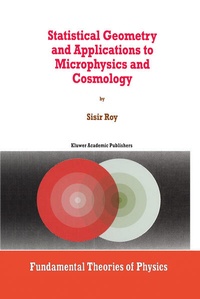
Statistical Geometry and Applications to Microphysics and Cosmology
Published on 31. January 1998
Book
Hardback
XI, 251 pages
978-0-7923-4907-5 (ISBN)
Description
Recent results from high-energy scattering and theoretical developments of string theory require a change in our understanding of the basic structure of space-time. This book is about the advancement of ideas on the stochastic nature of space-time from the 1930s onward. In particular, the author promotes the concept of space as a set of hazy lumps, first introduced by Karl Menger, and constructs a novel framework for statistical behaviour at the microlevel. The various chapters address topics such as space-time fluctuation and random potential, non-local fields, and the origin of stochasticity. Implications in astro-particle physics and cosmology are also explored.
Audience: This volume will be of interest to physicists, chemists and mathematicians involved in particle physics, astrophysics and cosmology.
Audience: This volume will be of interest to physicists, chemists and mathematicians involved in particle physics, astrophysics and cosmology.
Reviews / Votes
` ... of interest to physicists, mathematicians and chemists interested in particle physics, astrophysics, and cosmology.pb'Zentralblatt MATH, 929 (2000)
More details
Series
Edition
1998 ed.
Language
English
Place of publication
Dordrecht
Netherlands
Target group
Professional and scholarly
Research
Illustrations
XI, 251 p.
Dimensions
Height: 241 mm
Width: 160 mm
Thickness: 20 mm
Weight
571 gr
ISBN-13
978-0-7923-4907-5 (9780792349075)
DOI
10.1007/978-94-011-5230-3
Schweitzer Classification
Other editions
Additional editions
Book
10/2012
Springer
€106.99
Shipment within 15-20 days
Content
1 Introduction and Historical Survey.- 1.1 Introduction.- 1.2 Beginnings.- 1.3 Menger 1942.- 1.4 Rosen 1947.- 1.5 Mathematical developments 1956-1961.- 1.6 Blokhintsev and Takano 1960-1961.- 1.7 Random metrics.- 1.8 Ingraham 1966.- 1.9 New developments 1975 and later.- 2 Statistical Behavior of Microparticles.- 2.1 Microparticles and Quantum Mechanics.- 2.2 Fluctuation of Space-Time Metric.- 2.3 Decoherence in Quantum Mechanics.- 2.4 Frame dependence of Scattering Matrix.- 2.5 E-P-R Correlations.- 2.6 4? Periodicity of Spinor Wave Function.- 3 Space-Time Fluctuation and Random Potential.- 3.1 Introduction.- 3.2 Langrangian Mechanics.- 3.3 Lamb Shift and Hydrogen Atom.- 3.4 Fifth Force.- 3.5 Origin of Quantum Potential.- 3.6 Quantum Statistics and Random Trajectories.- 3.7 Quark Confinement.- 4 Non-Local Fields.- 4.1 Extended Elementary Objects.- 4.2 Internal Variable and Fluctuation of Space-Time Metric.- 4.3 Quantum Geometry.- 4.4 Probabilistic Finsler Geometry.- 4.5 Local Heat Energy and Local Temperature.- 5 Astro-Particle Physics.- 5.1 Acceleration Mechanism.- 5.2 Highest Energy Cosmic Ray Spectrum.- 5.3 Propagation of Light in a Dissipative Maxwell Vacuum.- 6 Einstein Equation for Gravitational Field.- 6.1 Einstein Equation and Fluctuation of g?v.- 6.2 Turbulent Gravitational Field and Cosmological Issues.- 6.3 Possible Implications.- 7 Origin of Stochasticity.- 7.1 Introduction.- 7.2 Random Zero-Point Field.- 7.3 Stochastic Strings.- 7.4 New Correspondence Principle.- 7.5 Stochastic Background Force and Origin of Quantization.- 8 Possible Implications.- 8.1 Prologue.- 8.2 Quantum Fluctuation.- 8.3 Limitations of the Measurement of Space-Time Distances.- 8.4 Relativistic Cosmology and Time Singularity.- 9 Epilogue: New Dialogue of Man With Nature.- 9.1Fuzziness in Space-Time.- 9.2 Spontaneity, Order and Wholeness.