

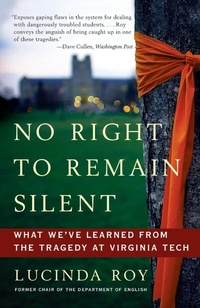
No Right to Remain Silent
What We've Learned from the Tragedy at Virginia Tech
Published on 30. March 2010
Book
Paperback/Softback
336 pages
978-0-307-58770-1 (ISBN)
Description
The world watched in horror in April 2007 when Virginia Tech student Seung-Hui Cho went on a killing rampage that resulted in the deaths of thirty-two students and faculty members before he ended his own life.
Former Virginia Tech English department chair and distinguished professor Lucinda Roy saw the tragedy unfold on the TV screen in her home and had a terrible realization. Cho was the student she had struggled to get to know-the loner who found speech torturous. After he had been formally asked to leave a poetry class in which he had shared incendiary work that seemed directed at his classmates and teacher, Roy began the difficult task of working one-on-one with him in a poetry tutorial. During those months, a year and a half before the massacre, Roy came to realize that Cho was more than just a disgruntled young adult experimenting with poetic license; he was, in her opinion, seriously depressed and in urgent need of intervention.
But when Roy approached campus counseling as well as others in the university about Cho, she was repeatedly told that they could not intervene unless a student sought counseling voluntarily. Eventually, Roy's efforts to persuade Cho to seek help worked. Unbelievably, on the three occasions he contacted the counseling center staff, he did not receive a comprehensive evaluation by them-a startling discovery Roy learned about after Cho's death. More revelations were to follow. After responding to questions from the media and handing over information to law enforcement as instructed by Virginia Tech, Roy was shunned by the administration. Papers documenting Cho's interactions with campus counseling were lost. The university was suddenly on the defensive.
Was the university, in fact, partially responsible for the tragedy because of the bureaucratic red tape involved in obtaining assistance for students with mental illness, or was it just, like many colleges, woefully underfunded and therefore underequipped to respond to such cases? Who was Seung-Hui Cho? Was he fully protected under the constitutional right to freedom of speech, or did his writing and behavior present serious potential threats that should have resulted in immediate intervention? How can we balance students' individual freedom with the need to protect the community? These are the questions that have haunted Roy since that terrible day.
No Right to Remain Silent is one teacher's cri de coeur-her dire warning that given the same situation today, two years later, the ending would be no less terrifying and no less tragic.
Former Virginia Tech English department chair and distinguished professor Lucinda Roy saw the tragedy unfold on the TV screen in her home and had a terrible realization. Cho was the student she had struggled to get to know-the loner who found speech torturous. After he had been formally asked to leave a poetry class in which he had shared incendiary work that seemed directed at his classmates and teacher, Roy began the difficult task of working one-on-one with him in a poetry tutorial. During those months, a year and a half before the massacre, Roy came to realize that Cho was more than just a disgruntled young adult experimenting with poetic license; he was, in her opinion, seriously depressed and in urgent need of intervention.
But when Roy approached campus counseling as well as others in the university about Cho, she was repeatedly told that they could not intervene unless a student sought counseling voluntarily. Eventually, Roy's efforts to persuade Cho to seek help worked. Unbelievably, on the three occasions he contacted the counseling center staff, he did not receive a comprehensive evaluation by them-a startling discovery Roy learned about after Cho's death. More revelations were to follow. After responding to questions from the media and handing over information to law enforcement as instructed by Virginia Tech, Roy was shunned by the administration. Papers documenting Cho's interactions with campus counseling were lost. The university was suddenly on the defensive.
Was the university, in fact, partially responsible for the tragedy because of the bureaucratic red tape involved in obtaining assistance for students with mental illness, or was it just, like many colleges, woefully underfunded and therefore underequipped to respond to such cases? Who was Seung-Hui Cho? Was he fully protected under the constitutional right to freedom of speech, or did his writing and behavior present serious potential threats that should have resulted in immediate intervention? How can we balance students' individual freedom with the need to protect the community? These are the questions that have haunted Roy since that terrible day.
No Right to Remain Silent is one teacher's cri de coeur-her dire warning that given the same situation today, two years later, the ending would be no less terrifying and no less tragic.
More details
Language
English
Place of publication
New York
United States
Publishing group
Random House USA Inc
Product notice
Paperback (trade)
Dimensions
Height: 203 mm
Width: 132 mm
Thickness: 18 mm
Weight
378 gr
ISBN-13
978-0-307-58770-1 (9780307587701)
Copyright in bibliographic data and cover images is held by Nielsen Book Services Limited or by the publishers or by their respective licensors: all rights reserved.
Schweitzer Classification
Other editions
Additional editions
E-Book
03/2009
1st Edition
Crown
€7.99
Available for download
Person
Lucinda Roy