

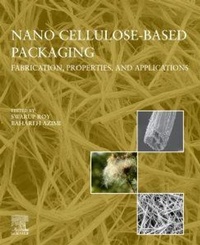
Nanocellulose-Based Packaging
Fabrication, Properties, and Applications
Will be published approx. on 1. November 2026
Book
Paperback/Softback
400 pages
978-0-443-45607-7 (ISBN)
Description
Nanocellulose-based Packaging: Fabrication, Properties, and Applications provides a comprehensive overview of cellulose nanomaterials and their applications in the packaging industry, emphasizing their role in developing sustainable and high-performance materials. The book begins by reviewing the fundamental concepts of nanocellulose, addressing its unique properties and recent advancements in the field. The following chapters explore several different applications, including its use in films, coatings, and active packaging systems. The use of natural additives such as plant extracts, polysaccharides, and proteins is also discussed, highlighting how these components can improve the functionality of nanocellulose-based materials. The final chapters discuss the challenges of industrializing nanocellulose production, addressing the economic viability and market potential of these materials. Regulatory and safety considerations are also discussed, providing an in-depth analysis of the broader implications of using nanocellulose in packaging applications. This book is a valuable resource for researchers and professionals in the fields of materials science, nanotechnology, and packaging technology, interested in a comprehensive overview of fundamentals, advances, and future opportunities in nanocellulose-based packaging.
More details
Language
English
Place of publication
Philadelphia
United States
Target group
Professional and scholarly
Product notice
Paperback (trade)
Unsewn / adhesive bound
Dimensions
Height: 235 mm
Width: 191 mm
Weight
449 gr
ISBN-13
978-0-443-45607-7 (9780443456077)
Copyright in bibliographic data and cover images is held by Nielsen Book Services Limited or by the publishers or by their respective licensors: all rights reserved.
Schweitzer Classification
Persons
Dr. Swarup Roy is currently working as an Assistant Professor at the Department of Food Technology and Nutrition, Lovely Professional University, India. He completed his PhD degree as a DST INSPIRE Fellow from University of Kalyani, India (2011-2016). He worked on microbial biosynthesis of metallic nanoparticles, fabrication bio-nanocomposite materials. During his postdoctoral research he worked on fabrication of bio-composite films in active and intelligent food packaging films. His current research work is focused on the preparation and application of biopolymer-based functional composite material for packaging applications. He is recognized by Stanford University's list of the world's Top 2% of the Most-Cited Scientists in Single Year and career Citation Impact.
Dr. Bahareh Azimi is an Assistant Professor at the Department of Civil and Industrial Engineering at the University of Pisa, Italy. She holds M.Sc. and Ph.D. degrees in Textile Engineering from Amirkabir University of Technology, Tehran, Iran. Since 2013, she has collaborated with several prestigious institutions, including the University of Pisa (Italy), Federal University of Sergipe (Brazil), and Massachusetts Institute of Technology (USA), as a visiting and postdoctoral researcher.
Her research focuses on fabricating and characterizing micro/nanofibers and particles using electrospinning and dry-wet spinning techniques, with applications in biomedical fields such as wound dressing, drug delivery, and tissue engineering, particularly in otology and dermatology. She has also contributed to the development of polymeric and composite materials for regenerative medicine, including electrically responsive biomaterials for nanomedicine applications.
Dr. Azimi's work integrates materials science and biomedical engineering, aiming to develop functionalized and antimicrobial materials for soft tissue applications. Her expertise spans piezoelectric nanostructured materials, biotransducers, and smart scaffolds designed to enhance therapeutic strategies and improve healthcare outcomes.
Dr. Bahareh Azimi is an Assistant Professor at the Department of Civil and Industrial Engineering at the University of Pisa, Italy. She holds M.Sc. and Ph.D. degrees in Textile Engineering from Amirkabir University of Technology, Tehran, Iran. Since 2013, she has collaborated with several prestigious institutions, including the University of Pisa (Italy), Federal University of Sergipe (Brazil), and Massachusetts Institute of Technology (USA), as a visiting and postdoctoral researcher.
Her research focuses on fabricating and characterizing micro/nanofibers and particles using electrospinning and dry-wet spinning techniques, with applications in biomedical fields such as wound dressing, drug delivery, and tissue engineering, particularly in otology and dermatology. She has also contributed to the development of polymeric and composite materials for regenerative medicine, including electrically responsive biomaterials for nanomedicine applications.
Dr. Azimi's work integrates materials science and biomedical engineering, aiming to develop functionalized and antimicrobial materials for soft tissue applications. Her expertise spans piezoelectric nanostructured materials, biotransducers, and smart scaffolds designed to enhance therapeutic strategies and improve healthcare outcomes.
Content
1. Introduction to cellulose nanofiber
2. Cellulose nanomaterial films and coatings
3. Characterization and properties of cellulose nanofiber
4. Barrier Properties of Cellulose nanofiber
5. Cellulose nanofiber based active packaging
6. Cellulose nanofiber as a reinforcement material in developing packaging materials
7. Plant extract added cellulose nanofiber-based packaging
8. Polysaccharide incorporated cellulose nanofiber-based packaging
9. Protein and cellulose nanofiber-based packaging
10. Bioplastics and cellulose nanofiber-based packaging
11. Cellulose nanofiber-based intelligent food packaging sensor
12. Impact of cellulose nanofiber-based packaging on food shelf life
13. Industrialization of cellulose nanofiber-based packaging
14. Economic viability, market potential and sustainability aspect of cellulose nanofiber
15. Regulation, Safety, and future outlook in cellulose nanofiber packaging
2. Cellulose nanomaterial films and coatings
3. Characterization and properties of cellulose nanofiber
4. Barrier Properties of Cellulose nanofiber
5. Cellulose nanofiber based active packaging
6. Cellulose nanofiber as a reinforcement material in developing packaging materials
7. Plant extract added cellulose nanofiber-based packaging
8. Polysaccharide incorporated cellulose nanofiber-based packaging
9. Protein and cellulose nanofiber-based packaging
10. Bioplastics and cellulose nanofiber-based packaging
11. Cellulose nanofiber-based intelligent food packaging sensor
12. Impact of cellulose nanofiber-based packaging on food shelf life
13. Industrialization of cellulose nanofiber-based packaging
14. Economic viability, market potential and sustainability aspect of cellulose nanofiber
15. Regulation, Safety, and future outlook in cellulose nanofiber packaging