

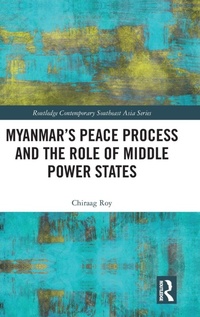
Myanmar's Peace Process and the Role of Middle Power States
1st Edition
Published on 3. June 2022
Book
Hardback
150 pages
978-1-032-15713-9 (ISBN)
Description
This book explores middle power engagement in peace processes through the cases of Australian, Japanese and Norwegian engagement in Myanmar's peace process, a core event in Myanmar's contemporary recent political history.
The book asks to what extent, and how, middle powers have engaged in Myanmar's peace process as a form of peacemaking entrepreneurship. Underpinning this study is a concern for the lack of clarity surrounding the middle power concept. Traditional conceptions of middle powers, steeped in idealist thinking, locate such states as capable peacemakers, without elucidating the motivations that drive middle powers to peacemaking beyond mere status seeking. Drawing on recent fieldwork interviews from within Myanmar as well as political economy literature, the author scrutinises this notion while concomitantly offering an incisive analysis of Myanmar's peace process. Based on the Myanmar context, the book argues that middle powers can better be conceptualised as "peace-making entrepreneurs," as actors that use peacemaking as an instrumental tool to cement their status and craft an image, which they can then trade upon to secure additional, namely, commercial, benefits. Significantly, this notion of peacemaking entrepreneurship problematises core theoretical assumptions of middle powers as capable peacemakers, presenting implications for future scholarship on middle powers.
A timely addition as Myanmar continues to grapple with its own future, the book is located within the fields of International Relations and Development Studies. It will be of interest to researchers studying Asian Studies, Peace and Conflict Studies, and Myanmar Politics.
The book asks to what extent, and how, middle powers have engaged in Myanmar's peace process as a form of peacemaking entrepreneurship. Underpinning this study is a concern for the lack of clarity surrounding the middle power concept. Traditional conceptions of middle powers, steeped in idealist thinking, locate such states as capable peacemakers, without elucidating the motivations that drive middle powers to peacemaking beyond mere status seeking. Drawing on recent fieldwork interviews from within Myanmar as well as political economy literature, the author scrutinises this notion while concomitantly offering an incisive analysis of Myanmar's peace process. Based on the Myanmar context, the book argues that middle powers can better be conceptualised as "peace-making entrepreneurs," as actors that use peacemaking as an instrumental tool to cement their status and craft an image, which they can then trade upon to secure additional, namely, commercial, benefits. Significantly, this notion of peacemaking entrepreneurship problematises core theoretical assumptions of middle powers as capable peacemakers, presenting implications for future scholarship on middle powers.
A timely addition as Myanmar continues to grapple with its own future, the book is located within the fields of International Relations and Development Studies. It will be of interest to researchers studying Asian Studies, Peace and Conflict Studies, and Myanmar Politics.
More details
Series
Language
English
Place of publication
London
United Kingdom
Publishing group
Taylor & Francis Ltd
Target group
Professional and scholarly
Academic and Postgraduate
Dimensions
Height: 240 mm
Width: 161 mm
Thickness: 14 mm
Weight
417 gr
ISBN-13
978-1-032-15713-9 (9781032157139)
Copyright in bibliographic data and cover images is held by Nielsen Book Services Limited or by the publishers or by their respective licensors: all rights reserved.
Schweitzer Classification
Other editions
Additional editions
Book
08/2024
1st Edition
Routledge
€62.70
Shipment within 10-20 days
E-Book
06/2022
1st Edition
Routledge
€55.49
Available for download
E-Book
06/2022
1st Edition
Routledge
€55.49
Available for download
Person
Chiraag Roy is an International Relations scholar with research interests in International Relations theory, Asia-Pacific politics, Australian foreign policy and middle power theory.
Content
Acknowledgments
List of acronyms
Preface
Introduction
PART 1
Myanmar's peace process and the relevance of middle powers
1 Myanmar's domestic and geopolitical context
2 Theory on middle powers
3 Political economy lenses
PART 2
The peacemaking landscape - International engagement with Myanmar's peace process
4 Major powers in Myanmar's peace process
5 Identity and middle power peacemaking in Myanmar
6 The political economy of middle-power peacemaking in Myanmar
PART 3
Contesting the peacemaking image of middle powers
7 Middle powers as "peacemaking entrepreneurs" in Myanmar's peace process
8 Where to for middle-power theory?
Conclusion
Appendix 1 Interview Participants
Appendix 2 Interview guiding questions
References
Index
List of acronyms
Preface
Introduction
PART 1
Myanmar's peace process and the relevance of middle powers
1 Myanmar's domestic and geopolitical context
2 Theory on middle powers
3 Political economy lenses
PART 2
The peacemaking landscape - International engagement with Myanmar's peace process
4 Major powers in Myanmar's peace process
5 Identity and middle power peacemaking in Myanmar
6 The political economy of middle-power peacemaking in Myanmar
PART 3
Contesting the peacemaking image of middle powers
7 Middle powers as "peacemaking entrepreneurs" in Myanmar's peace process
8 Where to for middle-power theory?
Conclusion
Appendix 1 Interview Participants
Appendix 2 Interview guiding questions
References
Index