

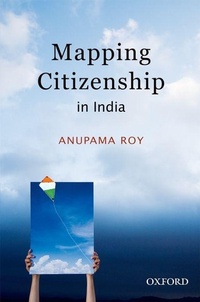
Mapping Citizenship in India
1st Edition
Published on 21. October 2010
Book
Hardback
252 pages
978-0-19-806674-3 (ISBN)
Description
This study contributes to the ongoing debate on the theory of citizenship. It traces the Citizenship Act of India, 1955-from its inception, through various amendments (1986, 2003, and 2005), its connection with other significant laws such as the Abducted Persons Recovery and Rehabilitation Act (1949) and the Illegal Migrants Determination by Tribunals Act (1983), and relevant judgments-to see how citizenship unfolded among differentially located individuals, communities, and groups. The book identifies the amendments in the Citizenship Act as transitions which are, however, not the manifestations of an irreversible, continuous historical process of progression, but moments which are enframed by major historical choices and decisions. The liminal categories of citizenship, which emerged at the commencement of the Indian Republic in the context of the partition, show that the question of legal membership remained a vexed one. Both the contest over citizenship and its resolution were embedded in processes of state-formation and institutional ordering, as seen in the ways in which institutions perceived, interpreted, and eventually resolved their respective powers of decision-making over citizenship matters.
The amendments in 1986 and 2003 manifest continued embeddedness of citizenship in the politics of place-making, the marking out of ethno-spaces, and the politics of neo-liberalism, setting in motion processes by which the association of citizenship with descent is affirmed, even as the category of overseas citizenship is recognized in law.
The amendments in 1986 and 2003 manifest continued embeddedness of citizenship in the politics of place-making, the marking out of ethno-spaces, and the politics of neo-liberalism, setting in motion processes by which the association of citizenship with descent is affirmed, even as the category of overseas citizenship is recognized in law.
More details
Language
English
Place of publication
New Delhi
India
Target group
Professional and scholarly
Students, teachers, and researchers of law, political science, sociology, history, development studies, and human rights; and social activists.
Product notice
sewn/stitched
Paper over boards
With dust jacket
Dimensions
Height: 234 mm
Width: 155 mm
Thickness: 33 mm
Weight
699 gr
ISBN-13
978-0-19-806674-3 (9780198066743)
Copyright in bibliographic data and cover images is held by Nielsen Book Services Limited or by the publishers or by their respective licensors: all rights reserved.
Schweitzer Classification
Other editions
Additional editions
Person
Anupama Roy is Associate Professor, Centre for Political Studies, Jawaharlal Nehru University, New Delhi.
Content
INTRODUCTION: 'CITIZEN/OUTSIDER': ENFRAMING THE CITIZEN IN CONTEMPORARY TIMES; CHAPTER 1: CITIZENSHIP OF INDIA ACT, AND LIMINAL CITIZENSHIP, AND THE COMMENCEMENT OF THE REPUBLIC; CHAPTER 2: THE CITIZENSHIP (AMENDMENT) ACT OF 1986: THE 'POLITICS OF PLACE-MAKING' AND SUSPECT CITIZENSHIP; CHAPTER 3: 'BLOOD AND BELONGING': THE CITIZENSHIP (AMENDMENT) ACT 2003, AND THE DECEPTION OF DE-TERRITORIALITY; CONCLUSION: CITIES, RESIDUAL CITIZENS, AND SOCIAL CITIZENSHIP; APPENDICES; BIBLIOGRAPHY