

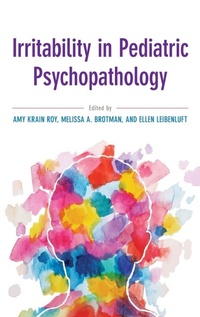
Irritability in Pediatric Psychopathology
Published on 30. May 2019
Book
Hardback
328 pages
978-0-19-084680-0 (ISBN)
Description
Pediatric irritability, defined as increased proneness to anger relative to peers, is among the most common reasons for mental health referrals. The past fifteen years have witnessed a dramatic rise in the empirical study of pediatric irritability with the goal of developing more effective methods of assessing and treating these impaired youth.
Irritability in Pediatric Psychopathology offers a comprehensive overview of this work, approaching the topic from multiple perspectives and disciplines including child psychiatry, clinical psychology, developmental psychology, and neuroscience. Offering five sections composed of chapters written by international experts, the book begins be defining pediatric irritability, reviewing its prevalence, current assessment methods, and novel behavioral and psychophysiological indicators. The second section reviews the literature on the development of pediatric irritability from preschool age through adolescence and young adulthood. The third section summarizes the current evidence for genetic and neurobiological factors contributing to pediatric irritability, while the fourth reviews its presentation transdiagnostically across mood and anxiety disorders, disruptive behavior disorders, and autism. Finally, the book concludes with a presentation of evidence-based psychological and pharmacological interventions. Irritability in Pediatric Psychopathology is an essential resource for researchers, clinicians, and trainees working with children and adolescents.
Irritability in Pediatric Psychopathology offers a comprehensive overview of this work, approaching the topic from multiple perspectives and disciplines including child psychiatry, clinical psychology, developmental psychology, and neuroscience. Offering five sections composed of chapters written by international experts, the book begins be defining pediatric irritability, reviewing its prevalence, current assessment methods, and novel behavioral and psychophysiological indicators. The second section reviews the literature on the development of pediatric irritability from preschool age through adolescence and young adulthood. The third section summarizes the current evidence for genetic and neurobiological factors contributing to pediatric irritability, while the fourth reviews its presentation transdiagnostically across mood and anxiety disorders, disruptive behavior disorders, and autism. Finally, the book concludes with a presentation of evidence-based psychological and pharmacological interventions. Irritability in Pediatric Psychopathology is an essential resource for researchers, clinicians, and trainees working with children and adolescents.
Reviews / Votes
Thistimely volume explores anger symptomatology in children and adolescents. Currently one of the most common reasons for pediatric referral for psychological evaluation, irritability is a common symptom in multiple disordersThe essays examine and report on how irritability presents itself across many disorders; consider potential long-term consequences; and make recommendations for treatment. This book will be most useful to clinicians, though select essays may be useful to scholars of development psychology. * CHOICE * A state-of-the-science book on pediatric irritability by leading experts in the field.While irritability is a common referral complaint that brings parents and children to mental health professionals, much needs to be understood about its significance across mood and behavioral disorders. This book provides a valuable and needed resource to guide assessment and treatment. * Mary K. Alvord, PhD, Director, Alvord, Baker & Associates and co-author of Conquer Negative Thinking for Teens and Resilience Builder Program for Children and Adolescents * Irritability is finally getting the scientific attention it deserves. This book provides the latest translational perspective on this dimension of human behavior from the fields of child psychiatry, clinical neuroscience, and developmental psychopathology. It will be valuable to researchers, but it will also have a place for helping clinicians and informed parents to understand a critical feature of psychopathology. * Erika E. Forbes, PhD, Professor of Psychiatry, Psychology, Pediatrics, and Clinical & Translational Science, University of Pittsburgh * The complex transdiagnostic manifestations of pediatric irritability are superbly addressed in this landmark compilation of perspectives by the leaders in the field. This incomparable resource on what is currently known delineates the research agendas in epidemiology, phenomenology, assessment, neuroimaging, genetics, and therapeutics over the next decade. Essential reading for all clinicians and investigators focused on the mental health of children and adolescents. * F. Xavier Castellanos, MD, Brooke and Daniel Neidich Professor of Child and Adolescent Psychiatry, Department of Child and Adolescent Psychiatry, Hassenfeld Children's Hospital at NYU Langone *More details
Language
English
Place of publication
New York
United States
Target group
Professional and scholarly
Dimensions
Height: 240 mm
Width: 161 mm
Thickness: 22 mm
Weight
652 gr
ISBN-13
978-0-19-084680-0 (9780190846800)
Copyright in bibliographic data and cover images is held by Nielsen Book Services Limited or by the publishers or by their respective licensors: all rights reserved.
Schweitzer Classification
Other editions
Additional editions
Amy Krain Roy | Melissa A. Brotman | Ellen Leibenluft
Irritability in Pediatric Psychopathology
E-Book
04/2019
1st Edition
OUP eBook
€49.99
Available for download
Amy Krain Roy | Melissa A. Brotman | Ellen Leibenluft
Irritability in Pediatric Psychopathology
E-Book
04/2019
1st Edition
OUP eBook
€49.99
Available for download
Persons
Amy K. Roy is an Associate Professor of Psychology at Fordham University where she also serves as the Director of the Integrative Neuroscience Program. She has been the recipient of numerous awards including two Young Investigator Awards from the Brain and Behavior Research Foundation (formerly NARSAD), an Anxiety Disorders Association of America Career Development Travel Award, and a New Clinical Drug Evaluation Unit New Investigator's Award. She has authored/co-authored over 40 peer-reviewed papers and has edited a book on Pediatric Anxiety Disorders.
Melissa A. Brotman is the Director of Neuroscience and Novel Therapeutics, Section on Mood Dysregulation and Neuroscience, Emotion and Development Branch at the National Institute of Mental Health. Currently, her developmental, translational research integrates basic and clinical approaches to the study of mood disorders in children and adolescents. Specifically, she uses affective neuroscience techniques (e.g., fMRI, behavioral
paradigms) to understand the brain-based mechanisms underlying severe irritability in youth, and then uses that pathophysiological knowledge to guide the development of novel targeted interventions. She is on the Editorial Board of the Journal of Affective Disorders. Finally, mentoring is an essential aspect of her career; she was recognized in September 2016 when she received the NIMH Outstanding Mentor Award.
Ellen Leibenluft is a Senior Investigator at the National Institute of Mental Health Intramural Research Program. Her contributions include identifying chronic irritability as an important clinical problem distinct from pediatric bipolar disorder, and using cognitive neuroscience to elucidate the nosology and pathophysiology of pediatric mental disorders, thus enabling the development of novel interventions. She has authored over 250 publications and served as an Editor and Editorial Board member for multiple journals in her field. She has received many awards, including
the NIMH Director's Merit Award and election to the National Academy of Medicine.
Melissa A. Brotman is the Director of Neuroscience and Novel Therapeutics, Section on Mood Dysregulation and Neuroscience, Emotion and Development Branch at the National Institute of Mental Health. Currently, her developmental, translational research integrates basic and clinical approaches to the study of mood disorders in children and adolescents. Specifically, she uses affective neuroscience techniques (e.g., fMRI, behavioral
paradigms) to understand the brain-based mechanisms underlying severe irritability in youth, and then uses that pathophysiological knowledge to guide the development of novel targeted interventions. She is on the Editorial Board of the Journal of Affective Disorders. Finally, mentoring is an essential aspect of her career; she was recognized in September 2016 when she received the NIMH Outstanding Mentor Award.
Ellen Leibenluft is a Senior Investigator at the National Institute of Mental Health Intramural Research Program. Her contributions include identifying chronic irritability as an important clinical problem distinct from pediatric bipolar disorder, and using cognitive neuroscience to elucidate the nosology and pathophysiology of pediatric mental disorders, thus enabling the development of novel interventions. She has authored over 250 publications and served as an Editor and Editorial Board member for multiple journals in her field. She has received many awards, including
the NIMH Director's Merit Award and election to the National Academy of Medicine.
Editor
Director, Integrative Neuroscience ProgramDirector, Integrative Neuroscience Program, Fordham University
Director, Neuroscience and Novel TherapeuticsDirector, Neuroscience and Novel Therapeutics, Section on Mood Dysregulation and Neuroscience, Emotion and Development Branch, NIMH
Chief, Section on Bipolar Spectrum Disorders, Emotion and DevelopmentChief, Section on Bipolar Spectrum Disorders, Emotion and Development, National Institute of Mental Health
Content
1. Introduction
Amy Krain Roy, Melissa A. Brotman, and Ellen Leibenluft
2. Epidemiology of Pediatric Irritability
Giovanni Abrahao Salum
3. Measurement of Irritability in Children and Adolescents
Merelise Ametti and Robert R. Althoff
4. Behavioral and Psychophysiological Investigations of Irritability
Mariah DeSerisy and Christen M. Deveney
5. Early Childhood Irritability: Using a Neurodevelopmental Framework to Inform Clinical Understanding
M. Catalina Camacho, Lauren S. Wakschlag, and Susan B. Perlman
6. Irritability Development from Middle Childhood through Adolescence: Trajectories, Concurrent Conditions, and Outcomes
Cynthia Kiefer and Jillian Lee Wiggins
7. On being Mad, Sad, and Very Young
Michael Potegal
8. Genetics of Pediatric Irritability
Meridith L. Eastman, Ashlee A. Moore, and Roxann Roberson-Nay
9. Neural Findings in Pediatric Irritability
Emily Hirsch and Leslie Hulvershorn
10. Irritability and Disruptive Behavior Disorders
Joel Stoddard, Valerie Scelsa, and Soonjo Hwang
11. Irritability in Pediatric Psychopathology - Autism
Carla A. Mazefsky, Taylor N. Day, and Joshua Golt
12. Irritability in Mood and Anxiety Disorders
Argyris Stringaris and Pablo Vidal-Ribas Belil
13. Behavioral Interventions for Irritability in Children and Adolescents
Denis G. Sukhodolsky, Theresa R. Gladstone, Carolyn L. Marsh, and Kimberly R. Cimino
14. Pharmacological Treatment of Pediatric Irritability
Daniel P. Dickstein and Rachel E. Christensen
Amy Krain Roy, Melissa A. Brotman, and Ellen Leibenluft
2. Epidemiology of Pediatric Irritability
Giovanni Abrahao Salum
3. Measurement of Irritability in Children and Adolescents
Merelise Ametti and Robert R. Althoff
4. Behavioral and Psychophysiological Investigations of Irritability
Mariah DeSerisy and Christen M. Deveney
5. Early Childhood Irritability: Using a Neurodevelopmental Framework to Inform Clinical Understanding
M. Catalina Camacho, Lauren S. Wakschlag, and Susan B. Perlman
6. Irritability Development from Middle Childhood through Adolescence: Trajectories, Concurrent Conditions, and Outcomes
Cynthia Kiefer and Jillian Lee Wiggins
7. On being Mad, Sad, and Very Young
Michael Potegal
8. Genetics of Pediatric Irritability
Meridith L. Eastman, Ashlee A. Moore, and Roxann Roberson-Nay
9. Neural Findings in Pediatric Irritability
Emily Hirsch and Leslie Hulvershorn
10. Irritability and Disruptive Behavior Disorders
Joel Stoddard, Valerie Scelsa, and Soonjo Hwang
11. Irritability in Pediatric Psychopathology - Autism
Carla A. Mazefsky, Taylor N. Day, and Joshua Golt
12. Irritability in Mood and Anxiety Disorders
Argyris Stringaris and Pablo Vidal-Ribas Belil
13. Behavioral Interventions for Irritability in Children and Adolescents
Denis G. Sukhodolsky, Theresa R. Gladstone, Carolyn L. Marsh, and Kimberly R. Cimino
14. Pharmacological Treatment of Pediatric Irritability
Daniel P. Dickstein and Rachel E. Christensen