

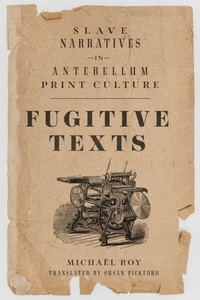
Fugitive Texts
Slave Narratives in Antebellum Print Culture
Published on 6. September 2022
Book
Hardback
280 pages
978-0-299-33840-4 (ISBN)
Description
Antebellum slave narratives have taken pride of place in the American literary canon. Once ignored, disparaged, or simply forgotten, the autobiographical narratives of Frederick Douglass, Harriet Jacobs, and other formerly enslaved men and women are now widely read and studied. One key aspect of the genre, however, has been left unexamined: its materiality. What did original editions of slave narratives look like? How were these books circulated? Who read them?
In Fugitive Texts, MichaEl Roy offers the first book-length study of the slave narrative as a material artifact. Drawing on a wide range of sources, he reconstructs the publication histories of a number of famous and lesser-known narratives, placing them against the changing backdrop of antebellum print culture. Slave narratives, he shows, were produced through a variety of print networks. Remarkably few were published under the full control of white-led antislavery societies; most were self-published and distributed by the authors, while some were issued by commercial publishers who hoped to capitalize on the success of Harriet Beecher Stowe's Uncle Tom's Cabin. The material lives of these texts, Roy argues, did not end within the pages. Antebellum slave narratives were "fugitive texts" apt to be embodied in various written, oral, and visual forms.
Published to rave reviews in French, Fugitive Texts illuminates the heterogeneous nature of a genre often described in monolithic terms and ultimately paves the way for a redefinition of the literary form we have come to recognize as "the slave narrative."
In Fugitive Texts, MichaEl Roy offers the first book-length study of the slave narrative as a material artifact. Drawing on a wide range of sources, he reconstructs the publication histories of a number of famous and lesser-known narratives, placing them against the changing backdrop of antebellum print culture. Slave narratives, he shows, were produced through a variety of print networks. Remarkably few were published under the full control of white-led antislavery societies; most were self-published and distributed by the authors, while some were issued by commercial publishers who hoped to capitalize on the success of Harriet Beecher Stowe's Uncle Tom's Cabin. The material lives of these texts, Roy argues, did not end within the pages. Antebellum slave narratives were "fugitive texts" apt to be embodied in various written, oral, and visual forms.
Published to rave reviews in French, Fugitive Texts illuminates the heterogeneous nature of a genre often described in monolithic terms and ultimately paves the way for a redefinition of the literary form we have come to recognize as "the slave narrative."
More details
Language
English
Place of publication
Wisconsin
United States
Target group
Professional and scholarly
Product notice
Laminated cover
Illustrations
14 b&w illustrations
Dimensions
Height: 229 mm
Width: 152 mm
Thickness: 14 mm
Weight
487 gr
ISBN-13
978-0-299-33840-4 (9780299338404)
Copyright in bibliographic data and cover images is held by Nielsen Book Services Limited or by the publishers or by their respective licensors: all rights reserved.
Schweitzer Classification
Persons
Michaël Roy is an associate professor of American studies at Université Paris Nanterre and a fellow of the Institut Universitaire de France. His work has appeared in journals such as Slavery & Abolition, MELUS, and Papers of the Bibliographical Society of America. He is the editor of Frederick Douglass in Context.
Content
Prologue - Runaway Bestsellers?
Chapter 1 - "The general diffusion of abolition light": The Institutional Origins of the Antebellum Slave Narrative
Raindrops, Autumn Leaves, and Snowflakes: Publishing and Circulating Antislavery Literature in the 1830s
The Narrative of James Williams as Antislavery Propaganda
Faithful Portrait, Lawful Weapon: Charles Ball's Slavery in the United States
Paradoxical Presences: The Narratives of Olaudah Equiano and Chloe Spear
Chapter 2 - "My Narrative is just published": Agency, Itinerancy, and the Slave Narrative
Marginality, Itinerancy, and Reform in Antebellum America
The Transatlantic Journeys of the Narrative of the Life of Frederick Douglass, an American Slave
Reprinting and Recycling the Narrative of William W. Brown, a Fugitive Slave
Other Narratives, Other Trajectories: Henry Bibb, Leonard Black, Sojourner Truth
Chapter 3 - "Quite a sensation": Slave Narratives in the Age of Uncle Tom
"The servile publishers of that day": Antislavery and the Book Trade
The Business of Twelve Years a Slave
Old Friends, New Names: Frederick Douglass and Charles Ball Redux
Incidents in the Life of Incidents in the Life of a Slave Girl
Epilogue - The Slave Narrative Unbound
Chapter 1 - "The general diffusion of abolition light": The Institutional Origins of the Antebellum Slave Narrative
Raindrops, Autumn Leaves, and Snowflakes: Publishing and Circulating Antislavery Literature in the 1830s
The Narrative of James Williams as Antislavery Propaganda
Faithful Portrait, Lawful Weapon: Charles Ball's Slavery in the United States
Paradoxical Presences: The Narratives of Olaudah Equiano and Chloe Spear
Chapter 2 - "My Narrative is just published": Agency, Itinerancy, and the Slave Narrative
Marginality, Itinerancy, and Reform in Antebellum America
The Transatlantic Journeys of the Narrative of the Life of Frederick Douglass, an American Slave
Reprinting and Recycling the Narrative of William W. Brown, a Fugitive Slave
Other Narratives, Other Trajectories: Henry Bibb, Leonard Black, Sojourner Truth
Chapter 3 - "Quite a sensation": Slave Narratives in the Age of Uncle Tom
"The servile publishers of that day": Antislavery and the Book Trade
The Business of Twelve Years a Slave
Old Friends, New Names: Frederick Douglass and Charles Ball Redux
Incidents in the Life of Incidents in the Life of a Slave Girl
Epilogue - The Slave Narrative Unbound