

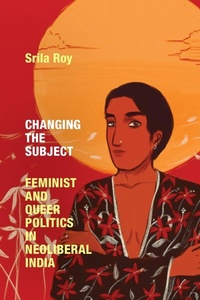
Changing the Subject
Feminist and Queer Politics in Neoliberal India
Published on 21. October 2022
Book
Paperback/Softback
280 pages
978-1-4780-1888-9 (ISBN)
Description
In Changing the Subject Srila Roy maps the rapidly transforming terrain of gender and sexual politics in India under the conditions of global neoliberalism. The consequences of India's liberalization were paradoxical: the influx of global funds for social development and NGOs signaled the co-optation and depoliticization of struggles for women's rights, even as they amplified the visibility and vitalization of queer activism. Roy reveals the specificity of activist and NGO work around issues of gender and sexuality through a decade-long ethnography of two West Bengal organizations, one working on lesbian, bisexual, and transgender issues and the other on rural women's empowerment. Tracing changes in feminist governmentality that were entangled in transnational neoliberalism, Roy shows how historical and highly local feminist currents shaped contemporary queer and nonqueer neoliberal feminisms. The interplay between historic techniques of activist governance and queer feminist governmentality's focus on changing the self offers a new way of knowing feminism-both as always already co-opted and as a transformative force in the world.
Reviews / Votes
"Changing the Subject brilliantly unpacks the different governmentalities at work in contemporary neoliberal West Bengal and within the activist and NGO world. Srila Roy shows that it is precisely within the intimate and complex interaction between processes of governance and the self that the possibility of self-making within and against dominant norms takes place." - Catherine Rottenberg (Sociological Review) "There is no doubt that this is an important and topical book, filling a very real gap. It is provocative in its conceptualisation and therefore an extremely productive addition to multiple areas of inquiry, including neo-liberalism and social movements, queer movements, feminist fields, development studies among others. It invites one to engage with this version of the story to interrogate it and multiply the many other possible stories of this moment in the life of the feminist world-making project." - Sneha Gole (Economic and Political Weekly) "Through her research and critique, she demonstrates powerfully a praxis against neoliberal, nationalist, and nativist logics. Srila Roy's book is a vibrant and richly ethnographic contribution to debates on political futures now." - Bridget Kenny (Anthropology & Humanism) "Roy's groundbreaking work, Changing the Subject, emerges as a beacon. . . . Changing the Subject offers different ways to think of feminism's co-optation in the context of global neoliberalism by thinking of feminism's entanglement with the forms of power, encouraging a deeper understanding of its multifaceted impact on individual transformation and societal change. . . . Thorough, meticulous ethnographic analysis reveals how feminist and queer political organizations negotiate their roles within broader power dynamics, engaging with and transforming prevailing governmentalities." - Kiran Raveendran (Women's Studies) "The proficiency and ease with which [Roy] threads together the fluid entanglements within and between feminism, queerness, neoliberal governmentality and the self, is awe-inspiring; especially for a reader incapable of articulating such deep connections. In addition, theorizing such entanglements and recounting powerful feminist subaltern stories from the margins, has opened new pathways to imagine self-(re)making and feminism in a neoliberal age." - Amya Agarwal (Doing Sociology) "Roy convincingly argues that feminists both in India and elsewhere should not remain attached to a 'proper feminist subject' against whom the self might always be judged as lacking, but rather allow for ambivalence and uncertainty (p. 159)." - Stephanie Clare (Year's Work in Critical and Cultural Theory)More details
Series
Language
English
Place of publication
North Carolina
United States
Target group
Professional and scholarly
Product notice
Paperback (trade)
Illustrations
7 illustrations
Dimensions
Height: 229 mm
Width: 152 mm
Thickness: 16 mm
Weight
407 gr
ISBN-13
978-1-4780-1888-9 (9781478018889)
Copyright in bibliographic data and cover images is held by Nielsen Book Services Limited or by the publishers or by their respective licensors: all rights reserved.
Schweitzer Classification
Other editions
Additional editions

E-Book
08/2022
1st Edition
De Gruyter
€198.99
Available for download
Person
Srila Roy is Professor of Sociology at the University of the Witwatersrand, author of Remembering Revolution: Gender, Violence, and Subjectivity in India's Naxalbari Movement, and editor of New South Asian Feminisms: Paradoxes and Possibilities.
Content
Abbreviations ix
Preface: We, Feminists xi
Acknowledgments xvii
Introduction. Changing the Subject of Indian Feminism 1
1. Indian Feminism in the New Millennium: Co-optation, Entanglement, Intersection 26
2. Queer Activism as Governmentality: Regulating Lesbians, Making Queer 47
3. Queer Self-Fashioning: In, out of, and beyond the Closet 77
4. Feminist Governmentality: Entangled Histories and Empowered Women 101
5. Subaltern Self-Government: Precarious Transformations 132
Conclusion. On Critique and Care 160
Notes 177
References 215
Index 243
Preface: We, Feminists xi
Acknowledgments xvii
Introduction. Changing the Subject of Indian Feminism 1
1. Indian Feminism in the New Millennium: Co-optation, Entanglement, Intersection 26
2. Queer Activism as Governmentality: Regulating Lesbians, Making Queer 47
3. Queer Self-Fashioning: In, out of, and beyond the Closet 77
4. Feminist Governmentality: Entangled Histories and Empowered Women 101
5. Subaltern Self-Government: Precarious Transformations 132
Conclusion. On Critique and Care 160
Notes 177
References 215
Index 243