

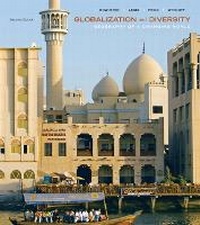
Globalization and Diversity
Geography of a Changing World
2nd Edition
Published on 12. March 2007
Book
Hardback
480 pages
978-0-13-175695-3 (ISBN)
Description
For undergraduate World Regional Geography courses, or for a course on globalization where instructors desire a BRIEF TREATMENT of the CORE IDEAS in World Regional Geography.
Globalization and Diversity 2e is an exciting contemporary approach to World Regional Geography that explicitly acknowledges the geographic changes that accompany today's rapid rate of globalization. The book's unique approach gives students access to the latest ideas, concepts and theories in geography while concurrently developing a strong foundation in the fundamentals of world regions. The book helps professors engender a strong sense of place and an understanding of the connections within and between world regions.
Globalization and Diversity 2e is a briefer version of the popular Diversity Amid Globalization by the same authors. This distillation focuses on core materials that professors and students need in a World Regional Geography course. This process resulted in a dramatic reduction of boxed materials, a consolidation of end-of-chapter materials, and a paring of the chapter length of discussion in the body of the text. The resulting condensed book will be a useful tool for those instructors interested in a briefer text or for those instructors who are concerned about the reading ability of their students.
Globalization and Diversity 2e is an exciting contemporary approach to World Regional Geography that explicitly acknowledges the geographic changes that accompany today's rapid rate of globalization. The book's unique approach gives students access to the latest ideas, concepts and theories in geography while concurrently developing a strong foundation in the fundamentals of world regions. The book helps professors engender a strong sense of place and an understanding of the connections within and between world regions.
Globalization and Diversity 2e is a briefer version of the popular Diversity Amid Globalization by the same authors. This distillation focuses on core materials that professors and students need in a World Regional Geography course. This process resulted in a dramatic reduction of boxed materials, a consolidation of end-of-chapter materials, and a paring of the chapter length of discussion in the body of the text. The resulting condensed book will be a useful tool for those instructors interested in a briefer text or for those instructors who are concerned about the reading ability of their students.
More details
Edition
2nd edition
Language
English
Place of publication
United States
Publishing group
Pearson Education (US)
Target group
Professional and scholarly
Dimensions
Height: 276 mm
Width: 216 mm
Weight
1143 gr
ISBN-13
978-0-13-175695-3 (9780131756953)
Copyright in bibliographic data and cover images is held by Nielsen Book Services Limited or by the publishers or by their respective licensors: all rights reserved.
Schweitzer Classification
Other editions
New editions
Lester Rowntree | Martin Lewis | Marie Price
Globalization and Diversity
Geography of a Changing World: International Edition
Book
02/2010
3rd Edition
Pearson
€111.59
Article exhausted; check for reprint
Previous edition
Lester Rowntree | Martin Lewis | Marie Price
Globalization and Diversity
Geography of a Changing World
Book
09/2004
Pearson
€73.15
Article exhausted; check for reprint
Persons
Les Rowntree teaches both Geography and Environmental Studies at San Jose State University in California, where he recently completed a term as the Chair of the interdisciplinary Department of Environmental Studies. As an environmental geographer, Dr. Rowntree's teaching and research interests focus on international environmental issues, the human dimensions of global change, biodiversity and conservation, and human-caused landscape transformation. He sees world regional geography as a way to engage and inform students by giving them the conceptual tools needed to assess global issues critically in their larger context. Dr. Rowntree has done research in Morocco, Mexico, Australia, and Europe, as well as in his native California. Current writing projects include a book on the natural history of California's Central Coast, along with textbooks in geography and environmental science.
Martin Lewis is a lecturer in International Affairs at Stanford University He has conducted extensive research on environmental geography in the Philippines and on the intellectual history of global geography. His publications include Wagering the Land: Ritual, Capital, and Environmental Degradation in the Cordillera of Northern Luzon, 1900-1986 (1992), and with Karen Wigen, The Myth of Continents: A Critique of Metageography (1997). Dr. Lewis has traveled extensively in East, South, and Southeast Asia. His current research focuses on the geographical dimensions of globalization.
Marie Price is an Associate Professor of Geography and International Affairs at George Washington University A Latin American specialist, Marie has conducted research in Belize, Mexico, Venezuela, Cuba, and Bolivia. She has also traveled widely throughout Latin America and Sub-Saharan Africa. Her studies have explored human migration, natural resource use, environmental conservation, and regional development. Dr. Price brings to Globalization and Diversity a special interest in regions as dynamic spatial constructs that are shaped over time through both global and local forces. Her publications include articles in the Annals of the Association of American Geographers, Geographical Review, Journal of Historical Geography, CLAG Yearbook, Studies in Comparative International Development, the Brookings Institution Series and Focus.
William Wyckoff is a geographer in the Department of Earth Sciences at Montana State University specializing in the cultural and historical geography of North America. He has written and co-edited several books on North American settlement geography, including The Developer's Frontier: The Making of the Western New York Landscape (1988), The Mountainous West: Explorations in Historical Geography (1995) and Colorado: The Making of a Western American Landscape 1860-1940 (1999). In 1990, he received the Burlington Northern Corporation's Award for Outstanding Teaching. In addition, in 2003 he received Montana State's Cox Family Fund for Excellence Faculty Award for Teaching and Scholarship. A World Regional Geography instructor for 18 years, Dr. Wyckoff hopes that the fresh approach taken in Globalization and Diversity will more effectively highlight the tensions evident in the world today as global change impacts particular places and people in dramatic and often unpredictable ways.
Martin Lewis is a lecturer in International Affairs at Stanford University He has conducted extensive research on environmental geography in the Philippines and on the intellectual history of global geography. His publications include Wagering the Land: Ritual, Capital, and Environmental Degradation in the Cordillera of Northern Luzon, 1900-1986 (1992), and with Karen Wigen, The Myth of Continents: A Critique of Metageography (1997). Dr. Lewis has traveled extensively in East, South, and Southeast Asia. His current research focuses on the geographical dimensions of globalization.
Marie Price is an Associate Professor of Geography and International Affairs at George Washington University A Latin American specialist, Marie has conducted research in Belize, Mexico, Venezuela, Cuba, and Bolivia. She has also traveled widely throughout Latin America and Sub-Saharan Africa. Her studies have explored human migration, natural resource use, environmental conservation, and regional development. Dr. Price brings to Globalization and Diversity a special interest in regions as dynamic spatial constructs that are shaped over time through both global and local forces. Her publications include articles in the Annals of the Association of American Geographers, Geographical Review, Journal of Historical Geography, CLAG Yearbook, Studies in Comparative International Development, the Brookings Institution Series and Focus.
William Wyckoff is a geographer in the Department of Earth Sciences at Montana State University specializing in the cultural and historical geography of North America. He has written and co-edited several books on North American settlement geography, including The Developer's Frontier: The Making of the Western New York Landscape (1988), The Mountainous West: Explorations in Historical Geography (1995) and Colorado: The Making of a Western American Landscape 1860-1940 (1999). In 1990, he received the Burlington Northern Corporation's Award for Outstanding Teaching. In addition, in 2003 he received Montana State's Cox Family Fund for Excellence Faculty Award for Teaching and Scholarship. A World Regional Geography instructor for 18 years, Dr. Wyckoff hopes that the fresh approach taken in Globalization and Diversity will more effectively highlight the tensions evident in the world today as global change impacts particular places and people in dramatic and often unpredictable ways.
Content
1. Globalization and Diversity
2. The Changing Global Environment
3. North America
4. Latin America
5. The Caribbean
6. Sub-Saharan Africa
7. Southwest Asia and North Africa
8. Europe
9. The Russian Domain
10. Central Asia
11. East Asia
12. South Asia
13. Southeast Asia
14. Australia and Oceania
2. The Changing Global Environment
3. North America
4. Latin America
5. The Caribbean
6. Sub-Saharan Africa
7. Southwest Asia and North Africa
8. Europe
9. The Russian Domain
10. Central Asia
11. East Asia
12. South Asia
13. Southeast Asia
14. Australia and Oceania