

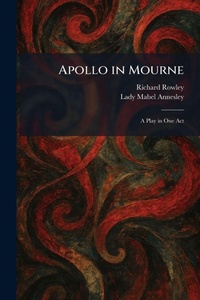
Apollo in Mourne
Description
"Apollo in Mourne a Play in One Act" is a lyrical and imaginative drama that transports the Greek god of light and music to the rugged, misty landscape of the Mourne Mountains in County Down. Written by the celebrated Ulster poet and playwright Richard Rowley, this work exemplifies a creative blending of classical mythology with local Irish atmosphere and character.
The play explores the poignant and often humorous interactions between the celestial deity and the pragmatic inhabitants of the Irish countryside. Through sharp dialogue and evocative stagecraft, Rowley examines themes of beauty, divinity, and the intersection of the mundane with the transcendent. The work is noted for its ability to ground ethereal, mythological concepts within the specific cultural and geographical context of Northern Ireland.
As a significant piece of early 20th-century regional drama, "Apollo in Mourne" offers a unique perspective on the Irish literary landscape. It remains a compelling example of how traditional myths can be reimagined to reflect the identity and spirit of a specific locale, making it a valuable work for enthusiasts of Irish theater, folklore, and classical adaptations.
This work has been selected by scholars as being culturally important, and is part of the knowledge base of civilization as we know it. This work was reproduced from the original artifact, and remains as true to the original work as possible. Therefore, you may see the original copyright references, library stamps (as most of these works have been housed in our most important libraries around the world), and other notations in the work.
This work is in the public domain in the United States of America, and possibly other nations. Within the United States, you may freely copy and distribute this work, as no entity (individual or corporate) has a copyright on the body of the work.
As a reproduction of a historical artifact, this work may contain missing or blurred pages, poor pictures, errant marks, etc. Scholars believe, and we concur, that this work is important enough to be preserved, reproduced, and made generally available to the public. We appreciate your support of the preservation process, and thank you for being an important part of keeping this knowledge alive and relevant.