

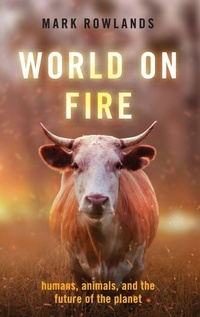
World on Fire
Humans, Animals, and the Future of the Planet
Published on 8. October 2021
Book
Hardback
256 pages
978-0-19-754189-0 (ISBN)
Description
Mark Rowlands presents a novel analysis of three epoch-defining environmental problems: climate, extinction, and pestilence. Our climate is changing at a rate that is unprecedented and, if unchecked, disastrous. Species are disappearing hundreds or thousands of times faster than normal. COVID-19 has wreaked social and economic havoc but is merely the latest off a blossoming production line of emerging infectious diseases, many of which have the potential to be far worse.
Rowlands establishes that all three problems are consequences of choices we have made about energy, which can be divided into two major forms: fuel and food. Focusing on food choices as far more central to the issue than commonly recognized, he argues that the solution is breaking our collective habit of eating animals. Rowlands shows that in doing so, we stem our insatiable hunger for land, which he identifies as central to the problems of extinction and pestilence. He explains that reversing the industrial farming of animals for food will first, substantially cut climate emissions, rapidly enough to allow sustainable energy technologies time to become viable alternatives; and most importantly, make vast areas of a land available for the kind of aggressive afforestation policy that he shows as necessary to bring all three problems under control.
With World on Fire, Mark Rowlands identifies the source of our environmental ills and provides a compelling and accessible account of how to solve them.
Rowlands establishes that all three problems are consequences of choices we have made about energy, which can be divided into two major forms: fuel and food. Focusing on food choices as far more central to the issue than commonly recognized, he argues that the solution is breaking our collective habit of eating animals. Rowlands shows that in doing so, we stem our insatiable hunger for land, which he identifies as central to the problems of extinction and pestilence. He explains that reversing the industrial farming of animals for food will first, substantially cut climate emissions, rapidly enough to allow sustainable energy technologies time to become viable alternatives; and most importantly, make vast areas of a land available for the kind of aggressive afforestation policy that he shows as necessary to bring all three problems under control.
With World on Fire, Mark Rowlands identifies the source of our environmental ills and provides a compelling and accessible account of how to solve them.
Reviews / Votes
Rowlands raises troubling challenges that are unavoidable if civilization is to endure while preserving current levels of quality of life. Rejecting his conclusions out of hand because we find them unpalatable is unacceptable, especially for scholars. With writing accessible to non-specialists, the book is charming yet disconcerting, a powerful and provocative read. * R. E. O'Connor, CHOICE *More details
Language
English
Place of publication
New York
United States
Target group
Professional and scholarly
Dimensions
Height: 240 mm
Width: 161 mm
Thickness: 18 mm
Weight
546 gr
ISBN-13
978-0-19-754189-0 (9780197541890)
Copyright in bibliographic data and cover images is held by Nielsen Book Services Limited or by the publishers or by their respective licensors: all rights reserved.
Schweitzer Classification
Other editions
Additional editions
E-Book
05/2021
OUP eBook
€15.49
Available for download
E-Book
05/2021
OUP eBook
€15.49
Available for download
Person
Mark Rowlands (D.Phil., University of Oxford) is Professor and Chair of Philosophy at the University of Miami. He is the author of twenty-one books, translated into roughly the same number of languages, and over a hundred journal articles, book chapters, and reviews. His work in the philosophy of mind comprises several books, including The Body in Mind (Cambridge University Press, 1999), The Nature of Consciousness (Cambridge University Press 1999), Externalism (Acumen 2003), Body Language (MIT Press 2006), The New Science of the Mind (MIT Press 2010), Memory and the Self (Oxford University Press 2016), and Can Animals be Persons? (Oxford University Press 2019). His work in ethics and moral psychology includes Animal Rights (Macmillan 1998), The Environmental Crisis (Macmillan 2000), Animals Like Us (Verso 2002), Can Animals be Moral? (Oxford University Press 2012), Animal Rights: All That Matters (Hodder 2013),
and A Good Life (Granta 2015). His memoir, The Philosopher and the Wolf (Granta 2008), became an international bestseller.
and A Good Life (Granta 2015). His memoir, The Philosopher and the Wolf (Granta 2008), became an international bestseller.
Content
Contents
1. Animals, Energy, Land: An Overview
2. Good Morning, Atlantis!
3. Welcome to Venus?
4. The Fire: Energy, Civilization and Collapse
5. Salvation Technologies?
6. The End of Meat
7. Our Forest Future?
8. The Great Dying
9. The Business Reallocation Program
10. Pale Horse
11. One Hundred Years of Ineptitude
12. The Wildwood
1. Animals, Energy, Land: An Overview
2. Good Morning, Atlantis!
3. Welcome to Venus?
4. The Fire: Energy, Civilization and Collapse
5. Salvation Technologies?
6. The End of Meat
7. Our Forest Future?
8. The Great Dying
9. The Business Reallocation Program
10. Pale Horse
11. One Hundred Years of Ineptitude
12. The Wildwood