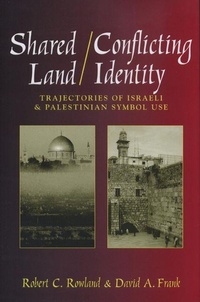
Shared Land/Conflicting Identity: Trajectories of Israeli and Palestinian Symbol Use argues that rhetoric, ideology, and myth have played key roles in influencing the development of the 100-year conflict between first the Zionist settlers and the current Israeli people and the Palestinian residents in what is now Israel. The Israeli-Palestinian conflict is usually treated as an issue of land and water. While these elements are the core of the conflict, they are heavily influenced by the symbols used by both peoples to describe, understand, and persuade each other. The authors argue that symbolic practices deeply influenced the Oslo Accords, and that the breakthrough in the peace process that led to Oslo could not have occurred without a breakthrough in communication styles.
Rowland and Frank develop four crucial ideas on social development: the roles of rhetoric, ideology, and myth; the influence of symbolic factors; specific symbolic factors that played a key role in peace negotiations; and the identification and value of criteria for evaluating symbolic practices in any society.
Series
Language
Place of publication
East Lansing, MI
United States
Target group
College/higher education
Professional and scholarly
Product notice
sewn/stitched
Cloth over boards
Dimensions
Height: 237 mm
Width: 196 mm
Thickness: 29 mm
Weight
ISBN-13
978-0-87013-635-1 (9780870136351)
Copyright in bibliographic data and cover images is held by Nielsen Book Services Limited or by the publishers or by their respective licensors: all rights reserved.
Schweitzer Classification
Robert C. Rowland is a Professor of Communication at the University of Kansas. He is the recipient of the 2003 Kohrs-Campbell Prize in Rhetorical Criticism, the largest and most significant book manuscript award in the field of rhetorical criticism, as coauthor of Shared Land/Conflicting Identity: Trajectories of Israeli and Palestinian Symbol Use. He is also the author of The Rhetoric of Menachem Begin.
Dr. Rowland's major teaching and research interests are in rhetorical criticism, argumentation, and the public sphere. Dr. Rowland and his debate colleague were the 1976 National Debate Champions. He is a former director of forensics at KU and at Baylor University. Dr. Rowland received the Louise Byrd Award for Graduate Teaching at the Doctoral Hooding ceremony May 2000. He also is a recipient of the William T. Kemper Teaching Fellowship and the Bernard Fink Award for outstanding teaching, and is a two-time HOPE Award finalist. A recent survey of journals in the discipline ranked him among the thirty most published scholars.
ContentsIntroductionKey Exigencies in the Israeli-Palestinian ConflictChapter 1:THE SYMBOLIC ROOTS OF THE ISRAELI-PALESTINIAN CONFLICTChapter 2:A SYMBOLIC TEMPLATE FOR ANALYZING THE ISRAELI-PALESTINIAN CONFLICTChapter 3:THE BIRTH OF THE SYMBOLIC SYSTEMS OF LABOR AND REVISIONIST ZIONISMChapter 4:THE SYMBOLIC CONSTRUCTION OF THE PALESTINIAN PEOPLEChapter 5:SYMBOLIC TRAJECTORIES IN THE DEVELOPMENT OF LABOR AND REVISIONIST ZIONISMChapter 6:THE ESSENTIAL PALESTINIANChapter 7:FROM CAMP DAVID TO LEBANONChapter 8:FROM THE OCCUPATION TO INTIFADAChapter 9:SYMBOLIC STAGNATION AND IDEOLOGICAL CALCIFICATION IN ISRAELChapter 10:PALESTINIAN SYMBOLIC TRAJECTORIES TO OSLOChapter 11:PALESTINIAN MYTH AND THE REALITY OF OSLOChapter 12:FROM SYMBOLIC STASIS TO THE END OF REVISIONISMChapter 13:SYMBOL USE AND THE ISRAELI-PALESTINIAN CONFLICTNotesSelected BibliographyIndex