

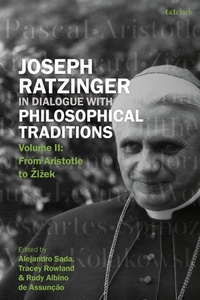
Joseph Ratzinger in Dialogue with Philosophical Traditions
Volume II: From Aristotle to Zizek
Will be published approx. on 29. October 2026
Book
Hardback
376 pages
978-0-567-72466-3 (ISBN)
Description
A sequel to the hugely successful volume published in 2024, this collection from Ratzinger specialists across the world examineshow he engaged with particular philosophers and philosophical traditions.
Joseph Ratzinger remains a huge name in the Catholic world, which makes this an essential read for graduate students in theology, especially those interested in the relationship between faith and reason.
Joseph Ratzinger remains a huge name in the Catholic world, which makes this an essential read for graduate students in theology, especially those interested in the relationship between faith and reason.
Reviews / Votes
Joseph Ratzinger was one of the most important theologians and Christian thinkers of the late twentieth and early twenty-first centuries. As professor, cardinal, and pope, he engaged with many of the central philosophical, political, and cultural questions of the modern age, bringing to them a perspective shaped by Sacred Scripture, the Fathers of the Church, and the great tradition of Catholic theology. This distinguished volume places his thought in conversation with major philosophers from antiquity to the present, from Aristotle to Zizek. Written by an accomplished group of scholars, its chapters illuminate with insight and subtlety the ways in which Ratzinger's thought at times converges with these thinkers and at times subjects their positions to a searching critique from within the Catholic intellectual tradition. The editors are to be warmly congratulated on a learned and stimulating collection which shows with great clarity the continuing significance of Ratzinger's thought for the intellectual and spiritual challenges of the modern world. Strongly recommended. * John Loughlin, University of Cambridge, UK * Christian theology has evolved through profound and thoughtful dialogue with tradition, as well as with contemporary intellectuals capable of addressing the mysteries of divine-human encounters and the paradoxes of human nature. This volume demonstrates the extent to which Ratzinger's theology is dialogical. Through the insights of leading experts, readers are invited to critically engage with the articulation of complex theological issues in Ratzinger's work and the reasoning behind his arguments. While Tracey Rowland's classic book Ratzinger's Faith can be interpreted in musical terms as a 'variation of a fugue', elaborating on various Ratzingerian motifs, this volume is an impressive series of rhapsodies. Each one further develops the underlying melodies of Ratzinger, depicting the authentic voices of a church singing liturgical music while dealing with worldly affairs. * Matyas Szalay, Episcopal Theological College of Pecs, Hungary *More details
Language
English
Place of publication
Edinburgh
United Kingdom
Publishing group
Bloomsbury Publishing PLC
Target group
College/higher education
Dimensions
Height: 234 mm
Width: 156 mm
ISBN-13
978-0-567-72466-3 (9780567724663)
Copyright in bibliographic data and cover images is held by Nielsen Book Services Limited or by the publishers or by their respective licensors: all rights reserved.
Schweitzer Classification
Persons
Alejandro Sada is Professor of Theology at the Universidad Panamericana, Mexico.
Tracey Rowland is St. John Paul II Chair of Theology at the University of Notre Dame, Australia.
Rudy Albino de Assuncao is Professor of Philosophy and Theology at Centro Universitario Catolica de Quixada, Brasil.
Tracey Rowland is St. John Paul II Chair of Theology at the University of Notre Dame, Australia.
Rudy Albino de Assuncao is Professor of Philosophy and Theology at Centro Universitario Catolica de Quixada, Brasil.
Content
Abbreviations (J. Ratzinger Collected Works)
Introduction Study: Philosophy and Theology According to Joseph Ratzinger/Benedict XVI (Pablo Blanco-Sarto, Pontifical University of Holy Cross, Italy)
1. Aristotle: Some Theological Inklings (Maria-Elena Garcia-Pelaez, Panamericana University, Mexico)
2. Stoicism and Epicureanism: Nature and Logos (Claudia Carbonell, University of Piura, Peru)
3. Francis Bacon: Science, Democracy, Freedom (Euclides Eslava, University of La Sabana, Colombia)
4. Rene Descartes: Healing the Ruptures of Modernity (Michael Dominic Taylor, The Thomas More College of Liberal Arts, USA)
5. Blaise Pascal: A Theology of Experience (Alejandro Sada, Panamericana University, Mexico)
6. Baruch Spinoza: "The War Between the Gods" - Deus sive natura or Deus caritas est (Michael Hanby, John Paul II Institute, Catholic University of America, USA)
7. Giambattista Vico: Verum quia factum (Thomas V. Gourlay, Catholic Institute of Western Australia, Australia)
8. Jean-Jaques Rousseau: The Comprehension of Nature and Freedom (Maria Esther Gomez de Pedro, University of Santo Tomas, Chile)
9. Soren Kierkegaard: Cinnamon for a Bland Christianity and the Entweltlichung Project (Emery de Gaal, University of St. Mary of the Lake / Mundelein Seminary, USA)
10. Wilhelm Dilthey: Hermeneutic Theory and Divine Pedagogy (Jacob Phillips, St. Mary's University, UK)
11. Karl Jaspers: Philosophical Faith and Christian Revelation (Josef Zoehrer, Higher School of Pedagogy in Freiburg, Germany)
12. Max Horkheimer and Theodor Adorno: Justice and Resurrection - Faith, Reason and Dialectic of Enlightenment (Rudy Albino de Assuncao, Italian-Brazilian Catholic University Center, Brazil)
13. Clive Staples Lewis: The Tao, Relativism and the Abolition of Man (Julio Borges Junyent, Cardenal Herrera University CEU, Spain)
14. Leo Strauss: A Theologian Open to the Challenge of Philosophy (Davide De Caprio, University of Strasbourg, France)
15. Emmanuel Levinas: Ostende faciem tuam - On the Concept of the Face (Donald Wallenfang, Sacred Heart Major Seminary, USA)
16. Hannah Arendt: Freedom and Politics (Stephan Kampowski, Pontifical John Paul II Theological Institute, Italy)
17. Karol Wojtyla: Gratia supponit naturam (Jaroslaw Kupczak, Pontifical University of John Paul II, Poland)
18. Leszek Kolakowski: The Priest and the Jester (Tracey Rowland, University of Notre Dame, Australia)
19. Slavoj Zizek: Anthropos, Eros, Christos, Logos (Matthew Tan, University of Notre Dame Australia, Australia)
Thematic Dialogues
20. Sacred Scripture and Philosophy (Julian Arturo Lopez Amozurrutia, Pontifical University of Mexico / Catholic University Lumen Gentium, Mexico)
21. Liturgy and Philosophy (Matthew Levering, University of St. Mary of the Lake / Mundelein Seminary, USA)
22. The Enlightenment Movement (Maurice Ashley Agbaw-Ebai, Catholic Institute of Technology, Italy)
23. The "Fruitful Reciprocity" of Science and Faith (Michael Dominic Taylor, The Thomas More College of Liberal Arts, USA)
24. Faith and Experience (Mariano Crespo, University of Navarra, Spain)
25. The Paradox with Paradox (Michaela Christine Hastetter, Catholic University ITI, Austria)
Bibliography
Contributors
Introduction Study: Philosophy and Theology According to Joseph Ratzinger/Benedict XVI (Pablo Blanco-Sarto, Pontifical University of Holy Cross, Italy)
1. Aristotle: Some Theological Inklings (Maria-Elena Garcia-Pelaez, Panamericana University, Mexico)
2. Stoicism and Epicureanism: Nature and Logos (Claudia Carbonell, University of Piura, Peru)
3. Francis Bacon: Science, Democracy, Freedom (Euclides Eslava, University of La Sabana, Colombia)
4. Rene Descartes: Healing the Ruptures of Modernity (Michael Dominic Taylor, The Thomas More College of Liberal Arts, USA)
5. Blaise Pascal: A Theology of Experience (Alejandro Sada, Panamericana University, Mexico)
6. Baruch Spinoza: "The War Between the Gods" - Deus sive natura or Deus caritas est (Michael Hanby, John Paul II Institute, Catholic University of America, USA)
7. Giambattista Vico: Verum quia factum (Thomas V. Gourlay, Catholic Institute of Western Australia, Australia)
8. Jean-Jaques Rousseau: The Comprehension of Nature and Freedom (Maria Esther Gomez de Pedro, University of Santo Tomas, Chile)
9. Soren Kierkegaard: Cinnamon for a Bland Christianity and the Entweltlichung Project (Emery de Gaal, University of St. Mary of the Lake / Mundelein Seminary, USA)
10. Wilhelm Dilthey: Hermeneutic Theory and Divine Pedagogy (Jacob Phillips, St. Mary's University, UK)
11. Karl Jaspers: Philosophical Faith and Christian Revelation (Josef Zoehrer, Higher School of Pedagogy in Freiburg, Germany)
12. Max Horkheimer and Theodor Adorno: Justice and Resurrection - Faith, Reason and Dialectic of Enlightenment (Rudy Albino de Assuncao, Italian-Brazilian Catholic University Center, Brazil)
13. Clive Staples Lewis: The Tao, Relativism and the Abolition of Man (Julio Borges Junyent, Cardenal Herrera University CEU, Spain)
14. Leo Strauss: A Theologian Open to the Challenge of Philosophy (Davide De Caprio, University of Strasbourg, France)
15. Emmanuel Levinas: Ostende faciem tuam - On the Concept of the Face (Donald Wallenfang, Sacred Heart Major Seminary, USA)
16. Hannah Arendt: Freedom and Politics (Stephan Kampowski, Pontifical John Paul II Theological Institute, Italy)
17. Karol Wojtyla: Gratia supponit naturam (Jaroslaw Kupczak, Pontifical University of John Paul II, Poland)
18. Leszek Kolakowski: The Priest and the Jester (Tracey Rowland, University of Notre Dame, Australia)
19. Slavoj Zizek: Anthropos, Eros, Christos, Logos (Matthew Tan, University of Notre Dame Australia, Australia)
Thematic Dialogues
20. Sacred Scripture and Philosophy (Julian Arturo Lopez Amozurrutia, Pontifical University of Mexico / Catholic University Lumen Gentium, Mexico)
21. Liturgy and Philosophy (Matthew Levering, University of St. Mary of the Lake / Mundelein Seminary, USA)
22. The Enlightenment Movement (Maurice Ashley Agbaw-Ebai, Catholic Institute of Technology, Italy)
23. The "Fruitful Reciprocity" of Science and Faith (Michael Dominic Taylor, The Thomas More College of Liberal Arts, USA)
24. Faith and Experience (Mariano Crespo, University of Navarra, Spain)
25. The Paradox with Paradox (Michaela Christine Hastetter, Catholic University ITI, Austria)
Bibliography
Contributors