

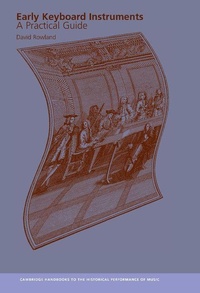
Early Keyboard Instruments
A Practical Guide
Published on 2. April 2001
Book
Hardback
168 pages
978-0-521-64366-5 (ISBN)
Description
Early Keyboard Instruments covers a wide range of performance issues on keyboard instruments relevant to the music from c.1700-c.1900. It includes descriptions of the harpsichords, clavichords, pianos and other stringed-keyboard instruments used by performers of the period as well as aspects of technique such as harpsichord registration, piano pedalling and keyboard fingering. Aspects of the notation of keyboard music are discussed, as is articulation, embellishment, tempo flexibility and rubato. A substantial chapter is devoted to case studies, illustrating how the aspects of performance discussed in the rest of the book are worked out in practice, whether playing on period instruments or on the modern piano.
Reviews / Votes
'... it is, in fact, an excellent introduction ... I wish there had been a book like it when I was a school.' Clifford Bartlett, Early Music Review 'A significant body of information, lucid and succinct.' Early Music '... the breadth and clarity of presentation and indexing will no doubt ensure that players of any keyboard instrument will want to have [this book] to hand for quick consultation and revision for many years to come.' The British Clavichord Society NewsletterMore details
Series
Language
English
Place of publication
Cambridge
United Kingdom
Target group
College/higher education
Illustrations
52 Printed music items
Dimensions
Height: 235 mm
Width: 157 mm
Thickness: 14 mm
Weight
403 gr
ISBN-13
978-0-521-64366-5 (9780521643665)
Copyright in bibliographic data and cover images is held by Nielsen Book Services Limited or by the publishers or by their respective licensors: all rights reserved.
Schweitzer Classification
Other editions
Additional editions
E-Book
01/2005
1st Edition
Cambridge University Press
€36.99
Available for download
Book
03/2001
Cambridge University Press
€54.00
Shipment within 15-20 days
Person
Content
1. Stylistic awareness and keyboard music; 2. Repertory, performance and notation; 3. The instruments; 4. Use of instruments and technique; 5. Non-notated and notated issues; 6. Case studies; 7. Continuo realisation.