

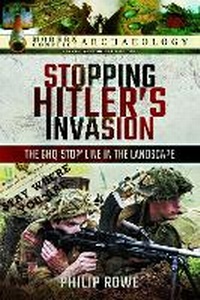
Stopping Hitler's Invasion
The GHQ 'Stop' Line in the Landscape
Book
Hardback
200 pages
978-1-5267-1360-5 (ISBN)
Description
In May 1940 the German army outmanoeuvred Allied forces in northern France and Belgium, forcing its evacuation from Dunkirk. Fearing an invasion, General Headquarters Home Forces set about the rapid re-militarisation of the United Kingdom to oppose, arguably, the first very real threat to the country's sovereignty since 1066.
Erecting a series of defensive fieldworks and gun emplacements countrywide, the backbone of these anti-invasion measures was the GHQ' [Stop] Line.
A physical linear defence line that extended the width and breadth of the country, the GHQ' Line has largely been bypassed by history. Moving ever closer to beyond living memory, the strategic effectiveness of the anti-invasion defences has long been overshadowed by popular culture in its depiction of home defence during the Second World War. Viewed as a defensive folly derived from First World War strategies, it has been suggested that the Stop Line' strategy was intended to act as a visual deterrent rather than a serious defensive countermeasure. Never contested, the GHQ' Line was a prepared battlefield that never faced the unpredictable test of conflict, and so remains untried as a singular defensive strategy.
With many of its fieldworks now removed, forgotten or overgrown in the contemporary landscape, this book explores the thought processes behind its design, construction, siting and strategic effectiveness in the landscape by examining GHQ Line Green, a 145km section of GHQ line largely extant within South West England.
Only archaeological investigation can bring it alive once more and answer these questions
Erecting a series of defensive fieldworks and gun emplacements countrywide, the backbone of these anti-invasion measures was the GHQ' [Stop] Line.
A physical linear defence line that extended the width and breadth of the country, the GHQ' Line has largely been bypassed by history. Moving ever closer to beyond living memory, the strategic effectiveness of the anti-invasion defences has long been overshadowed by popular culture in its depiction of home defence during the Second World War. Viewed as a defensive folly derived from First World War strategies, it has been suggested that the Stop Line' strategy was intended to act as a visual deterrent rather than a serious defensive countermeasure. Never contested, the GHQ' Line was a prepared battlefield that never faced the unpredictable test of conflict, and so remains untried as a singular defensive strategy.
With many of its fieldworks now removed, forgotten or overgrown in the contemporary landscape, this book explores the thought processes behind its design, construction, siting and strategic effectiveness in the landscape by examining GHQ Line Green, a 145km section of GHQ line largely extant within South West England.
Only archaeological investigation can bring it alive once more and answer these questions
More details
Series
Language
English
Place of publication
South Yorkshire
United Kingdom
Publishing group
Pen & Sword Books Ltd
Illustrations
70 illustrations
Dimensions
Height: 234 mm
Width: 156 mm
ISBN-13
978-1-5267-1360-5 (9781526713605)
Copyright in bibliographic data and cover images is held by Nielsen Book Services Limited or by the publishers or by their respective licensors: all rights reserved.
Schweitzer Classification
Person
An archaeological 'conflict' landscape investigator by profession, Philip Rowe's main area of interest and research is the social archaeology of modern conflict, in particular Britain's home defences of the early to mid-20th century.