

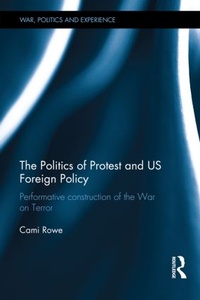
The Politics of Protest and US Foreign Policy
Performative Construction of the War on Terror
1st Edition
Published on 11. February 2013
Book
Hardback
166 pages
978-0-415-52390-5 (ISBN)
Description
This book offers a study of post-9/11 anti-war organizations in the United States and their role in domestic foreign policy debates.
The moment of the 9/11 terrorist attacks has been much cited in political and cultural scholarship and much attention has been paid to the promotion of "War on Terror" policies. The social mechanisms behind the circumscription and regulation of national ideals attracted critical analyses from scholars across disciplines; yet the prevalence of scholarly concern with the negative political devices of the Bush Administration at times seemed to risk reproducing the hierarchies of power that underpinned the very issue of concern, and even the War on Terror itself.
By contrast, this book celebrates the political acts of individuals committed to changing the dominant politics of the Bush era. Drawing on participant observation and interviews with the leaders of prominent anti-war organizations including Code Pink and Iraq Veterans Against the War, the book employs Performance Theory to evaluate the capacity of protest to effect lasting social change. In addition to highlighting an often overlooked aspect of foreign policy formation, this volume demonstrates that Performance Studies can be used as innovative approach to Politics and IR.
This book will be of much interest to students of US politics and foreign policy, theatre studies, cultural studies, and critical security and international relations.
The moment of the 9/11 terrorist attacks has been much cited in political and cultural scholarship and much attention has been paid to the promotion of "War on Terror" policies. The social mechanisms behind the circumscription and regulation of national ideals attracted critical analyses from scholars across disciplines; yet the prevalence of scholarly concern with the negative political devices of the Bush Administration at times seemed to risk reproducing the hierarchies of power that underpinned the very issue of concern, and even the War on Terror itself.
By contrast, this book celebrates the political acts of individuals committed to changing the dominant politics of the Bush era. Drawing on participant observation and interviews with the leaders of prominent anti-war organizations including Code Pink and Iraq Veterans Against the War, the book employs Performance Theory to evaluate the capacity of protest to effect lasting social change. In addition to highlighting an often overlooked aspect of foreign policy formation, this volume demonstrates that Performance Studies can be used as innovative approach to Politics and IR.
This book will be of much interest to students of US politics and foreign policy, theatre studies, cultural studies, and critical security and international relations.
More details
Series
Language
English
Place of publication
London
United Kingdom
Publishing group
Taylor & Francis Ltd
Target group
College/higher education
Professional and scholarly
Illustrations
6 s/w Photographien bzw. Rasterbilder
6 Halftones, black and white
Dimensions
Height: 234 mm
Width: 156 mm
Weight
490 gr
ISBN-13
978-0-415-52390-5 (9780415523905)
Copyright in bibliographic data and cover images is held by Nielsen Book Services Limited or by the publishers or by their respective licensors: all rights reserved.
Schweitzer Classification
Other editions
Additional editions
Cami Rowe
The Politics of Protest and US Foreign Policy
Performative Construction of the War on Terror
E-Book
03/2013
1st Edition
Routledge
€60.49
Available for download
Cami Rowe
The Politics of Protest and US Foreign Policy
Performative Construction of the War on Terror
E-Book
03/2013
Routledge
€60.49
Available for download
Person
Cami Rowe is Lecturer at Goldsmiths, University of London and has a PhD in International Relations from Lancaster University and an MA in Drama Studies from University College Dublin.
Content
Introduction 1. Setting 2. Time 3. Costume 4. Dramatis Personae 5. Genre Conclusion