

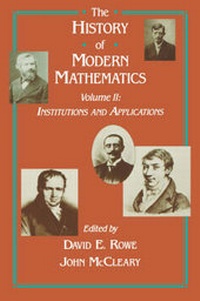
Institutions and Applications
Proceedings of the Symposium on the History of Modern Mathematics, Vassar College, Poughkeepsie, New York, June 20-24, 1989
Published on 8. March 1990
Book
Hardback
325 pages
978-0-12-599662-4 (ISBN)
Description
The History of Modern Mathematics, Volume II: Institutions and Applications focuses on the history and progress of methodologies, techniques, principles, and approaches involved in modern mathematics. The selection first elaborates on crystallographic symmetry concepts and group theory, case of potential theory and electrodynamics, and geometrization of analytical mechanics. Discussions focus on differential geometry and least action, intrinsic differential geometry, physically-motivated research in potential theory, introduction of potentials in electrodynamics, and group theory and crystallography in the mid-19th century. The text then elaborates on Schouten, Levi-Civita, and emergence of tensor calculus, modes and manners of applied mathematics, and pure and applied mathematics in divergent institutional settings in Germany. Topics include function of mathematics within technical colleges, evolvement of the notion of applied mathematics, rise of technical colleges, and an engineering approach to mechanics. The publication examines the transformation of numerical analysis by the computer; mathematics at the Berlin Technische Hochschule/Technische Universitaet; and contribution of mathematical societies to promoting applications of mathematics in Germany. The selection is a valuable reference for mathematicians and researchers interested in the history of modern mathematics.
Reviews / Votes
"These volumes will interest advanced undergraduate and graduate students of the history of mathematics." --CHOICE"Very interesting reading." --AMERICAN MATHEMATICAL MONTHLY
More details
Language
English
Place of publication
San Diego
United States
Publishing group
Elsevier Science Publishing Co Inc
Target group
Professional and scholarly
Mathematicians, mathematical libraries, and historians of science.
Dimensions
Height: 229 mm
Width: 152 mm
Weight
630 gr
ISBN-13
978-0-12-599662-4 (9780125996624)
Copyright in bibliographic data and cover images is held by Nielsen Book Services Limited or by the publishers or by their respective licensors: all rights reserved.
Schweitzer Classification
Other editions
New editions

Book
08/1994
3rd Edition
Academic Press
€117.61
Article is exhausted; no reprint
Additional editions
David E. Rowe | John McCleary
Institutions and Applications
Proceedings of the Symposium on the History of Modern Mathematics, Vassar College, Poughkeepsie, New York, June 20-24, 1989
E-Book
06/2014
Academic Press
€131.00
Available for download
Persons
Content
The Crossroads of Mathematics and Physics: E. Scholz, Crystallographic Symmetry Concepts and Group Theory (1850-1880). T. Archibald, Physics as a Constraint on Mathematical Research: The Case of Potential Theory and Electrodynamics. J. L*adutzen, The Geometrization of Analytical Mechanics: A Pioneering Contribution by Joseph Liouville (ca. 1850). D.J. Struik, Schouten, Levi-Civita, and the Emergence of Tensor Calculus. Applied Mathematics in the Early 19th-Century France: I. Grattan-Guinness, Modes and Manners of Applied Mathematics: The Case of Mechanics. A.D. Dalmedico, La Propogation des Ondes en Eau Profoned et ses D*aaeveloppements Math*aaematiques: (Poisson, Cauchy 1815-1825). Pure versus Applied Mathematics in Late 19th-Century Germany: G. Schubring, Pure and Applied Mathematics in Divergent Institutional Settings in Germany: The Role and Impact of Felix Klein. R. Tobies, On the Contribution of Mathematical Societies to Promoting Applications of Mathematics in Germany. E. Knobloch, Mathematics at the Berlin Technische Hochschule/Technische Universit*adat: Social, Institutional, and Scientific Aspects. Applied Mathematics in the United States During World War II: L. Owens, Mathematicians at War: Warren Weaver and the Applied Mathematics Panel, 1942-1945. W. Aspray, The Transformation of Numerical Analysis by the Computer: An Example from the Work of John von Neumann. Notes on the Contributors.