

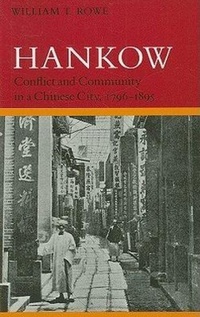
Hankow
Conflict and Community in a Chinese City, 1796-1895
Published on 1. December 1992
Book
Paperback/Softback
448 pages
978-0-8047-2160-8 (ISBN)
Description
This is the second volume of a two-volume social history of nineteenth-century Hankow, a city of over one million inhabitants and the commercial hub of central China. In the first volume, Hankow: Commerce and Society in a Chinese City, 1796-1889 (1984), the author emphasized the dynamism of late imperial commerce, the relation of the metropolis to its hinterland, and the corporate institutions of the city, notably its guilds, which assumed a number of functions we normally attribute to a municipal government. In this volume, the focus is on the people of Hankow, in all their ethnic diversity, occupational variety, and constant mobility, and on the social bonds that enabled this mass of people to live and work in a crowded city with much less disruptive social conflict than occurred in Hankow's counterparts in early modern Europe.
Built into the argument of the book is a running comparison nineteenth-century Hankow with such cities as London and Paris in the somewhat earlier period when they, too, were experiencing the growing pains of nascent preindustrial capitalism. How are we to account for the fact that the cities of early modern Europe were so much more prone to protest and social upheaval than Hankow was in a comparable stage of development? The author finds the answer in the cultural hegemony of an activist elite that fostered moral consensus, social harmony, and an aura of solicitude for the well-being of residents at every social level, exemplified in such service institutions as poor relief, firefighting, and public security.
Toward the end of the nineteenth century, however, the social bonds that had held Hankow together were beginning to fragment, as social polarization and growing class-consciousness fostered an atmosphere of increasing unrest.
Built into the argument of the book is a running comparison nineteenth-century Hankow with such cities as London and Paris in the somewhat earlier period when they, too, were experiencing the growing pains of nascent preindustrial capitalism. How are we to account for the fact that the cities of early modern Europe were so much more prone to protest and social upheaval than Hankow was in a comparable stage of development? The author finds the answer in the cultural hegemony of an activist elite that fostered moral consensus, social harmony, and an aura of solicitude for the well-being of residents at every social level, exemplified in such service institutions as poor relief, firefighting, and public security.
Toward the end of the nineteenth century, however, the social bonds that had held Hankow together were beginning to fragment, as social polarization and growing class-consciousness fostered an atmosphere of increasing unrest.
Reviews / Votes
"Rowe's earlier Hankow volume was such a superb book one really wondered how he could get another study of equaly quality from the same city in the same time period. But he has done it. There really are few historians who combine empirical richness with analytical incisiveness as well as Rowe does. And this book is Rowe at his best, a book of rare importance that takes the comparison of China and Europe seriously, and thus helps to bring Chinese history into the larger discourse of the historical discipline. It is truly a masterly job." -Joseph W. Esherick ,University of OregonMore details
Edition
New edition
Language
English
Place of publication
Palo Alto
United States
Target group
College/higher education
Professional and scholarly
Edition type
New edition
Product notice
Paperback (trade)
Dimensions
Height: 228 mm
Width: 151 mm
Thickness: 32 mm
Weight
647 gr
ISBN-13
978-0-8047-2160-8 (9780804721608)
Copyright in bibliographic data and cover images is held by Nielsen Book Services Limited or by the publishers or by their respective licensors: all rights reserved.
Schweitzer Classification
Person
William T. Rowe is Professor of History at Johns Hopkins University.
Content
Introduction; Part I. The City: 1. City people; 2. Urban space; Part II. Community: 3. Popular welfare; 4. Public goods and public services; Part III. Conflict: 5. Structures of conflict; 6. Dangerous classes and laboring classes; 7. True believers; Part IV. Control; 8. Forces of order; 9. Crisis and response; Conclusion; Notes; Selected bibliography; Character list; Index.