

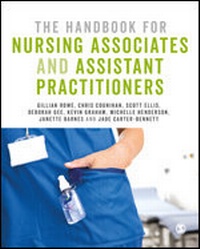
The Handbook for Nursing Associates and Assistant Practitioners
1st Edition
Published on 1. December 2017
Book
Hardback
320 pages
978-1-5264-0582-1 (ISBN)
Description
Written specifically for students who are undertaking a foundation degree or higher level apprenticeship in healthcare practice, or for those studying for the new nursing associate role, this book provides readers with the core knowledge and skills, giving them a springboard to further study.
Key features include:
A broad range of topics such as study skills, professional development, infection control and health promotion, health sciences, mental health, learning disabilities, children and families
Clinical case studies throughout to show how theory relates to real-life practice
Different levels of activity to help students 'step up learning' whether they are at level 4 or 5
Written by a wide range of authors with both experience in practice and in running degrees in nursing and health, the book is essential reading for all healthcare support workers, assistant practitioners and nursing associates.
Key features include:
A broad range of topics such as study skills, professional development, infection control and health promotion, health sciences, mental health, learning disabilities, children and families
Clinical case studies throughout to show how theory relates to real-life practice
Different levels of activity to help students 'step up learning' whether they are at level 4 or 5
Written by a wide range of authors with both experience in practice and in running degrees in nursing and health, the book is essential reading for all healthcare support workers, assistant practitioners and nursing associates.
Reviews / Votes
'A useful book for both trainee Nursing Associates and Associate Practitioner students commencing their studies. It provides a good introduction to key aspects of health and social care, as well as clinical and academic study skills, with the added bonus of recommendations for further reading and additional resources.' -- Lucie Llewellyn 'This text is a valuable resource for beginners in healthcare to acquire transferable skills and experience to be successful in the world of work. It lays the foundation for understanding the principles of life long care and health promotion including the development of leadership and management skills.' -- Dr Swapna Williamson, Associate Professor 'I am delighted to endorse this book, as it is almost a one-stop point of academic education with clinical competencies that I have not seen before. It is contemporary yet main stream and will be a perfect aide memoire for not only student Assistant Practitioners, Nursing Associates and Higher Level Apprenticeship but for first year student nurses too.' -- Jane GidmanMore details
Language
English
Place of publication
London
United Kingdom
Target group
College/higher education
Dimensions
Height: 232 mm
Width: 186 mm
Weight
742 gr
ISBN-13
978-1-5264-0582-1 (9781526405821)
Copyright in bibliographic data and cover images is held by Nielsen Book Services Limited or by the publishers or by their respective licensors: all rights reserved.
Schweitzer Classification
Other editions
New editions
Gillian Rowe | Scott Ellis | Deborah Gee
The Handbook for Nursing Associates and Assistant Practitioners
Book
12/2019
2nd Edition
SAGE Publications Ltd
€136.67
Article exhausted; check for reprint
Persons
Gillian Rowe is a writer and researcher who has edited and authored the primary textbook for Nursing Associates, she has extensive experience in the health and social care sectors both nursing and managing residential care settings. She is a qualified lecturer, lecturing for University of Plymouth Partnerships and delivers mental health training to the wider community. Gillian is an Associate Fellow of the Higher Education Academy. Deborah Gee is a Senior Lecturer and Course Lead for the Specialist Community Public Health Course (SCPHN) at Teesside University. In 2006, Deborah qualified as a registered nurse and has worked within a variety of settings including Neonatal Intensive Care and Community District Nursing. In 2010, Deborah completed her PGDip SCPHN qualification and has significant experience working with families and young children, assessing, and identifying their health needs and those of the wider population in her role as a health visitor. Deborah has an MSc in Education in Professional Practice; she is a Fellow of the Higher Education Academy in addition to holding recognised teacher status with the Nursing and Midwifery Council.
Content
Part 1: Academic, Personal and Professional Development
Chapter 1: Developing Academic Study Skills: Techniques and Guidance for Undergraduate Students
Chapter 2: Values and Ethical Frameworks in Health and Social Care
Chapter 3: Personal and Professional Development
Chapter 4: Leadership and Teamwork in Health and Social Care
Part 2: Biosciences and Essential Knowledge and Skills for Care
Chapter 5: Bioscience
Chapter 6: Prevention and Control of Infection
Chapter 7: Essential Skills for Care
Chapter 8: Applied Health Sciences
Chapter 9: Health Promotion
Part 3: Working with Different Groups of People
Chapter 10: Additional Needs and Challenging Behaviours in Children and Adults
Chapter 11: Introduction to Mental Health and Wellbeing
Chapter 12: Protecting Children and Vulnerable Adults
Chapter 1: Developing Academic Study Skills: Techniques and Guidance for Undergraduate Students
Chapter 2: Values and Ethical Frameworks in Health and Social Care
Chapter 3: Personal and Professional Development
Chapter 4: Leadership and Teamwork in Health and Social Care
Part 2: Biosciences and Essential Knowledge and Skills for Care
Chapter 5: Bioscience
Chapter 6: Prevention and Control of Infection
Chapter 7: Essential Skills for Care
Chapter 8: Applied Health Sciences
Chapter 9: Health Promotion
Part 3: Working with Different Groups of People
Chapter 10: Additional Needs and Challenging Behaviours in Children and Adults
Chapter 11: Introduction to Mental Health and Wellbeing
Chapter 12: Protecting Children and Vulnerable Adults