

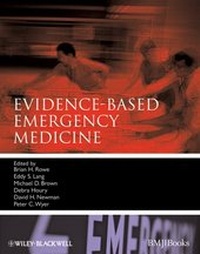
Evidence-Based Emergency Medicine
Published on 30. October 2008
Book
Hardback
680 pages
978-1-4051-6143-5 (ISBN)
Description
Emergency physicians assess and manage a wide variety of problems from patients presenting with a diversity of severities, ranging from mild to severe and life-threatening. They are expected to maintain their competency and expertise in areas where there is rapid knowledge change.
Evidence-based Emergency Medicine is the first book of its kind in emergency medicine to tackle the problems practicing physicians encounter in the emergency setting using an evidence-based approach. It summarizes the published evidence available for the diagnosis and treatment of common emergency health care problems in adults. Each chapter contextualizes a topic area using a clinical vignette and generates a series of key clinically important diagnostic and treatment questions. By completing detailed reviews of diagnostic and treatment research, using evidence from systematic reviews, RCTs, and prospective observational studies, the authors provide conclusions and practical recommendations.
Focusing primarily on diagnosis in areas where evidence for treatment is well accepted (e.g. DVTs), and treatment in other diseases where diagnosis is not complex (e.g. asthma), this text is written by leading emergency physicians at the forefront of evidence-based medicine. Evidence-based Emergency Medicine is ideal for emergency physicians and trainees, emergency department staff, and family physicians specialising in the acute care of medical and injured patients.
Reviews / Votes
"The forward to this large format, hard cover, 658 page excellent book encapsulates why its topic is so important to the practice of modern emergency medicine." (BMJ, 13 April 2011)"Dr. Brian Rowe, his co-editors and contributors, have masterfully designed a book to 'answer the direct, give-me-the-bottom-line questions emergency physicians ask in the middle of their shifts' ... .Each chapter is extremely well referenced and the index seems complete and is user friendly ... .This will be my new goto text for evidenced-based answers to specific clinical questions. It belongs in every emergency medicine library, as well as on the shelf of those in charge of journal clubs and evidence-based lecture series." (Annals of Emergency Medicine, November 2009)
"This book alone takes on the difficult challenge of reviewing the evidence based decisions that are still not ubiquitous in the emergency departments of America." (Doody's, August 2009)
"The best available evidence in a clear and concise manner. ... Especially useful to medical and pharmacy residents because of their background in the topics covered in this book ... .It is a significant evidence-based contribution to the emergency medicine literature." (The Annals of Pharmacotherapy, July 2009)
More details
Product info
gebunden
Series
Edition
1. Auflage
Language
English
Place of publication
United Kingdom
Publishing group
John Wiley and Sons Ltd
Target group
Professional and scholarly
Product notice
sewn/stitched
Cloth over boards
Dimensions
Height: 277 mm
Width: 226 mm
Thickness: 41 mm
Weight
1905 gr
ISBN-13
978-1-4051-6143-5 (9781405161435)
Schweitzer Classification
Other editions
Additional editions
Brian Rowe | Eddy S. Lang | Michael D. Brown
Evidence-Based Emergency Medicine
E-Book
08/2011
Wiley-Blackwell
€254.99
Available for download
Brian Rowe | Eddy S. Lang | Michael D. Brown
Evidence-Based Emergency Medicine
E-Book
01/2009
Wiley-Blackwell
€254.99
Available for download
Person
Chief Editor: Brian H. Rowe, MD, MSc, CCFP(EM), FCCP
Canada Research Chair in Emergency Airway Diseases
Research Director, Department of Emergency Medicine
Professor, University of Alberta
Content
List of Contributors.
Foreword.
Acknowledgments.
List of Abbreviations.
Part 1 General Issues.
1 Introduction.
2 Knowledge Translation: a Primer for Emergency Physicians.
3 Critical Appraisal: General Issues in Emergency Medicine.
4 Continuing Education.
5 Quality Improvement.
6 Medication Adherence.
7 Emergency Department Triage.
8 Emergency Department Overcrowding.
Part 2 Respiratory.
9 Emergency Management of Asthma Exacerbations.
10 Chronic Obstructive Pulmonary Disease Exacerbations.
11 Diagnosis and Treatment of Community-Acquired Pneumonia.
12 Deep Vein Thrombosis.
13 Pulmonary Embolism.
14 Prevention and Treatment of Influenza.
15 Anaphylaxis.
Part 3 Cardiology.
16 Chest Pain.
17 Acute Coronary Syndromes.
18 Acute Myocardial Infarction.
19 Acute Decompensated Heart Failure.
20 Acute Fibrillation.
21 Ventricular and Supraventricular Arrhythmias.
22 Cardiac Arrest.
Part 4 General Medical Conditions.
23 Severe Sepsis and Septic Shock.
24 Delirium.
25 Caring for the Elderly.
26 Syncope.
27 General Toxicology.
28 Toxicology: Acetaminophen and Salicylate Poisoning.
Part 5 Injury.
29 Minor Traumatic Brain Injury.
30 Neck Injuries.
31 Ankle Injuries.
32 Knee Injuries.
33 Wrist injuries.
34 Shoulder Injuries.
35 Chest Trauma.
36 Hemorrhagic Shock.
Part 6 Genitourinary and Abdominal.
37 Acute Appendicitis.
38 Ectopic Pregnancy.
39 Acute Ureteric Colic.
40 Urinary Tract Infection.
41 Pelvic Inflammatory Disease.
42 Pregnancy.
43 Gastrointestinal Bleeding.
Part 7 Neurosciences.
44 Transient Ischemic Attack.
45 Stroke.
46 Subarachnoid Hemorrhage.
47 Bacterial Meningitis.
48 Migraine and Other Primary Headache Disorders.
49 Seizures.
50 The Agitated Patient.
Part 8 ENT.
51 Sore Throat.
52 Sinusitis.
53 Conjunctivitis.
Part 9 Minor Procedures.
54 Procedural Sedation and Analgesia.
55 Wound Repair.
56 Soft Tissue Abscess.
57 Ultrasound Use: Three Select Applications.
Part 10 Public Health.
58 Injury Prevention.
59 Intimate Partner Violence.
60 Smoking Cessation.
61 Immunization.
62 Alcohol and Other Drugs.
63 Elder Abuse.
Index