

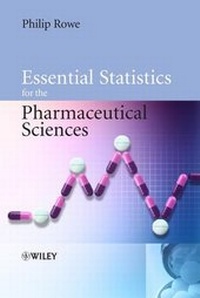
Essential Statistics for the Pharmaceutical Sciences
Published on 9. March 2007
Book
Paperback/Softback
308 pages
978-0-470-03468-2 (ISBN)
Description
Essential Statistics for the Pharmaceutical Sciences is a clear, accessible introduction to the key statistical techniques employed for the analysis of data within this subject area. Written in a concise and logical manner, the book explains why statistics are necessary and discusses the issues that experimentalists need to consider. The reader is carefully taken through the whole process, from planning an experiment to interpreting the results, avoiding unnecessary calculation methodology. The most commonly used statistical methods are described in terms of their purpose, when they should be used and what they mean once they have been performed.
Numerous examples are provided throughout the text, all within a pharmaceutical context, with key points highlighted in summary boxes to aid student understanding.
Essential Statistics for the Pharmaceutical Sciences takes a new and innovative approach to statistics with an informal style that will appeal to the reader who finds statistics a challenge!
This book is an invaluable introduction to statistics for any science student. It is an essential text for students taking biomedical or pharmaceutical-based science degrees and also a useful guide for researchers.
Numerous examples are provided throughout the text, all within a pharmaceutical context, with key points highlighted in summary boxes to aid student understanding.
Essential Statistics for the Pharmaceutical Sciences takes a new and innovative approach to statistics with an informal style that will appeal to the reader who finds statistics a challenge!
This book is an invaluable introduction to statistics for any science student. It is an essential text for students taking biomedical or pharmaceutical-based science degrees and also a useful guide for researchers.
Reviews / Votes
"A useful reference text for PhD students, academics, clinicians or industrialists who need to perform and understand a range of statistical tests." (The Pharmaceutical Journal, November 2008)"... this text takes a novel approach.... The style... is not as dry as other statistics texts, and so should not be intimidating even to a relative newcomer to the subject.... The layout is easy to navigate, there are chapter aims, summaries and 'key point boxes' throughout." (The Pharmaceutical Journal, 2008)
More details
Other editions
New editions
Book
10/2015
2nd Edition
Wiley
€51.90
Shipment within 15-20 days
Additional editions
E-Book
04/2007
Wiley
€45.99
Available for download
Book
03/2007
Wiley
€165.00
Article exhausted; check for reprint
Person
Dr Philip Rowe. Reader in Pharmaceutical Computing, School of Pharmacy and Chemistry, Liverpool,?UK
In addition to Dr Rowe's teaching and research at LJMU he also works on a consultancy basis offering advice and assistance with pharmacokinetic or general data analysis problems for the pharmaceutical industry, professional organizations and hospitals. He has recently secured a post delivering statistics training for the Institute of Clinical Research.
In addition to Dr Rowe's teaching and research at LJMU he also works on a consultancy basis offering advice and assistance with pharmacokinetic or general data analysis problems for the pharmaceutical industry, professional organizations and hospitals. He has recently secured a post delivering statistics training for the Institute of Clinical Research.
Content
Preface .
Statistical packages.
PART 1. DATA TYPES.
1. Data types.
PART 2. INTERVAL-SCALE DATA.
2. Descriptive statistics.
3. The normal distribution.
4. Sampling from populations. the SEM.
5. Ninety-five per cent confidence interval for the mean.
6. The two-sample t-test(1).Introducing hypothesis tests.
7. The two-sample t-test(2).The dreaded P value.
8. The two-sample t-test(3).False negatives, power and necessary sample sizes.
9. The two-sample t-test(4).Statistical significance, practical significance and equivalence.
10. The two-sample t-test(5).One-sided testing.
11. What does a statistically significant result really tell us?
12. The paired t-test. comparing two related sets of measurements.
13. Analyses of variance. going beyond t-tests.
14. Correlation and regression. relationships between measured values.
PART 3. NOMINAL-SCALE DATA.
15. Describing categorized data.
16. Comparing observed proportions. the contingency chi-square test.
PART 4. ORDINAL-SCALE DATA.
17. Ordinal and non-normally distributed data.Transformations and non-parametric tests.
Appendix to Chapter 17.
PART 5. SOME CHALLENGES FROM THE REAL WORLD.
18. Multiple testing.
19. Questionnaires.
PART 6. CONCLUSIONS.
20. Conclusions.
Index.
Statistical packages.
PART 1. DATA TYPES.
1. Data types.
PART 2. INTERVAL-SCALE DATA.
2. Descriptive statistics.
3. The normal distribution.
4. Sampling from populations. the SEM.
5. Ninety-five per cent confidence interval for the mean.
6. The two-sample t-test(1).Introducing hypothesis tests.
7. The two-sample t-test(2).The dreaded P value.
8. The two-sample t-test(3).False negatives, power and necessary sample sizes.
9. The two-sample t-test(4).Statistical significance, practical significance and equivalence.
10. The two-sample t-test(5).One-sided testing.
11. What does a statistically significant result really tell us?
12. The paired t-test. comparing two related sets of measurements.
13. Analyses of variance. going beyond t-tests.
14. Correlation and regression. relationships between measured values.
PART 3. NOMINAL-SCALE DATA.
15. Describing categorized data.
16. Comparing observed proportions. the contingency chi-square test.
PART 4. ORDINAL-SCALE DATA.
17. Ordinal and non-normally distributed data.Transformations and non-parametric tests.
Appendix to Chapter 17.
PART 5. SOME CHALLENGES FROM THE REAL WORLD.
18. Multiple testing.
19. Questionnaires.
PART 6. CONCLUSIONS.
20. Conclusions.
Index.