

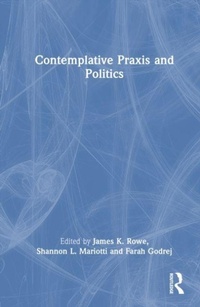
Contemplative Praxis and Politics
1st Edition
Will be published approx. on 22. July 2026
Book
Hardback
360 pages
978-1-032-89530-7 (ISBN)
Description
Mindfulness is now a zeitgeist. The mainstreaming of mindfulness - what Time Magazine calls the "mindful revolution" - is being powered by research documenting the physical and mental health benefits of meditation. Like most revolutions, the mindful revolution is composed of multiple, competing forces. While corporate "McMindfulness" has received considerable and appropriate critical attention, less work has been done on the generative political potential of contemplative practices, particularly on how they might support the liberation goals of progressive social movements.
This book is the first collection to systematically map the political implications of contemplative practices of all kinds - Buddhist meditation, yoga, and Indigenous ritual to name a few - with an explicit focus on the political, with an interdisciplinary approach, and from practitioners with firsthand experience. In addition to making a novel argument about the author's own area of expertise, each chapter includes a literature review that maps the existing research and commentary at the intersection of contemplative praxis and applicable terrain of political struggle being covered in the chapter.
Readers will come away with both a broad and deep understanding of emerging themes, new areas of research, and future directions.
This book is the first collection to systematically map the political implications of contemplative practices of all kinds - Buddhist meditation, yoga, and Indigenous ritual to name a few - with an explicit focus on the political, with an interdisciplinary approach, and from practitioners with firsthand experience. In addition to making a novel argument about the author's own area of expertise, each chapter includes a literature review that maps the existing research and commentary at the intersection of contemplative praxis and applicable terrain of political struggle being covered in the chapter.
Readers will come away with both a broad and deep understanding of emerging themes, new areas of research, and future directions.
Reviews / Votes
This book is a call to radical wakefulness, showing how contemplative practices become political tools capable of disrupting colonial and neoliberal forces shaping our bodies, minds, and collective possibilities. Revealing how domination embeds itself in the nervous system, the contributors offer a roadmap of responsibility, liberation, and decolonial resurgence through collective, embodied contemplative praxis. These teachings remind us that contemplative work is not passive; it is active, relational, and necessary for building the collective freedom our ancestors envisioned-and our descendants deserve.Michael Yellow Bird, Lee Wu Kee Ming Chair in Indigenous Social Work, University of Toronto
Contemplative Praxis and Politics brings together some of the most experienced and creative scholars and scholar-practitioners interweaving contemplative practice and radical politics to embody and envision better ways of being. Building on but going far beyond critiques of the individualistic commodification of mindfulness, contributors offer ways to engage in contemplative praxis-from meditation to indigenous prayer, yoga to ritual-in communal and life sustaining ways. Contemplative Praxis and Politics reminds us that transformative politics must be rooted in human depth and human depth must be expressed in justice. Living during a time in which, to quote James Baldwin, we cannot afford despair, this collection and the collective contemplation that forms it brings the hope that we always need. Essential reading.
Ann Gleig, Professor of Religion and Cultural Studies, University of Central Florida
Social and political analysis of the mindfulness movement has generally been critical of the potential of mindfulness to reinforce tacit norms, the political status quo, and regimes of self-care that uphold neoliberalism and corporate capitalism. But are there potentials for mindfulness-and the concepts and ethics surrounding it-to challenge norms and support more progressive political projects? Contemplative Praxis and Politics answers that question affirmatively with a diverse array of essays addressing the relationship between contemplative practices and education, activism, disability, colonialism, gender, and other issues. This volume expands the territory of humanistic research on contemplative practices and opens up new, provocative, and productive realms of inquiry.
David L. McMahan, Charles A. Dana Professor of Religious Studies, Franklin & Marshall College
More details
Language
English
Place of publication
London
United Kingdom
Publishing group
Taylor & Francis Ltd
Target group
College/higher education
Postgraduate, Undergraduate Advanced, and Undergraduate Core
Illustrations
1 s/w Tabelle
1 Tables, black and white
Dimensions
Height: 229 mm
Width: 152 mm
Weight
453 gr
ISBN-13
978-1-032-89530-7 (9781032895307)
Copyright in bibliographic data and cover images is held by Nielsen Book Services Limited or by the publishers or by their respective licensors: all rights reserved.
Schweitzer Classification
Other editions
Additional editions
James K. Rowe | Shannon L. Mariotti | Farah Godrej
Contemplative Praxis and Politics
Book
approx. 07/2026
1st Edition
Routledge
€50.00
Not yet published

James K. Rowe | Shannon L. Mariotti | Farah Godrej
Contemplative Praxis and Politics
E-Book
approx. 07/2026
1st Edition
Routledge
€52.49
Not yet available
James K. Rowe | Shannon L. Mariotti | Farah Godrej
Contemplative Praxis and Politics
E-Book
approx. 07/2026
1st Edition
Routledge
€52.49
Not yet available
Persons
James K. Rowe, Canada, University of Victoria. Rowe's interdisciplinary research program is motivated by a desire to understand and strengthen social movements working toward social and ecological justice. His most recent book is Radical Mindfulness: Why Transforming Fear of Death Is Politically Vital (Routledge, 2024). He has published in the journals: The Arrow; BioScience; Mortality; New Political Science; Socialist Studies; Studies in Political Economy; and Theory & Event.
Shannon L. Mariotti, USA, Trinity University. Mariotti's scholarship focuses on democratic theory and practice, in 19th century American Transcendentalism and Romanticism as well as 20th century Critical Social Theory and Modernism. She is the author of Thoreau's Democratic Withdrawal: Alienation, Participation, and Modernity (2010), as well as Adorno and Democracy: The American Years (2016), and, most recently, Contemplative Democracy: Politics, Pedagogy, and Practice (2025). She is also co-editor of A Political Companion to Marilynne Robinson (2016) and The Witch: A Reader in Feminist Political Theory (2026).
Farah Godrej, USA, University of California, Riverside. Godrej's areas of research and teaching include Indian political thought, Gandhi's political thought, comparative political theory, prisons and punishment. She is the author of Cosmopolitan Political Thought: Method, Practice, Discipline (2011); Fred Dallmayr: Cross-Cultural Theory, Post-Secularity, Cosmopolitanism (Routledge, 2017); and Freedom Inside? Yoga and Meditation in the Carceral State (2022).
Shannon L. Mariotti, USA, Trinity University. Mariotti's scholarship focuses on democratic theory and practice, in 19th century American Transcendentalism and Romanticism as well as 20th century Critical Social Theory and Modernism. She is the author of Thoreau's Democratic Withdrawal: Alienation, Participation, and Modernity (2010), as well as Adorno and Democracy: The American Years (2016), and, most recently, Contemplative Democracy: Politics, Pedagogy, and Practice (2025). She is also co-editor of A Political Companion to Marilynne Robinson (2016) and The Witch: A Reader in Feminist Political Theory (2026).
Farah Godrej, USA, University of California, Riverside. Godrej's areas of research and teaching include Indian political thought, Gandhi's political thought, comparative political theory, prisons and punishment. She is the author of Cosmopolitan Political Thought: Method, Practice, Discipline (2011); Fred Dallmayr: Cross-Cultural Theory, Post-Secularity, Cosmopolitanism (Routledge, 2017); and Freedom Inside? Yoga and Meditation in the Carceral State (2022).
Content
1. Introduction: Contemplative Praxis and Politics 2. Contemplative Praxis and the Political Economy of Capitalism 3. Contemplative Praxis, Parliamentary Culture, and the Inner Capacities of Politicians 4. Disability Politics and Mindfulness Praxis 5. Contemplative Practice and Black Politics 6. Relational Contemplative Praxis and the Politics of Indigenous Grief 7. Trauma-Informed Praxis and Metabolic Identity: From Traumacracy to Public Cultures of Care and Repair 8. Contemplative Praxis and Queer Politics 9. Contemplative Praxis and International Politics 10. Contemplative Praxis: Activism, Organizing and Contemplation 11. Forming an International Bhikkhuni Sangha through Contemplative Praxis 12. The End of "the World": Contemplation and the Decolonization of the Self 13. Contemplative Praxis for a Healthier and More Holistic Human Rights Practice 14. Coda: Contemplative Praxis, through Cascading Crises and a Circus of Chaos and Cruelty