

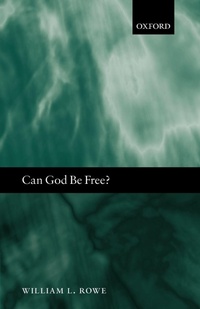
Can God Be Free?
Published on 17. August 2006
Book
Paperback/Softback
184 pages
978-0-19-920412-0 (ISBN)
Description
In the three major religions of the West, God is understood to be a being whose goodness, knowledge, and power are such that it is impossible for any being, including God himself, to have a greater degree of goodness, knowledge, and power. This book focuses on God's freedom and praiseworthiness in relation to his perfect goodness. Given his necessary perfections, if there is a best world for God to create he would have no choice other than to create it. For, as Leibniz tells us, 'to do less good than one could is to be lacking in wisdom or in goodness'. But if God could not do otherwise than create the best world, he created the world of necessity, not freely. And, if that is so, it may be argued that we have no reason to be thankful to God for creating us, since, as parts of the best possible world, God was simply unable to do anything other than create us---he created us of necessity, not freely. Moreover, we are confronted with the difficulty of having to believe that this world, with its Holocaust, and innumerable other evils, is the best that an infinitely powerful, infinitely good being could do in creating a world. Neither of these conclusions, taken by itself, seems at all plausible. Yet each conclusion appears to follow from the conception of God now dominant in the great religions of the West.
William Rowe presents a detailed study of this important problem, both historically in the writings of Gottfried Leibniz, Samuel Clarke, Thomas Aquinas, and Jonathan Edwards, and in the contemporary philosophical literature devoted to the issue. Rowe argues that this problem is more serious than is commonly thought and may require some significant revision in contemporary thinking about the nature of God.
William Rowe presents a detailed study of this important problem, both historically in the writings of Gottfried Leibniz, Samuel Clarke, Thomas Aquinas, and Jonathan Edwards, and in the contemporary philosophical literature devoted to the issue. Rowe argues that this problem is more serious than is commonly thought and may require some significant revision in contemporary thinking about the nature of God.
Reviews / Votes
This book will necessarily test some preconceptions that the readers of Heythrop Journal possess, to be sure, and challenge them to perhaps revisit their beliefs about God and the problem of evil...All in all, this book is a worthy read * Bradford Mccall, The Heythrop Journal * Rowe writes in a clear, accessible style on important topics. * Patrick Richmond, Themelios *More details
Language
English
Place of publication
Oxford
United Kingdom
Target group
College/higher education
Professional and scholarly
Dimensions
Height: 216 mm
Width: 140 mm
Thickness: 10 mm
Weight
240 gr
ISBN-13
978-0-19-920412-0 (9780199204120)
Copyright in bibliographic data and cover images is held by Nielsen Book Services Limited or by the publishers or by their respective licensors: all rights reserved.
Schweitzer Classification
Other editions
Additional editions
William L. Rowe
Can God Be Free?
Book
04/2004
Oxford University Press
€134.10
Shipment within 15-20 days
Person
Content
1. Leibniz on Divine Perfection and Freedom ; 2. Clarke on Divine Perfection and Freedom ; 3. Aquinas on the Infinity of Worlds ; 4. Jonathan Edwards on Divine and Human Freedom ; 5. Must God create the best world? ; 6. Divine Perfection and Freedom: The Contemporary Debate ; 7. Can God be the cause of his own nature?