

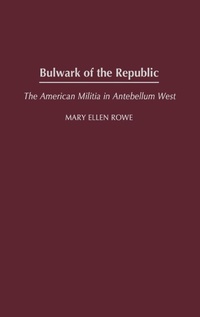
Bulwark of the Republic
The American Militia in Antebellum West
Published on 30. September 2003
Book
Hardback
248 pages
978-0-313-32410-9 (ISBN)
Description
Although a poor replacement for a professional military in wartime, the militia embodied a set of ideas that defined attitudes toward social order, civic responsibility, and the nature and relative powers of the government. It was the supreme expression of civic values in a traditional, communal, agrarian village society. Rowe argues that the antebellum militia should be seen as a social and political institution, rather than a military one, and contends that it is a key to understanding the political and social values of early 19th century America. Ultimately, changing social and political values, demographic change and mobility, and finally the dramatic expansion of federal power occasioned by the Civil War would destroy the traditional militia.
Because the militia's functions, failures, and meanings were most clearly apparent in new settlements along the frontier, Rowe examines three case studies that represent successive leaps across the Appalachians (Kentucky), the Mississippi (Missouri), and the Great Plains (Washington Territory). The first generation of settlers in Kentucky deliberately built a formal militia organization, in part for self-defense, in part as an explicit ideological and political statement. Despite both pre-existing Franco-Spanish militia and federal attempts to use the Territory in militia reform, American settlers in Missouri created a traditional Anglo-American militia there. A generation later, settlers in Washington Territory attempted to do the same, but the effort dissolved in a bitter controversy over the territorial governor's declaration of martial law.
Because the militia's functions, failures, and meanings were most clearly apparent in new settlements along the frontier, Rowe examines three case studies that represent successive leaps across the Appalachians (Kentucky), the Mississippi (Missouri), and the Great Plains (Washington Territory). The first generation of settlers in Kentucky deliberately built a formal militia organization, in part for self-defense, in part as an explicit ideological and political statement. Despite both pre-existing Franco-Spanish militia and federal attempts to use the Territory in militia reform, American settlers in Missouri created a traditional Anglo-American militia there. A generation later, settlers in Washington Territory attempted to do the same, but the effort dissolved in a bitter controversy over the territorial governor's declaration of martial law.
Reviews / Votes
[T]he book contains numerous entertaining anecdotes . . . . appeal to scholars of frontier history. Recommended. Upper-division undergraduates and above. * Choice * [T]his is a well-written book that for an academic study does a good job of holding the reader's interest. If you are interested in a view of the politics and personalities involved, as well as its structure and organization of the militia in these frontier territories during this period this is an excellent choice. This is a specialized work, but I can still recommend it to a broader audience. * The Journal of America's Military Past * Bulwark of the Republic is one of the most important works on trans-Appalachian and trans-Mississippi militias ever published. . . . This precisely written, impeccably documented book is free of academic jargon, culturual studies mantra, and influences of the new western history. . . . [B]ulwark of the Republic charts a new course and provides a basis for future scholarship. * Western Historical Society * Bulwark of the Republic meticulously dissects militia affairs in the three locales, sometimes in war, notably in 1812 and 1846, but chiefly assesses Native American and internal threats to local safety and stability. . . . Rowe's work is notable for demonstrating that the traditional militia persisted well past the American Revolution, contrary to standard scholarly views, through the careful examination of country and state militia records and accounts. * The Journal of Military History * [R]owe has crafted an attractive analytic framework for militia studies that invites application on other American frontiers, both before and during the Civil War. * The Journal of American History *More details
Series
Language
English
Place of publication
United States
Publishing group
Bloomsbury Publishing Plc
Target group
Interest Age: From 7 to 17 years
Dimensions
Height: 240 mm
Width: 161 mm
Thickness: 18 mm
Weight
543 gr
ISBN-13
978-0-313-32410-9 (9780313324109)
Copyright in bibliographic data and cover images is held by Nielsen Book Services Limited or by the publishers or by their respective licensors: all rights reserved.
Schweitzer Classification
Other editions
Additional editions
E-Book
09/2003
1st Edition
Praeger Publishers Inc
€82.49
Available for download
Person
Mary Ellen Rowe is professor of history at Central Missouri State University. She holds a PhD from the University of Washington. Her interests include popular culture of the early Federal and Jacksonian eras and Native American History. She has worked with historical societies in the Pacific Northwest.
Content
Acknowledgment
Introduction
Claiming Kentucky
To the Wide Missouri
The War of 1812 in the West
Kentucky, Missouri, and the Nation
Jacksonian Missouri
The Arms of a Republican Empire
Oregon and Washington
Indian War and Martial Law
Border Wars and Disputed Boundaries
Bibliography
Index
Introduction
Claiming Kentucky
To the Wide Missouri
The War of 1812 in the West
Kentucky, Missouri, and the Nation
Jacksonian Missouri
The Arms of a Republican Empire
Oregon and Washington
Indian War and Martial Law
Border Wars and Disputed Boundaries
Bibliography
Index