

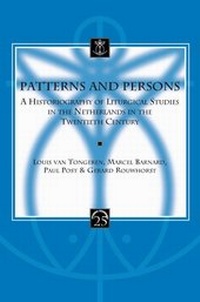
Patterns and Persons
A Historiography of Liturgical Studies in the Netherlands in the Twentieth Century
Published on 29. October 2010
Book
Paperback/Softback
500 pages
978-90-429-2301-0 (ISBN)
Description
Scholarly research does not develop in an historical vacuum. The questions
addressed and the vantage points from where they are studied, are closely
related to the social and cultural contexts in which the researchers are
working and living. This holds in a particular way true for liturgical
research done in the twentieth century. The research carried out in this
period was clearly influenced by the changes that various forms of
Christianity, and more in general religion as such, went through during
this century. The clearest evidence of the strong impact these changes had
on liturgical practice is provided by a series of sweeping liturgical
reforms taking place in the second half of the century.The research of
liturgical scholars was indirectly or directly influenced by the social
and cultural processes that were taking place. These processes unavoidably
had their effect on the questions that were raised and on the foci that
were chosen and it also coloured, at least to some extent, the
interpretations given to the data studied. During the last few decades,
these issues have frequently and thoroughly been discussed by the Dutch
liturgical scholars who are cooperating within the open,
inter-confessional and interdisciplinary setting of the Institute for
Liturgical and Ritual Studies located at the Tilburg University.Apart
from furthering reflection about the various scholarly paradigms that were
followed among these scholars, these discussions and conversations also
aroused a historiographic curiosity, especially with regard to the
development of liturgical scholarship in the Netherlands. How did
liturgical studies develop in the course of this century in the
Netherlands? What scholarly approaches were predominant? What paradigms
and shifts of paradigm can one discern? And how did these relate to the
development of liturgical practice and the underlying religious, cultural
and historical processes? In several respects the Dutch case was unique,
due to specific historical circumstances. These considerations led to the
decision to devote a common research project to the history of liturgical
studies in the Netherlands and this volume is the final outcome of this
project.
addressed and the vantage points from where they are studied, are closely
related to the social and cultural contexts in which the researchers are
working and living. This holds in a particular way true for liturgical
research done in the twentieth century. The research carried out in this
period was clearly influenced by the changes that various forms of
Christianity, and more in general religion as such, went through during
this century. The clearest evidence of the strong impact these changes had
on liturgical practice is provided by a series of sweeping liturgical
reforms taking place in the second half of the century.The research of
liturgical scholars was indirectly or directly influenced by the social
and cultural processes that were taking place. These processes unavoidably
had their effect on the questions that were raised and on the foci that
were chosen and it also coloured, at least to some extent, the
interpretations given to the data studied. During the last few decades,
these issues have frequently and thoroughly been discussed by the Dutch
liturgical scholars who are cooperating within the open,
inter-confessional and interdisciplinary setting of the Institute for
Liturgical and Ritual Studies located at the Tilburg University.Apart
from furthering reflection about the various scholarly paradigms that were
followed among these scholars, these discussions and conversations also
aroused a historiographic curiosity, especially with regard to the
development of liturgical scholarship in the Netherlands. How did
liturgical studies develop in the course of this century in the
Netherlands? What scholarly approaches were predominant? What paradigms
and shifts of paradigm can one discern? And how did these relate to the
development of liturgical practice and the underlying religious, cultural
and historical processes? In several respects the Dutch case was unique,
due to specific historical circumstances. These considerations led to the
decision to devote a common research project to the history of liturgical
studies in the Netherlands and this volume is the final outcome of this
project.
More details
Series
Language
English
Place of publication
Leuven
Belgium
Target group
Professional and scholarly
ISBN-13
978-90-429-2301-0 (9789042923010)
Copyright in bibliographic data and cover images is held by Nielsen Book Services Limited or by the publishers or by their respective licensors: all rights reserved.
Schweitzer Classification