

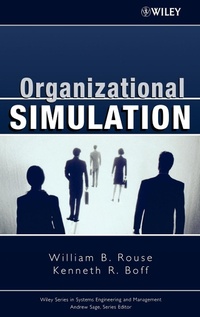
Organizational Simulation
1st Edition
Published on 12. July 2005
Book
Hardback
688 pages
978-0-471-68163-2 (ISBN)
Description
From modeling and simulation to games and entertainment
With contributions from leaders in systems and organizational modeling, behavioral and social sciences, computing and visualization, and gaming and entertainment, Organizational Simulation both articulates the grand vision of immersive environments and shows, in detail, how to realize it. This book offers unparalleled insight into the cutting edge of the field, since it was written by those who actually researched, designed, developed, deployed, marketed, sold, and critiqued today's best organizational simulations.
The coverage is divided into four sections:
* Introduction outlines the need for organizational simulation to support strategic thinking, design of unprecedented systems, and organizational learning, including the functionality and technology required to enable this support
* Behaviors covers the state of knowledge of individual, group, and team behaviors and performance, how performance can best be supported, how performance is affected by national differences, and how organizational performance can best be measured
* Modeling describes the latest approaches to modeling and simulating people, groups, teams, and organizations, as well as narrative contexts and organizational environments within which these entities act, drawing from a rich set of modeling methods and tools
* Simulations and Games illustrates a wide range of fielded simulations, games, and entertainment, including the methods and tools employed for designing, developing, deploying, and evaluating these systems, as well as the social implications for the associated communities that have emerged
Addressing all levels of organizational simulation architecture with theories and applications, and enabling technologies for each, Organizational Simulation offers students and professionals the premier reference and practical toolbox for this dynamic field.
With contributions from leaders in systems and organizational modeling, behavioral and social sciences, computing and visualization, and gaming and entertainment, Organizational Simulation both articulates the grand vision of immersive environments and shows, in detail, how to realize it. This book offers unparalleled insight into the cutting edge of the field, since it was written by those who actually researched, designed, developed, deployed, marketed, sold, and critiqued today's best organizational simulations.
The coverage is divided into four sections:
* Introduction outlines the need for organizational simulation to support strategic thinking, design of unprecedented systems, and organizational learning, including the functionality and technology required to enable this support
* Behaviors covers the state of knowledge of individual, group, and team behaviors and performance, how performance can best be supported, how performance is affected by national differences, and how organizational performance can best be measured
* Modeling describes the latest approaches to modeling and simulating people, groups, teams, and organizations, as well as narrative contexts and organizational environments within which these entities act, drawing from a rich set of modeling methods and tools
* Simulations and Games illustrates a wide range of fielded simulations, games, and entertainment, including the methods and tools employed for designing, developing, deploying, and evaluating these systems, as well as the social implications for the associated communities that have emerged
Addressing all levels of organizational simulation architecture with theories and applications, and enabling technologies for each, Organizational Simulation offers students and professionals the premier reference and practical toolbox for this dynamic field.
Reviews / Votes
"...researchers and students in organization science and computational organization theory will find it useful...informative reading for professionals and technical management personnel." (Computing Reviews.com, May 24, 2007)More details
Series
Language
English
Place of publication
United States
Publishing group
John Wiley & Sons Inc
Target group
Professional and scholarly
Product notice
sewn/stitched
Cloth over boards
Illustrations
Drawings: 50 B&W, 0 Color
Dimensions
Height: 240 mm
Width: 161 mm
Thickness: 41 mm
Weight
1188 gr
ISBN-13
978-0-471-68163-2 (9780471681632)
Copyright in bibliographic data and cover images is held by Nielsen Book Services Limited or by the publishers or by their respective licensors: all rights reserved.
Schweitzer Classification
Other editions
Additional editions
William B. Rouse | Kenneth R. Boff
Organizational Simulation
E-Book
07/2005
Wiley
€141.99
Available for download
Persons
WILLIAM B. ROUSE, PhD, is Executive Director of the Tennenbaum Institute at Georgia Tech and a professor in the College of Computing and the School of Industrial and Systems Engineering. Dr. Rouse has over thirty years of experience in the field of individual and organizational performance, decision support systems, and information systems. He has written hundreds of articles and book chapters, and has authored several Wiley books, including Essential Challenges of Strategic Management, and is a coeditor of Handbook of Systems Engineering and Management. He is a Fellow of IEEE, INFORMS, and HFES, as well as a member of the National Academy of Engineering. KENNETH R. BOFF, PhD, is a Chief Scientist of the Human Effectiveness Directorate, Air Force Research Laboratory, headquartered at Wright-Patterson Air Force Base, in Dayton, Ohio. His research includes human engineering of complex systems, training, safety, protection, and deployment logistics. He has authored numerous articles and book chapters, and has edited several books. He is a founder and technical director of the Department of Defense Human System Information Analysis Center, and is a founding member and former chair of the DoD Reliance Human-Systems Interface Technology Panel.
Content
Forward. Preface.
Contributors.
1. Introduction and Overview (W. Rouse & K. Boff).
2. Strategic Thinking Via Organizational Simulation (W. Rouse).
3. Using Organizational Simulation to Develop Unprecedented Systems (S. Cross).
4. The Learning Organization and Organizational Simulation (D. Andrews, et al.).
5. Requirements and Approaches For Modeling Individuals Within Organizational Simulations (E. Hudlicka & G. Zacharias).
6. Common Ground and Coordination in Joint Activity (G. Klein, et al.).
7. Modeling Team Performance: The Basic Ingredients and Research Needs (E. Salas, et al.).
8. National Differences in Teamwork (H. Klein & A. McHugh).
9. How Well Did It Work? Measuring Organizational Performance in Simulation Environments (J. MacMillan, et al.).
10. Technical and Conceptual Challenges in Organizational Simulation (L. McGinnis).
11. Narrative Abstraction For Organizational Simulations (J. Murray).
12. Agent-Based Modeling and Simulation of Socio-Technical Systems (A. Shah & A. Pritchett).
13. Executable Models of Decision Making Organizations (A. Levis).
14. Organizational Design and Assessment in Cyber-Space (K. Carley).
15. Artificial Intelligence and Its Applications to Organizational Simulation (S. Cross & S. Fouse).
16. Simulating Humans (I. Essa & A. Bobick).
17. Modeling Crowd Behavior For Military Simulation Applications (R. Loftin, et al.).
18. Application of Immersive Technology For Next Generation Simulation (R. Lindheim & J. Korris).
19. From Viz-Sim to VR to Games: How We Build a Hit Game-Based Simulation (M. Zyda, et al.).
20. Distributed Simulation and the High Level Architecture (R. Fujimoto).
21. Harnessing the Hive: Innovation as a Distributed Function in The Online Game Community (J. Herz).
Author Index.
Subject Index.
Contributors.
1. Introduction and Overview (W. Rouse & K. Boff).
2. Strategic Thinking Via Organizational Simulation (W. Rouse).
3. Using Organizational Simulation to Develop Unprecedented Systems (S. Cross).
4. The Learning Organization and Organizational Simulation (D. Andrews, et al.).
5. Requirements and Approaches For Modeling Individuals Within Organizational Simulations (E. Hudlicka & G. Zacharias).
6. Common Ground and Coordination in Joint Activity (G. Klein, et al.).
7. Modeling Team Performance: The Basic Ingredients and Research Needs (E. Salas, et al.).
8. National Differences in Teamwork (H. Klein & A. McHugh).
9. How Well Did It Work? Measuring Organizational Performance in Simulation Environments (J. MacMillan, et al.).
10. Technical and Conceptual Challenges in Organizational Simulation (L. McGinnis).
11. Narrative Abstraction For Organizational Simulations (J. Murray).
12. Agent-Based Modeling and Simulation of Socio-Technical Systems (A. Shah & A. Pritchett).
13. Executable Models of Decision Making Organizations (A. Levis).
14. Organizational Design and Assessment in Cyber-Space (K. Carley).
15. Artificial Intelligence and Its Applications to Organizational Simulation (S. Cross & S. Fouse).
16. Simulating Humans (I. Essa & A. Bobick).
17. Modeling Crowd Behavior For Military Simulation Applications (R. Loftin, et al.).
18. Application of Immersive Technology For Next Generation Simulation (R. Lindheim & J. Korris).
19. From Viz-Sim to VR to Games: How We Build a Hit Game-Based Simulation (M. Zyda, et al.).
20. Distributed Simulation and the High Level Architecture (R. Fujimoto).
21. Harnessing the Hive: Innovation as a Distributed Function in The Online Game Community (J. Herz).
Author Index.
Subject Index.