

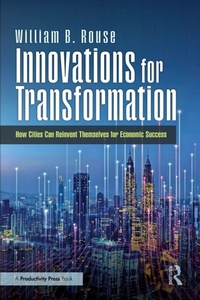
Innovations for Transformation
How Cities Can Reinvent Themselves for Economic Success
1st Edition
Published on 30. July 2025
Book
Hardback
162 pages
978-1-041-05021-6 (ISBN)
Description
This book chronicles how four resort cities (Asheville, Aspen, Key West and Laguna Beach) addressed failing economic situations to reinvent themselves and prosper. The author explores bottom-up reinventions of local community value propositions, often driven by economic forces that require reinvention due to declining or disappearing traditional economic opportunities.
The author foregoes broad national policies and focuses on a wide range of citizen groups, local institutions and businesses that coalesce to understand what is happening or has happened to their community. These cities then formulate future aspirations with new value propositions and experiment to determine what works. The investment becomes focused on emergent successes.
The book addresses four community ecosystems and a spectrum of contexts-For example, mountains vs. oceans and venues for entertainment vs. thought leadership. These four ecosystems were reinvented creatively to enable great economic and societal successes. In particular, the energy provided by bottom-up innovation was crucial.
The information presented in this book is drawn from two sources-First, historical accounts of such initiatives are leveraged. Second, and more substantial are findings synthesized from extensive interviews in Asheville, NC.
The author foregoes broad national policies and focuses on a wide range of citizen groups, local institutions and businesses that coalesce to understand what is happening or has happened to their community. These cities then formulate future aspirations with new value propositions and experiment to determine what works. The investment becomes focused on emergent successes.
The book addresses four community ecosystems and a spectrum of contexts-For example, mountains vs. oceans and venues for entertainment vs. thought leadership. These four ecosystems were reinvented creatively to enable great economic and societal successes. In particular, the energy provided by bottom-up innovation was crucial.
The information presented in this book is drawn from two sources-First, historical accounts of such initiatives are leveraged. Second, and more substantial are findings synthesized from extensive interviews in Asheville, NC.
More details
Language
English
Place of publication
London
United Kingdom
Publishing group
Taylor & Francis Ltd
Target group
Professional and scholarly
Professional Practice & Development
Illustrations
14 s/w Zeichnungen, 14 s/w Tabellen, 14 s/w Abbildungen
14 Tables, black and white; 14 Line drawings, black and white; 14 Illustrations, black and white
Dimensions
Height: 260 mm
Width: 183 mm
Thickness: 14 mm
Weight
538 gr
ISBN-13
978-1-041-05021-6 (9781041050216)
Copyright in bibliographic data and cover images is held by Nielsen Book Services Limited or by the publishers or by their respective licensors: all rights reserved.
Schweitzer Classification
Other editions
Additional editions
William B. Rouse
Innovations for Transformation
How Cities Can Reinvent Themselves for Economic Success
E-Book
07/2025
1st Edition
Productivity Press
€45.99
Available for download
William B. Rouse
Innovations for Transformation
How Cities Can Reinvent Themselves for Economic Success
E-Book
07/2025
1st Edition
Productivity Press
€45.99
Available for download
William B. Rouse
Innovations for Transformation
How Cities Can Reinvent Themselves for Economic Success
Book
07/2025
1st Edition
Productivity Press
€51.50
Shipment within 15-20 days
Person
William B. Rouse is a Research Professor at the McCourt School of Public Policy at Georgetown University, as well as a Senior Fellow in the office of the Senior Vice President for Research, Professor Emeritus, and former Chair of the School of Industrial and Systems Engineering at the Georgia Institute of Technology, and Principal at Curis Meditor, a firm focused on the health of people, processes, organizations, and society. His research focuses on understanding and managing complex public-private systems such as healthcare delivery, higher education, transportation, and national security, emphasizing the mathematical and computational modeling of these systems for policy design and analysis.
Rouse has written hundreds of articles and book chapters and has authored many books, including most recently Design of a Human-Centered Society (Routledge, 2024), Beyond Quick Fixes (Oxford, 2023), Bigger Pictures for Innovation (Routledge, 2023), Transforming Public-Private Ecosystems (Oxford, 2022), Failure Management (Oxford, 2021), Computing Possible Futures (Oxford, 2019), Universities as Complex Enterprises (Wiley, 2016), Modeling and Visualization of Complex Systems and Enterprises (Wiley, 2015), Understanding and Managing the Complexity of Healthcare (MIT Press, 2014), Economic Systems Analysis and Assessment (Wiley, 2011), People and Organizations: Explorations of Human-Centered Design (Wiley, 2007), Essential Challenges of Strategic Management (Wiley, 2001) and the award-winning Don't Jump to Solutions (Jossey-Bass, 1998). He has edited or co-edited numerous books including Perspectives on Complex Global Challenges (Wiley, 2016), Engineering the System of Healthcare Delivery (IOS Press, 2010), The Economics of Human Systems Integration (Wiley, 2010), Enterprise Transformation: Understanding and Enabling Fundamental Change (Wiley, 2006), Organizational Simulation: From Modeling & Simulation to Games & Entertainment (Wiley, 2005), the best-selling Handbook of Systems Engineering and Management (Wiley, 1999, 2009), and the eight-volume series Human/Technology Interaction in Complex Systems (Elsevier).
Among many advisory roles, he has served as Chair of the Committee on Human Factors (now Board on Human Systems Integration) of the National Academies, a member of the advisory committee for the Division of Behavioral and Social Sciences and Education of the National Academies, a member of the U.S. Air Force Scientific Advisory Board, and a member of the DoD Senior Advisory Group on Modeling and Simulation. He has been designated a lifetime National Associate of the National Research Council and National Academies. Rouse is a member of the National Academy of Engineering and has been elected a fellow of four professional societies -- Institute of Electrical and Electronics Engineers (IEEE), the International Council on Systems Engineering (INCOSE), the Institute for Operations Research and Management Science (INFORMS), and the Human Factors and Ergonomics Society (HFES).
Rouse received his B.S. from the University of Rhode Island, and his S.M. and Ph.D. from the Massachusetts Institute of Technology.
Rouse has written hundreds of articles and book chapters and has authored many books, including most recently Design of a Human-Centered Society (Routledge, 2024), Beyond Quick Fixes (Oxford, 2023), Bigger Pictures for Innovation (Routledge, 2023), Transforming Public-Private Ecosystems (Oxford, 2022), Failure Management (Oxford, 2021), Computing Possible Futures (Oxford, 2019), Universities as Complex Enterprises (Wiley, 2016), Modeling and Visualization of Complex Systems and Enterprises (Wiley, 2015), Understanding and Managing the Complexity of Healthcare (MIT Press, 2014), Economic Systems Analysis and Assessment (Wiley, 2011), People and Organizations: Explorations of Human-Centered Design (Wiley, 2007), Essential Challenges of Strategic Management (Wiley, 2001) and the award-winning Don't Jump to Solutions (Jossey-Bass, 1998). He has edited or co-edited numerous books including Perspectives on Complex Global Challenges (Wiley, 2016), Engineering the System of Healthcare Delivery (IOS Press, 2010), The Economics of Human Systems Integration (Wiley, 2010), Enterprise Transformation: Understanding and Enabling Fundamental Change (Wiley, 2006), Organizational Simulation: From Modeling & Simulation to Games & Entertainment (Wiley, 2005), the best-selling Handbook of Systems Engineering and Management (Wiley, 1999, 2009), and the eight-volume series Human/Technology Interaction in Complex Systems (Elsevier).
Among many advisory roles, he has served as Chair of the Committee on Human Factors (now Board on Human Systems Integration) of the National Academies, a member of the advisory committee for the Division of Behavioral and Social Sciences and Education of the National Academies, a member of the U.S. Air Force Scientific Advisory Board, and a member of the DoD Senior Advisory Group on Modeling and Simulation. He has been designated a lifetime National Associate of the National Research Council and National Academies. Rouse is a member of the National Academy of Engineering and has been elected a fellow of four professional societies -- Institute of Electrical and Electronics Engineers (IEEE), the International Council on Systems Engineering (INCOSE), the Institute for Operations Research and Management Science (INFORMS), and the Human Factors and Ergonomics Society (HFES).
Rouse received his B.S. from the University of Rhode Island, and his S.M. and Ph.D. from the Massachusetts Institute of Technology.
Content
Chapter 1: Reinvention Framework Chapter 2: Nature, Climate & Weather Chapter 3: Nature, Food, & Drink Chapter 4: Art & Architecture Chapter 5: Health & Sustainability Chapter 6: Transforming Asheville Chapter 7: The Politics Of Change Chapter 8: Change Management Chapter 9: Framework Revisited Chapter 10: Asheville Perspectives