

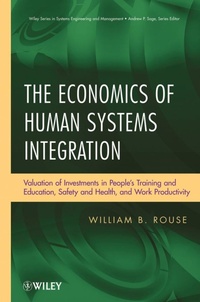
The Economics of Human Systems Integration
Valuation of Investments in People?s Training and Education, Safety and Health, and Work Productivity
1st Edition
Will be published approx. on 20. August 2010
Book
Hardback
440 pages
978-0-470-48676-4 (ISBN)
Description
Fundamental Economic Principles, Methods, and Tools for Addressing Human Systems Integration Issues and Tradeoffs Human Systems Integration (HSI) is a new and fundamental integrating discipline designed to help move business and engineering cultures toward more human-centered systems. Integrating consideration of human abilities, limitations, and preferences into engineering systems yields important cost and performance benefits that otherwise would not have been accomplished. In order for this new discipline to be effective, however, a cultural change-starting with organizational leadership-is often necessary.
The Economics of Human Systems Integration explains the difficulties underlying valuation of investments in people's training and education, safety and health, and work productivity. It provides an overview of how the field of economics addresses these difficulties, focusing on human issues associated with design, development, production, operations, maintenance, and sustainment of complex systems.
The set of thought leaders recruited as contributors to this volume collectively provides a compelling set of data and principles for assessing the economic value of investing in people, not just in general but in specific investment situations. The early chapters provide the contexts for HSI and investment analysis, illustrating the enormous difference context makes in how issues are best framed and analyzed. A host of practical methods and tools for investment valuation are then presented. Provided are:
A variety of real-world applications of economic analysis ranging from military acquisition and automotive investment to healthcare and high-tech investments in general, in both the U.S. and abroad
A range of economics-based methods and tools for cost analysis, cost-benefit analysis, and investment analysis, as well as sources of data for performing such analyses
Differing perspectives on economic decision-making, including a range of private sector points of view, as well as government and regulatory perspectives
In addition, five real-world case studies illustrate how such valuations have been done and their major impacts on investment decisions. HSI professionals, systems engineers, and finance professionals who address investment analysis will appreciate the wide range of methods and real-life applications; senior undergraduates and masters-level graduate students will find this to be an excellent textbook that provides theory and supports practice.
The Economics of Human Systems Integration explains the difficulties underlying valuation of investments in people's training and education, safety and health, and work productivity. It provides an overview of how the field of economics addresses these difficulties, focusing on human issues associated with design, development, production, operations, maintenance, and sustainment of complex systems.
The set of thought leaders recruited as contributors to this volume collectively provides a compelling set of data and principles for assessing the economic value of investing in people, not just in general but in specific investment situations. The early chapters provide the contexts for HSI and investment analysis, illustrating the enormous difference context makes in how issues are best framed and analyzed. A host of practical methods and tools for investment valuation are then presented. Provided are:
A variety of real-world applications of economic analysis ranging from military acquisition and automotive investment to healthcare and high-tech investments in general, in both the U.S. and abroad
A range of economics-based methods and tools for cost analysis, cost-benefit analysis, and investment analysis, as well as sources of data for performing such analyses
Differing perspectives on economic decision-making, including a range of private sector points of view, as well as government and regulatory perspectives
In addition, five real-world case studies illustrate how such valuations have been done and their major impacts on investment decisions. HSI professionals, systems engineers, and finance professionals who address investment analysis will appreciate the wide range of methods and real-life applications; senior undergraduates and masters-level graduate students will find this to be an excellent textbook that provides theory and supports practice.
Reviews / Votes
"It provides an overview of how the field of economics addresses these difficulties, focusing on human issues associated with design, development, production, operations, maintenance, and sustainment of complex systems." (Smart Grid, 9 February 2011)More details
Series
Language
English
Place of publication
New York
United States
Target group
Professional and scholarly
Product notice
sewn/stitched
Cloth over boards
Dimensions
Height: 243 mm
Width: 164 mm
Thickness: 27 mm
Weight
710 gr
ISBN-13
978-0-470-48676-4 (9780470486764)
Copyright in bibliographic data and cover images is held by Nielsen Book Services Limited or by the publishers or by their respective licensors: all rights reserved.
Schweitzer Classification
Other editions
Additional editions
William B. Rouse
The Economics of Human Systems Integration
Valuation of Investments in People s Training and Education, Safety and Health, and Work Productivity
E-Book
01/2011
Wiley
€120.99
Available for download
William B. Rouse
The Economics of Human Systems Integration
Valuation of Investments in People s Training and Education, Safety and Health, and Work Productivity
E-Book
08/2010
Wiley
€120.99
Available for download
Person
William B. Rouse is Executive Director of the Tennenbaum Institute at the Georgia Institute of Technology. He is also a professor in the College of Computing and School of Industrial and Systems Engineering. Rouse's earlier positions include chair of the School of Industrial and Systems Engineering, CEO of two innovative software companies-Enterprise Support Systems and Search Technology-and faculty positions at Georgia Tech, University of Illinois, Delft University of Technology, and Tufts University.
Content
Preface. Contributors.
PART I INTRODUCTION.
1. Introduction (William B. Rouse).
2. Industry and Commercial Context (William B. Rouse).
3. Government and Defense Context (William B. Rouse and Douglas A. Bodner).
PART II ECONOMICS OVERVIEW.
4. Human Capital Economics (William B. Rouse).
5. Labor Economics (Nachum Sicherman).
6. Defense Economics (Keith Hartley).
7. Engineering Economics (William B. Rouse).
PART III MODELS, METHODS, AND TOOLS.
8. Parametric Cost Estimation for Human Systems Integration (Ricardo Valerdi and Kevin Liu).
9. A Spreadsheet-Based Tool for Simple Cost-Benefit Analyses of HSI Contributions During Software Application Development (Deborah J. Mayhew).
10. Multistage Real Options (Michael J. Pennock).
11. Organizational Simulation for Economic Assessment (Douglas A. Bodner).
PART IV CASE STUDIES.
12. HSI Practices in Program Management: Case Studies of Aegis (Aruna Apte).
13. The Economic Impact of Integrating Ergonomics within an Automotive Production Facility (W. Gary Allread and William S. Marras).
14. How Behavioral and Biometric Health Risk Factors Can Predict Medical and Productivity Costs for Employers (Ron Z. Goetzel, Enid Chung Roemer, Maryam Tabrizi, Rivka Liss-Levinson, and Daniel K. Samoly).
15. Options for Surveillance and Reconnaissance (William B. Rouse).
16. Governing Opportunism in International Armaments Collaboration: The Role of Trust (Ethan B. Kapstein).
Index.
PART I INTRODUCTION.
1. Introduction (William B. Rouse).
2. Industry and Commercial Context (William B. Rouse).
3. Government and Defense Context (William B. Rouse and Douglas A. Bodner).
PART II ECONOMICS OVERVIEW.
4. Human Capital Economics (William B. Rouse).
5. Labor Economics (Nachum Sicherman).
6. Defense Economics (Keith Hartley).
7. Engineering Economics (William B. Rouse).
PART III MODELS, METHODS, AND TOOLS.
8. Parametric Cost Estimation for Human Systems Integration (Ricardo Valerdi and Kevin Liu).
9. A Spreadsheet-Based Tool for Simple Cost-Benefit Analyses of HSI Contributions During Software Application Development (Deborah J. Mayhew).
10. Multistage Real Options (Michael J. Pennock).
11. Organizational Simulation for Economic Assessment (Douglas A. Bodner).
PART IV CASE STUDIES.
12. HSI Practices in Program Management: Case Studies of Aegis (Aruna Apte).
13. The Economic Impact of Integrating Ergonomics within an Automotive Production Facility (W. Gary Allread and William S. Marras).
14. How Behavioral and Biometric Health Risk Factors Can Predict Medical and Productivity Costs for Employers (Ron Z. Goetzel, Enid Chung Roemer, Maryam Tabrizi, Rivka Liss-Levinson, and Daniel K. Samoly).
15. Options for Surveillance and Reconnaissance (William B. Rouse).
16. Governing Opportunism in International Armaments Collaboration: The Role of Trust (Ethan B. Kapstein).
Index.