

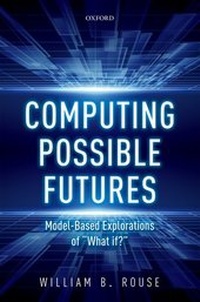
Computing Possible Futures
Published on 12. September 2019
Book
Hardback
202 pages
978-0-19-884642-0 (ISBN)
Description
Mathematical modelling and simulation is an increasingly powerful area of mathematics and computer science, which in recent years has been fuelled by the unprecedented access to larger than ever stores of data. These techniques have an increasing number of applications in the professional and political spheres, and people try to predict the results of certain courses of action as accurately as possible.
Computing Possible Futures explores the use of models on everyday phenomena such as waiting in lines and driving a car, before expanding the model's complexity to look at how large-scale computational models can help imagine big scale "what-if" scenarios like the effect self-driving cars on the US economy. The successes and failures of complex real world problems are examined, and it is shown how few, if any, failures are due to model errors or computational difficulties. It is also shown how real life decision makers have addressed important problems and used their model-based understanding of possible futures to inform these decisions.
Written in an entertaining and accessible way, Computing Possible Futures will help those concerned about the futurity of their decisions to understand what fundamentally needs to be done, why it needs to be done, and how to do it.
Computing Possible Futures explores the use of models on everyday phenomena such as waiting in lines and driving a car, before expanding the model's complexity to look at how large-scale computational models can help imagine big scale "what-if" scenarios like the effect self-driving cars on the US economy. The successes and failures of complex real world problems are examined, and it is shown how few, if any, failures are due to model errors or computational difficulties. It is also shown how real life decision makers have addressed important problems and used their model-based understanding of possible futures to inform these decisions.
Written in an entertaining and accessible way, Computing Possible Futures will help those concerned about the futurity of their decisions to understand what fundamentally needs to be done, why it needs to be done, and how to do it.
Reviews / Votes
A must read for everyone who has ever wondered 'What If?' and felt unprepared to rigorously generate possible answers ... The chapter on intelligent systems is especially timely, and covers artificial intelligence and machine learning from a fresh perspective. * Jim Spohrer, Director, Cognitive OpenTech at IBM * Computing Possible Futures provides a compelling approach to systems thinking, as well as an array of tools for exploring what might happen and leading indicators of likely futures. * Denis A. Cortese MD, Foundation Professor, Arizona State University * The hope is that readers will discuss this book and develop a 'shared mental model' of computational modeling in the process, which will greatly enhance their chances of success. * MathSciNet *More details
Language
English
Place of publication
Oxford
United Kingdom
Target group
Professional and scholarly
Product notice
sewn/stitched
Cloth over boards
Dimensions
Height: 234 mm
Width: 163 mm
Thickness: 15 mm
Weight
499 gr
ISBN-13
978-0-19-884642-0 (9780198846420)
Copyright in bibliographic data and cover images is held by Nielsen Book Services Limited or by the publishers or by their respective licensors: all rights reserved.
Schweitzer Classification
Other editions
Additional editions
William B. Rouse
Computing Possible Futures
E-Book
09/2019
1st Edition
OUP eBook
€33.99
Available for download
William B. Rouse
Computing Possible Futures
E-Book
09/2019
1st Edition
OUP eBook
€33.99
Available for download
Person
William B. Rouse is Research Professor within the McCourt School of Public Policy at Georgetown University and Professor Emeritus, and former chair, of the School of Industrial and Systems Engineering at Georgia Institute of Technology. He has written many books on modelling complex systems and enterprises, technology management and innovation. He lives in Washington, DC.
Content
1: Introduction
2: Elements of Modeling
3: Economic Bubbles
4: Markets & Competitors
5: Technology Adoption
6: System Failures
7: Health & Well Being
8: Intelligent Systems
9: Enterprise Transformation
10: Exploring Possible Futures
2: Elements of Modeling
3: Economic Bubbles
4: Markets & Competitors
5: Technology Adoption
6: System Failures
7: Health & Well Being
8: Intelligent Systems
9: Enterprise Transformation
10: Exploring Possible Futures