

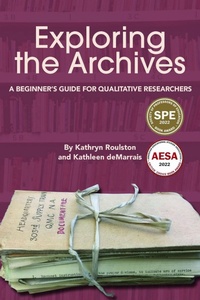
Exploring the Archives
A Beginner's Guide for Qualitative Researchers
Will be published approx. on 30. June 2021
Book
Paperback/Softback
175 pages
978-1-9755-0312-3 (ISBN)
Description
This book offers qualitative researchers an entree into the world of working with archival repositories and special collections. It serves as a primer for students and researchers who might not be familiar with these sorts of collections, but with an interest in what has become known asthe "archival turn," in which the use of archival materials and artifacts in contemporary research has increased dramatically since the 1990s. Suited to novice researchers seeking a general introduction into how special collections are created and how they can be used, the book offers useful, clear guidance on using different types of archives, developing topics for research within the archives, assessing materials available, how to work with archivists and curators, documenting the research process, and writing up an archival study. Archival records and material culture (including manuscripts, documents, audio- and video-recordings, and visual and material culture) housed in special collections provide a wealth of resources for qualitative researchers seeking to conduct research in the social sciences.
Perfect for courses in: Introduction to Qualitative Research Methods, Research Methods in Higher Education, Exploring Archival Collections, Family Studies, Community Research, Introduction to Special Collections Research.
Perfect for courses in: Introduction to Qualitative Research Methods, Research Methods in Higher Education, Exploring Archival Collections, Family Studies, Community Research, Introduction to Special Collections Research.
More details
Series
Language
English
Place of publication
Gorham
United States
Target group
Professional and scholarly
Product notice
Paperback (trade)
Unsewn / adhesive bound
Dimensions
Height: 226 mm
Width: 150 mm
Thickness: 18 mm
Weight
340 gr
ISBN-13
978-1-9755-0312-3 (9781975503123)
Copyright in bibliographic data and cover images is held by Nielsen Book Services Limited or by the publishers or by their respective licensors: all rights reserved.
Schweitzer Classification
Persons
Kathryn Roulston is Professor in the Qualitative Research Program in the College of Education at the University of Georgia in Athens, Georgia, where she teaches qualitative research methods. She is the author of Reflective Interviewing: A Guide to Theory and Practice (2010), editor of Interactional Studies of Qualitative Interviews (2019), and a contributor to a variety journals and book collections.
Kathleen deMarrais is professor and department head in the Department of Lifelong Education, Administration and Policy at the University of Georgia. After a 14-year career as a K-12 special education teacher, she earned a doctorate in Social Foundations of Education at the University of Cincinnati. She serves as a qualitative methodologist in UGA's Qualitative Research Program. Her research is focused on qualitative methodologies, qualitative pedagogy, and the impact of philanthropy in educational policy and practice. In addition to numerous articles and book chapters, her books include: Foundations for Research: Methods of Inquiry in Education and the Social Sciences (with S. Lapan); Inside Stories: Educating Young Adolescent Girls (with P. O'Reilly & B. Penn); The Way Schools Work: A Sociological Analysis of Schooling, 3rd Edition (with M. LeCompte); Life at the Margins: Profiles of Diverse Adults (with J. Merrifield, D. Hemphill & B. Bingman); Teach for America Counter Narratives: Alumni Speak Up and Speak Out (with T. J. Brewer); and Philanthropy, Hidden Strategy, and Collective Resistance: A Primer for Concerned Educators. She was honored by her undergraduate alma mater, East Stroudsburg University, with the 2017 Excellence in Education Award for demonstrated superior teaching ability and extraordinary commitment to students at the elementary, secondary or college level.
Kathleen deMarrais is professor and department head in the Department of Lifelong Education, Administration and Policy at the University of Georgia. After a 14-year career as a K-12 special education teacher, she earned a doctorate in Social Foundations of Education at the University of Cincinnati. She serves as a qualitative methodologist in UGA's Qualitative Research Program. Her research is focused on qualitative methodologies, qualitative pedagogy, and the impact of philanthropy in educational policy and practice. In addition to numerous articles and book chapters, her books include: Foundations for Research: Methods of Inquiry in Education and the Social Sciences (with S. Lapan); Inside Stories: Educating Young Adolescent Girls (with P. O'Reilly & B. Penn); The Way Schools Work: A Sociological Analysis of Schooling, 3rd Edition (with M. LeCompte); Life at the Margins: Profiles of Diverse Adults (with J. Merrifield, D. Hemphill & B. Bingman); Teach for America Counter Narratives: Alumni Speak Up and Speak Out (with T. J. Brewer); and Philanthropy, Hidden Strategy, and Collective Resistance: A Primer for Concerned Educators. She was honored by her undergraduate alma mater, East Stroudsburg University, with the 2017 Excellence in Education Award for demonstrated superior teaching ability and extraordinary commitment to students at the elementary, secondary or college level.
Content
List of Figures and Tables
List of Abbreviations
Dedication
Acknowledgments
ONE?Introduction
TWO? Entering the Archives
Reflection 1?PermissionsFrom the President and Missing Materials: The Challenges of Archival Research
Amanda Ingram
THREE? Examples of Archival Research
FOUR? Archiving Principles and Accessing Archival Collections
Reflection 2?You Won't Find It Online: Entering the Archives to Tell the Story of the B-52s
Brigette Adair Herron and Scott Creney
FIVE?Developing and Implementing a Research Study in the Archives
Reflection 3? Entering the Archives: Developing a Topic
E. Anthony Muhammad
Reflection 4? Enteringthe Archives: Developing a Topic
Judith Brauer
Reflection 5? TheDark Room: Thomas Evan Walker's Journey from Pennsgrove, N.J. to France and Back
Kathleen deMarrais
SIX? Digital Repositories and Archiving Qualitative Data
Reflection 6?Accessing Online Repositories
Janie Copple
SEVEN?Politics and the Archives
Reflection 7?Lucy and Her Sisters
Jean Swindle
EIGHT? Doing Quality Research with Archives
Reflection 8? Are Some Skeletons Best Left in the Closet?Ethics of Family Research Involving Illicit Activities
Jamie B. Lewis
Additional Resources
Glossary of Terms
About the Authors
Index
List of Abbreviations
Dedication
Acknowledgments
ONE?Introduction
TWO? Entering the Archives
Reflection 1?PermissionsFrom the President and Missing Materials: The Challenges of Archival Research
Amanda Ingram
THREE? Examples of Archival Research
FOUR? Archiving Principles and Accessing Archival Collections
Reflection 2?You Won't Find It Online: Entering the Archives to Tell the Story of the B-52s
Brigette Adair Herron and Scott Creney
FIVE?Developing and Implementing a Research Study in the Archives
Reflection 3? Entering the Archives: Developing a Topic
E. Anthony Muhammad
Reflection 4? Enteringthe Archives: Developing a Topic
Judith Brauer
Reflection 5? TheDark Room: Thomas Evan Walker's Journey from Pennsgrove, N.J. to France and Back
Kathleen deMarrais
SIX? Digital Repositories and Archiving Qualitative Data
Reflection 6?Accessing Online Repositories
Janie Copple
SEVEN?Politics and the Archives
Reflection 7?Lucy and Her Sisters
Jean Swindle
EIGHT? Doing Quality Research with Archives
Reflection 8? Are Some Skeletons Best Left in the Closet?Ethics of Family Research Involving Illicit Activities
Jamie B. Lewis
Additional Resources
Glossary of Terms
About the Authors
Index