

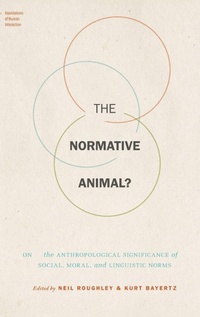
The Normative Animal?
On the Anthropological Significance of Social, Moral, and Linguistic Norms
Published on 5. September 2019
Book
Hardback
392 pages
978-0-19-084646-6 (ISBN)
Description
It is often claimed that humans are rational, linguistic, cultural, or moral creatures. What these characterizations may all have in common is the more fundamental claim that humans are normative animals, in the sense that they are creatures whose lives are structured at a fundamental level by their relationships to norms. The various capacities singled out by discussion of rational, linguistic, cultural, or moral animals might then all essentially involve an orientation to obligations, permissions and prohibitions. And, if this is so, then perhaps it is a basic susceptibility, or proclivity to normative or deontic regulation of thought and behaviour that enables humans to develop the various specific features of their life form.
This volume of new essays investigates the claim that humans are essentially normative animals in this sense. The contributors do so by looking at the nature and relations of three types of norms, or putative norms-social, moral, and linguistic-and asking whether they might all be different expressions of one basic structure unique to humankind. These questions are posed by philosophers, primatologists, behavioural biologists, psychologists, linguists, and cultural anthropologists, who have collaborated on this topic for many years. The contributors are committed to the idea that understanding normativity is a two-way process, involving a close interaction between conceptual clarification and empirical research.
This volume of new essays investigates the claim that humans are essentially normative animals in this sense. The contributors do so by looking at the nature and relations of three types of norms, or putative norms-social, moral, and linguistic-and asking whether they might all be different expressions of one basic structure unique to humankind. These questions are posed by philosophers, primatologists, behavioural biologists, psychologists, linguists, and cultural anthropologists, who have collaborated on this topic for many years. The contributors are committed to the idea that understanding normativity is a two-way process, involving a close interaction between conceptual clarification and empirical research.
More details
Series
Language
English
Place of publication
New York
United States
Target group
Professional and scholarly
Dimensions
Height: 240 mm
Width: 161 mm
Thickness: 26 mm
Weight
752 gr
ISBN-13
978-0-19-084646-6 (9780190846466)
Copyright in bibliographic data and cover images is held by Nielsen Book Services Limited or by the publishers or by their respective licensors: all rights reserved.
Schweitzer Classification
Other editions
Additional editions
Neil Roughley | Kurt Bayertz
The Normative Animal?
On the Anthropological Significance of Social, Moral, and Linguistic Norms
E-Book
06/2019
1st Edition
OUP eBook
€36.99
Available for download
Neil Roughley | Kurt Bayertz
The Normative Animal?
On the Anthropological Significance of Social, Moral, and Linguistic Norms
E-Book
06/2019
1st Edition
OUP eBook
€36.99
Available for download
Persons
Neil Roughley is Chair for Philosophical Anthropology and Ethics at the University of Duisburg-Essen. He specializes in metaethics, action theory, philosophical psychology, and the theory of human nature. His historical interests include the classical figures of ethical sentimentalism, particularly Adam Smith and David Hume, as well as the history of action theory. He is author of Wanting and Intending: Elements of a Philosophy of Practical Mind (Springer Macmillan, 2015), has edited several volumes, including Forms of Fellow Feeling: Empathy, Sympathy, Concern and Moral Agency (Cambridge University Press, 2018), and was recently guest editor of a special issue of Philosophical Psychology, vol. 31/5 (2018), on Tomasello's A Natural History of Human Morality.
Kurt Bayertz is Senior-Professor of Practical Philosophy at the University of Munster. His research focuses on ethics, anthropology, and selected topics in the history of philosophy. He is author of
Technological Intervention in Human Reproduction as a Philosophical Problem (Cambridge: Cambridge UP 1994), among other books. His book Der aufrechte Gang ("The Upright Posture") received the Tractatus Prize for philosophy.
Kurt Bayertz is Senior-Professor of Practical Philosophy at the University of Munster. His research focuses on ethics, anthropology, and selected topics in the history of philosophy. He is author of
Technological Intervention in Human Reproduction as a Philosophical Problem (Cambridge: Cambridge UP 1994), among other books. His book Der aufrechte Gang ("The Upright Posture") received the Tractatus Prize for philosophy.
Content
Foreword
Part I: Introductory
1. Might We Be Essentially Normative Animals?
Neil Roughley
2. On Social, Moral and Linguistic Norms. The Contributions to This Volume
Neil Roughley and Kurt Bayertz
Part II: Social Norms
3. There Ought to be Roots. Evolutionary Precursors of Social Norms and Conventions in Non-Human Primates
Peter Kappeler, Claudia Fichtel and Carel van Schaik
4. On the Human Addiction to Norms. Social Norms and Cultural Universals of Normativity
Christoph Antweiler
5. On the Identification and Analysis of Social Norms and the Heuristic Relevance of Deviant Behaviour
Karl Mertens
6. On the Uniqueness of Human Normative Attitudes
Marco F.H. Schmidt and Hannes Rakoczy
Part III: Moral Norms
7. The Evolution of Human Normativity: The Role of Prosociality and Reputation Management
Carel van Schaik and Judith Burkart
8. The Form of Morality: Its Importance and Emergence
Kurt Bayertz
9. Joint Activities and Moral Obligation
Holmer Steinfath
10. The Development of Moral and Social Norms, Coordination in Decision-Making, and the Implications of Social Opposition
Elliot Turiel and Audun Dahl
11. Moral Obligation from the Outside In
Neil Roughley
Part IV: Linguistic Norms?
12. Language Evolution and Linguistic Norms
Nikola Kompa
13. The Normative Nature of Language
Nick J. Enfield, Jack Sidnell
14. Can there be Linguistic Norms?
Anne Reboul
15. The Normativity of Meaning Revisited
Hanjo Glock
Part V: Afterword
16. Normative Guidance, Deontic Statuses and the Normative Animal Thesis
Neil Roughley
References
Part I: Introductory
1. Might We Be Essentially Normative Animals?
Neil Roughley
2. On Social, Moral and Linguistic Norms. The Contributions to This Volume
Neil Roughley and Kurt Bayertz
Part II: Social Norms
3. There Ought to be Roots. Evolutionary Precursors of Social Norms and Conventions in Non-Human Primates
Peter Kappeler, Claudia Fichtel and Carel van Schaik
4. On the Human Addiction to Norms. Social Norms and Cultural Universals of Normativity
Christoph Antweiler
5. On the Identification and Analysis of Social Norms and the Heuristic Relevance of Deviant Behaviour
Karl Mertens
6. On the Uniqueness of Human Normative Attitudes
Marco F.H. Schmidt and Hannes Rakoczy
Part III: Moral Norms
7. The Evolution of Human Normativity: The Role of Prosociality and Reputation Management
Carel van Schaik and Judith Burkart
8. The Form of Morality: Its Importance and Emergence
Kurt Bayertz
9. Joint Activities and Moral Obligation
Holmer Steinfath
10. The Development of Moral and Social Norms, Coordination in Decision-Making, and the Implications of Social Opposition
Elliot Turiel and Audun Dahl
11. Moral Obligation from the Outside In
Neil Roughley
Part IV: Linguistic Norms?
12. Language Evolution and Linguistic Norms
Nikola Kompa
13. The Normative Nature of Language
Nick J. Enfield, Jack Sidnell
14. Can there be Linguistic Norms?
Anne Reboul
15. The Normativity of Meaning Revisited
Hanjo Glock
Part V: Afterword
16. Normative Guidance, Deontic Statuses and the Normative Animal Thesis
Neil Roughley
References