

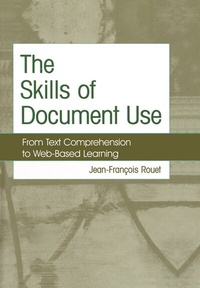
The Skills of Document Use
From Text Comprehension to Web-Based Learning
1st Edition
Published on 28. June 2012
Book
Paperback/Softback
256 pages
978-0-415-65454-8 (ISBN)
Description
The Skills of Document Use: From Text Comprehension to Web-Based Learning examines functional literacy from a psychological standpoint. It offers a comprehensive discussion of the cognitive skills involved in reading, comprehending, and making use of complex documents. Understanding such skills is important at times when printed and online information systems are being used more and more extensively for work, education, and personal development. It is also very important to understand how the Internet transforms the way we search, read, and comprehend documents.
The core purpose of the book is to inform research scientists, students, and instructional designers about recent advances in the psychology of document comprehension. Whereas reading research has mostly focused on basic cognitive processes involved in simple comprehension tasks, this book extends the psychology of reading to more complex, real-life comprehension activities. The book draws a link between research areas usually separated: language psychology, on the one hand, and Web design, on the other hand.
The work also attempts to bridge a gap between research in cognitive psychology and practical issues in the design and use of information systems. It invites the reader to a guided journey from theoretical models of text comprehension to concrete issues in the design and use of instructional technology.
The book will be of interest to students specializing in psychology, language, communication, and publishing. It will also be useful to all those who are involved in the training of literacy skills, or in the design of information systems accessible to a wide audience.
The core purpose of the book is to inform research scientists, students, and instructional designers about recent advances in the psychology of document comprehension. Whereas reading research has mostly focused on basic cognitive processes involved in simple comprehension tasks, this book extends the psychology of reading to more complex, real-life comprehension activities. The book draws a link between research areas usually separated: language psychology, on the one hand, and Web design, on the other hand.
The work also attempts to bridge a gap between research in cognitive psychology and practical issues in the design and use of information systems. It invites the reader to a guided journey from theoretical models of text comprehension to concrete issues in the design and use of instructional technology.
The book will be of interest to students specializing in psychology, language, communication, and publishing. It will also be useful to all those who are involved in the training of literacy skills, or in the design of information systems accessible to a wide audience.
Reviews / Votes
"...the book's treatment of complex documents includes a great deal of new research and a very rich context of functional literacy, technology, and education. It uniquely defines a new area of research, demonstrates its agenda, and provides some of the research answers to questions about the use of complex documents."-Charles Perfetti
From the Foreword, University of Pittsburgh
More details
Language
English
Place of publication
London
United Kingdom
Publishing group
Taylor & Francis Ltd
Target group
Professional and scholarly
Dimensions
Height: 229 mm
Width: 152 mm
Weight
470 gr
ISBN-13
978-0-415-65454-8 (9780415654548)
Copyright in bibliographic data and cover images is held by Nielsen Book Services Limited or by the publishers or by their respective licensors: all rights reserved.
Schweitzer Classification
Other editions
Additional editions
Book
03/2006
1st Edition
Routledge
€215.41
Shipment within 10-20 days
E-Book
03/2006
1st Edition
Routledge
€69.99
Available for download
E-Book
03/2006
1st Edition
Routledge
€69.99
Available for download
Person
Jean-Francois Rouet
Content
Contents: Foreword. Preface. Introduction. The Psychology of Text Comprehension: Current Theories and Issues. The Role of Text Organizers in Expert Comprehension. Comprehending Multiple Documents. Question Answering and Document Search. Using Hypertext Systems. Learning From Multiple Online Sources of Information. General Conclusions.